


Is anything safe from artificial intelligence these days?
It’s hard to pick up the New York Times or science and engineering journals, including high-quality, generalist journals such as Science and Nature, without weekly, even daily reminders about the latest achievements in AI.
Those reminders fuel concern about the growing omnipresence of AI not only in science, but the wider public work space and, in this column’s case, mathematics.
Mathematics is the linchpin key to understanding the universe on the largest and tiniest scales. That was certainly the case for Einstein’s general relativity theory in 1915 and 10 years later Heisenberg’s and Schrödinger’s independent mathematical solutions for describing quantum mechanics, and in the latter half of the 20th century, was the case for mathematical models designed to explain the universe’s beginning and expansion — efforts that all led to Nobel prizes.
Mathematics is about relationships. Take that simplest and powerful equation, E = mc2 which simply states that energy (E) is equal to mass (m) times the speed of light (c) squared (c2) — an equation Einstein came up with in 1905 as one of four major triumphs that year.
Before Einstein, who would have imagined that such a relationship could be expressed so simply, and precisely, with no other modifying factors? That takes conceptual genius, expressed in this case by mathematics and foreshadowed by Einstein’s thought experiments.
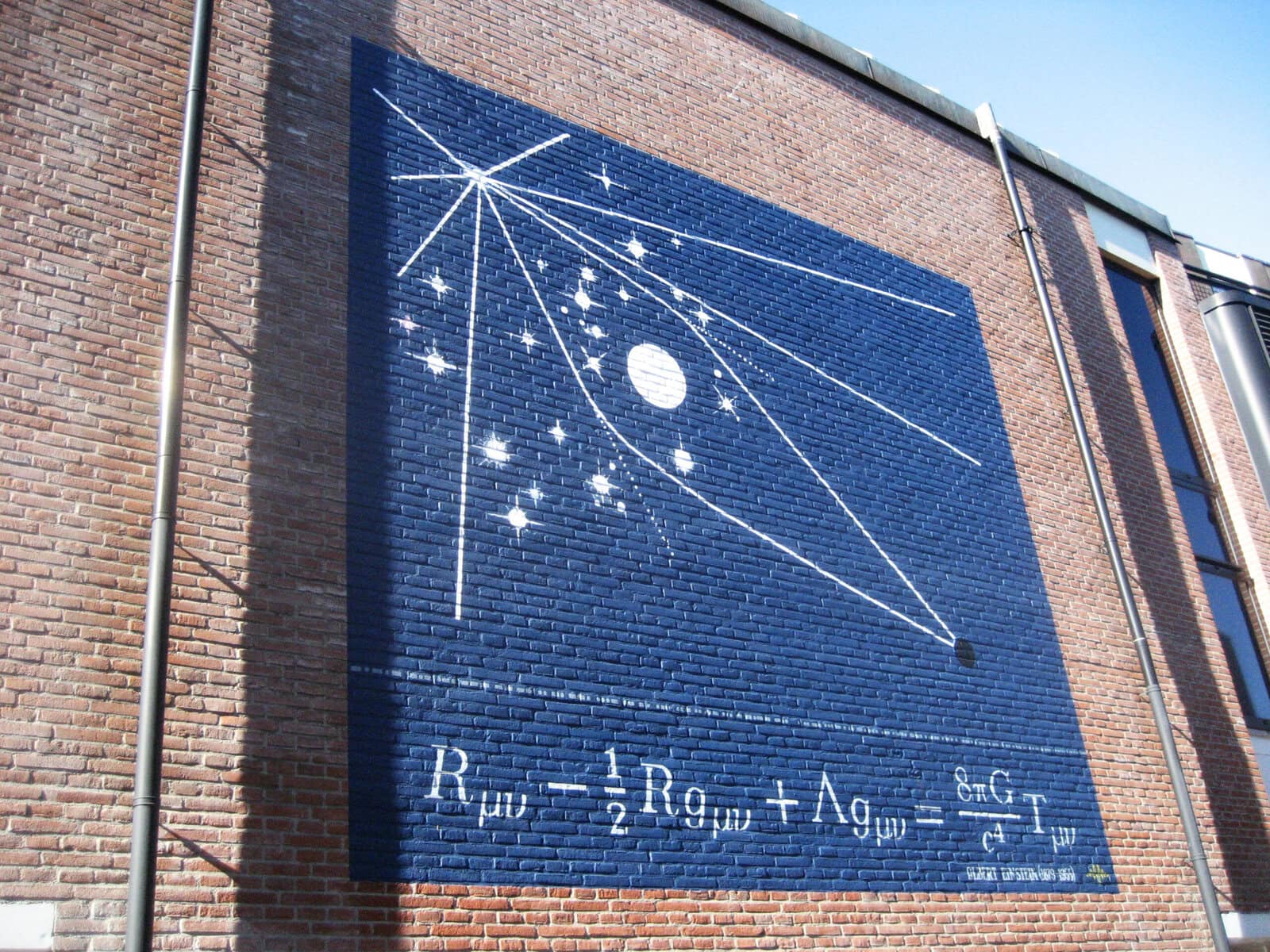
Or what about Einstein’s later equation that related the curvature of space-time to mass — so wonderfully illustrated on an exterior brick wall in Leiden, Germany?
To those who live and breathe mathematics, especially as applied to physics, mathematics can be beautiful because of its power to express nature in such precise condensed ways.
Indeed, Steven Weinberg, a Nobel Prize winner for his contributions to the standard model for describing atomic physics, felt that one of the reasons Einstein’s theoretical model, general relativity, was so widely accepted early on was that the math underpinning his theory was so beautiful.
So, readers might be sympathetic to mathematicians world-wide who were upset when OpenAI found a solution to a long-standing mathematical problem that hitherto had not been solved by humans. Perhaps more upsetting was that OpenAI’s solution was novel.
Mathematicians worldwide were so upset that some banded together and published a manifesto of sorts, called the Leiden Declaration on Artificial Intelligence in an attempt to establish ground rules for AI.
Aside from bruises to egos rubbed the wrong way by highly publized releases of triumphs by OpenAI in mathematics, the underlying concern was lack of transparency by the companies about their methods, including how their algorithms work and, in some cases, evolve to become even more potent.
Then there’s the practical problem accompanying the onslaught of AI — how human mathematicians can vet a growing slew of papers using AI.
That’s a real problem, and not only in mathematics but any fields such as physics, which depend so much on mathematics. How can you judge a paper’s math when it’s been generated by AI, and you have no clue how AI got to the solution? Those are fair points.
These problems with AI are just the tipping point, because the power of AI seems to increase exponentially — unlike human intelligence, as Steven Weinberg reminded us.
Nor is it just OpenAI: there’s a growing number of AI companies including Google’s Deepmind and Anthropic, to say nothing of several new start-ups.
Back in May, I wrote about Richard Dawkins and his encounter with Claude and the question of whether Claude was conscious and intelligent (“Dr. Brown: Richard Dawkins believes AI may be conscious … but is it?” May 14). My take on was that AI is certainly intelligent, based on its ability to learn and solve problems, but with a caveat.
ChatGPT came out in late 2022 and look what’s happened since. Plot the curve for human intelligence and AI’s intelligence and the differences are obvious.
Human intelligence based on the same criteria — our ability to learn and solve problems — has barely changed in 100,000 years, but our collective knowledge and understanding of nature has increased exponentially, especially in the last few hundred years.
By comparison, AI’s data base has also increased exponentially, especially in the last few years and will continue to do so as it learns more from us and evolves its own machine equivalents to Einstein’s thought experiments to autonomously come up with novel solutions beyond its data base — a power that will increase much faster with the coming of quantum computing.
Dr. William Brown is a professor of neurology at McMaster University and co-founder of the InfoHealth series at the Niagara-on-the-Lake Public Library.