
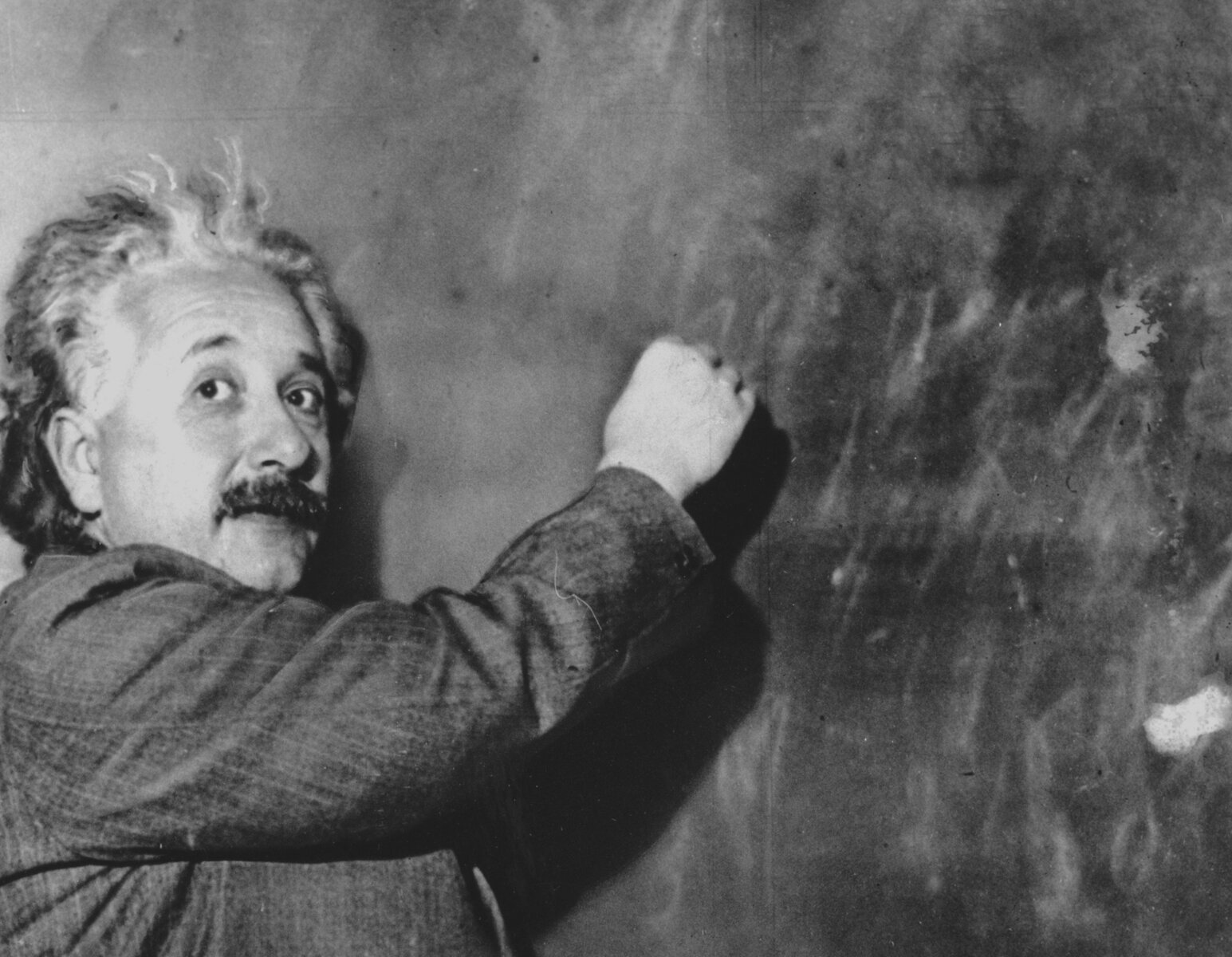


In 1921, Albert Einstein won his only Nobel Prize for his 1905 theoretical study of the quantal nature of light in the photoelectric effect.
In 1900, Max Planck reluctantly adopted the notion that energy was quantal in nature, because only when he did so did his equations describing the radiation emitted by a heated black box make any sense.
Planck was 20 years older and far more cautious than Einstein, but together, they became the founding fathers of the brand new field of quantum physics, which reached maturity in 1925-26, with the work of Werner Heisenberg and Erwin Schrödinger, in a period I’ve called the Camelot period in physics.
By 21st-century times and standards, it was a small group of roughly 30 pioneers who mostly got along and respected one another even if they disagreed about their theories. Except for Ernest Rutherford and his Cambridge group, and Marie Skłodowska-Curie, they were all theoretical physicists.
Einstein’s work on the photoelectric effect was only one of four brilliant contributions in 1905. In the same year, he described the equivalence of energy and mass in a surprisingly powerful but simple equation, E = mc2, where E is energy, m is mass and c is the speed of light.
If that was not enough, he explained Brownian motion, the random motion of particles on the surface of water and used it to estimate the size of water molecules and even the atom.
Last, but certainly not least, was Einstein’s special relativity paper, in which he overturned the prevailing view that time was constant everywhere, the speed of light varied, and space was filled with a mythical substance called ether.
Einstein simply ignored “ether” and through clever thought experiments, showed that the speed of light was constant and time varied with speed. It was an astonishing year for a 26-year-old patent office clerk with no PhD and no university appointment.
Those four papers were published in one issue of one of the most influential journals of its day, three of which — special relativity, the photoelectric effect, and the equivalence of energy and mass — deserved a Nobel prize.
Not content with what he knew was an incomplete theory (special relativity), Einstein moved on to develop his masterpiece, general relativity, which combined mass and space-time and clearly showed that mass bent light. It took him 11 years to complete, with many challenges, including mastering equations for curvatures for which he sought help from others.
Newtonian physics had ruled the roost of cosmology for 250 years ever since 23 year-old Isaac Newton created his laws of motion. But with the birth of Einstein’s general relativity, gravity took on a whole dimension.
Four-dimensional space-time told mass where to go and mass shaped space-time — strictly speaking, there was no attractive gravity as Newton had imagined.
Einstein’s general relativity led to several discoveries: large enough masses could collapse space-time into what was called by Schwarzschild, a singularity or later a black hole; mass could bend light enough to act as stellar lens to see galaxies otherwise hidden from view by intervening galaxies or groups of galaxies; and collisions of masses could create gravitational waves in space-time.
All three have since been proven to be true and each warranted a Nobel Prize, as did general relativity itself. Only two were awarded a Nobel Prize — the 2017 prize for gravitational waves and the 2020 prize for black holes, both of which were awarded well after Einstein’s death.
It’s shocking to look back and realize that Einstein, who arguably created the finest work in physics in the 20th century, general relativity, was not awarded a Nobel Prize for his best effort.
Einstein died in 1955, far too early to be included in the prizes for gravitational wave and black holes, but there’s no excuse for the Nobel committee’s earlier omission of general relativity — none. It was not a simple oversight.
We may never know what the opinions of contributing members of the Nobel committee were to the debate about the merits of general relatively at the time. My guess is that their opinions varied widely between admiration and enthusiasm for what some members judged to be a masterpiece and other more conservative members who couldn’t accept such a radical hypothesis without sufficient evidence.
Unfortunately, the latter group won the day, but later abundant evidence would prove Einstein’s theory to be correct every time it was tested.
Einstein could be stubborn. For example, he didn’t initially appreciate, as others such as Lemaitre pointed out to him, that his equations for general relativity were consisstent with an expanding universe, not the constant universe Newton imagined and Einstein adamently hung onto.
However, once he saw astronomer Edwin Hubble’s evidence in the late 1920s that galaxies were racing away from one another, he relented. So, stubborn, but persuadable by evidence.
On the whole, Einstein supported quantum mechanics. However in two areas he was at odds with the field. For example, Einstein was never comfortable with Heisenberg’s uncertainty principal which for example, suggested you could know the position of a particle but not its angular velocity or the reverse. But what really troubled Einstein, was the absence of “causality” in quantum physics.
He spent the last 30 years of his life trying to develop a “field” theory that would reconcile general relativity and the quantum universe. He failed.
However, recent surveys of physicists suggest that many believe he was right — even so those modern-day physicists weren’t interested in committing their time and effort to resolving Einstein’s questions, which still bedevil quantum physics.
Einstein’s life was rich: he achieved much in physics, was the face of physics to the world for a century and never lost his fascination with the universe. His thought experiments and achievements were stunning.
He also had a sense of humour and was perhaps the most famous scientist of the 20th century and remains the father of much of the best in physics and, in a populist way, philosophy.
Dr. William Brown is a professor of neurology at McMaster University and co-founder of the InfoHealth series at the Niagara-on-the-Lake Public Library.