


The floodwaters have receded. The financial fallout hasn’t.
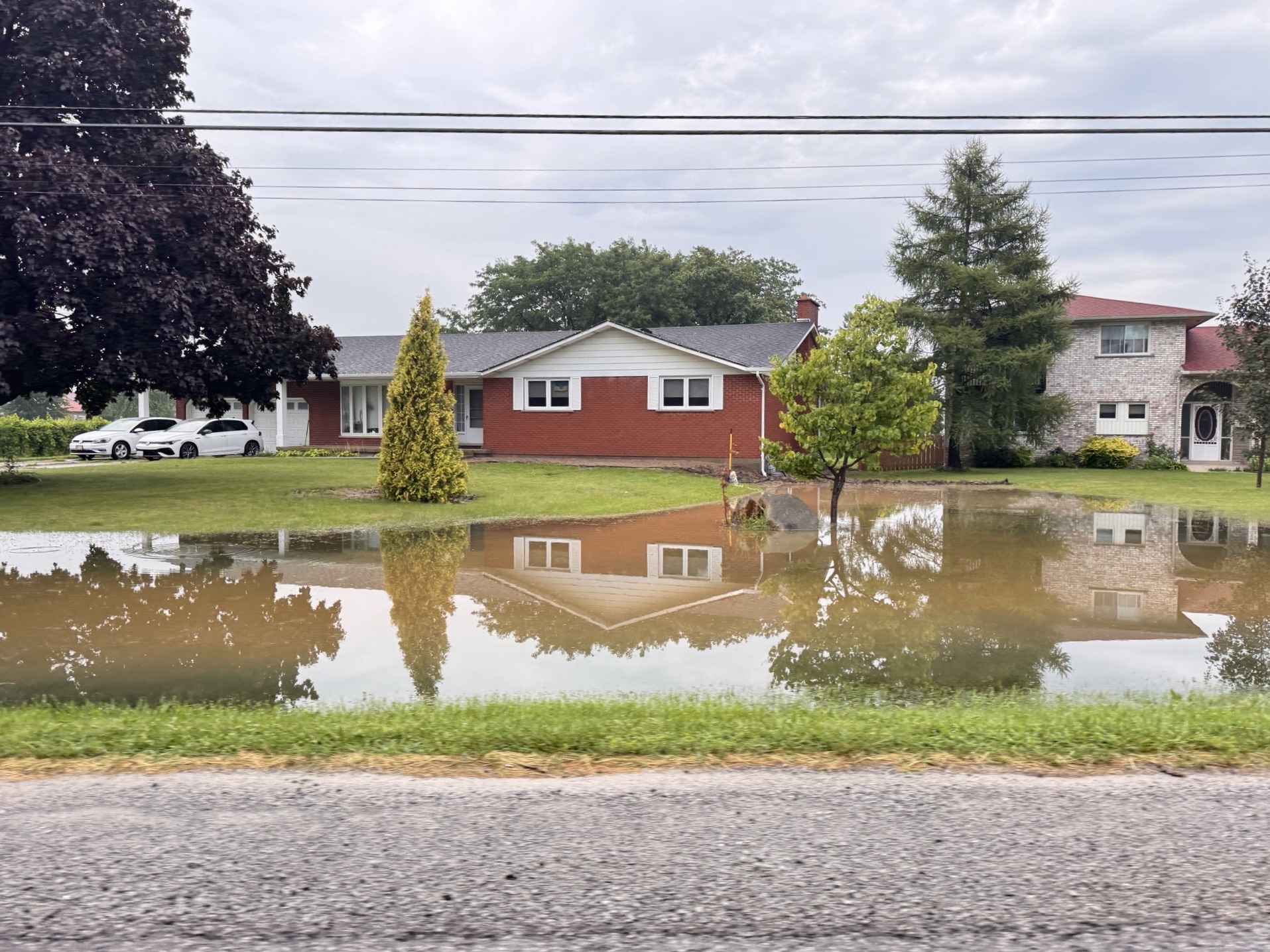
Nearly four months after summer flooding battered Niagara-on-the-Lake, residents are still facing thousands of dollars in losses, with no clear answer on whether the province will help cover the costs.
One farmer estimates $70,000 in losses, with only a fraction potentially recoverable through crop insurance. Another resident says insurance covered only half his losses. A third is still living without running water, relying on his mother next door for basic necessities.
None of the flood victims interviewed by The Lake Report reported receiving provincial disaster relief funds. Niagara Falls MPP Wayne Gates, who said he has been pressing ministers for assistance since August, says no funding decisions have been formally confirmed to him.
Province to assess losses
At Friday’s wine funding announcement in NOTL, St. Catharines MP Chris Bittle told The Lake Report that Ontario must request federal disaster funding before Ottawa can provide it. He also said he was disappointed the province had not stepped up to help flood victims.
Ontario has two disaster assistance programs: one to help residents, small businesses and farms cover uninsured losses, and another to help municipalities pay for cleanup and infrastructure repairs.
Farmers may also qualify for existing support programs through Agricorp.
Separately, Ottawa can help cover some of Ontario’s disaster recovery costs, but the province must formally request that funding.
Ontario does not need federal approval to activate its own assistance programs.
When asked whether Ontario had formally requested federal disaster funding from Ottawa, Gates couldn’t say, suggesting the question be directed to Agriculture Minister Sam Oosterhoff.
NOTL is not listed among the areas where Ontario has activated its Disaster Recovery Assistance for Ontarians program. The province has activated assistance for parts of Ottawa affected by July 1 flooding.
Responding to a question about flooding in St. Catharines, Municipal Affairs and Housing Minister Rob Flack told the Ontario legislature on Oct. 27 that disaster assistance had not been activated because the province considered the flooding to be caused by sewer backups rather than overland flooding
“(Disaster Recovery Assistance for Ontarians) was not activated because it was not overland water; it was sewer backups,” Flack said, according to the official legislative transcript.
The town says provincial officials plan to contact several affected property owners to assess their losses and determine whether assistance may be available. No funding approval has been announced.
Despite speaking with Oosterhoff on Monday, Gates acknowledged he hadn’t raised the federal funding question himself.
“I never thought to raise the federal issue with him,” Gates said, adding that he would ask him about it.
The Lake Report contacted Oosterhoff to ask whether Ontario requested federal assistance. A response wasn’t received by publication deadline.
Gates did, however, write a letter to Municipal Affairs and Housing Minister Rob Flack in August, requesting disaster assistance for flood-affected residents and businesses.
Flack never responded in writing, Gates said, although the two have discussed the issue in person.
When asked what the minister said during those conversations, Gates declined to provide specifics, saying he didn’t want to misquote the minister.
Gates said triggering any type of funding could require co-operation between Ottawa and Queen’s Park.
“Because some of these programs involve both the provincial and federal governments, any changes would require the co-operation between both levels of government,” he said.
Gates suggested he, Bittle and Oosterhoff meet to discuss how to move forward on disaster assistance.
“The harsh reality is the scope of what the province covers is not good enough to help families impacted,” Gates said.
No confirmation of approved funds
The Lake Report contacted the Ministry of Municipal Affairs and Housing about disaster assistance for affected residents, businesses and the town. After receiving follow-up questions about farmers, the ministry forwarded them to the Ministry of Agriculture, Food and Agribusiness, but did not provide answers about broader disaster relief.
In a written statement, Ministry of Agriculture, Food and Agribusiness press secretary Spencer Fair encouraged flood-affected farmers to contact Agricorp to determine whether they qualify for existing Business Risk Management programs.
Fair said the province has been in contact with the town and affected farmers, including Agriculture Minister Sam Oosterhoff, who has spoken with growers affected by the flooding.
He added that ministry staff regularly meet with Ontario Tender Fruit Growers and Grape Growers of Ontario.
However, Fair did not identify any new funding specifically approved for flood-affected Niagara farmers.
While the town released a recovery report Tuesday noting that the town has met with provincial officials about disaster assistance and shared residents’ damage information, it did not confirm whether provincial assistance had been approved for residents.
It also didn’t share whether the town formally applied for reimbursement of its own cleanup and infrastructure repair costs, or when funding decisions could be expected by publication time.
Lord mayor-elect Vaughn Goettler told The Lake Report the province plans to contact several affected property owners to assess their losses.
Goettler, who expects to be briefed on the town’s recovery efforts this week, said he would work with town staff and provincial representatives to pursue outstanding assistance requests and clearer timelines for residents.
Current lord mayor Gary Zalepa said he was out of town and referred The Lake Report’s questions about flood recovery and provincial assistance to town chief administrative officer.
Residents still rebuilding
NOTL resident Madis Tambre has electricity in parts of his home, but his water system remains out of service.
He relies on his mother next door for water and bathroom facilities and uses a wood stove for heat when temperatures drop.
His insurer paid the $30,000 maximum under his coverage, but his assessed losses exceeded $32,000, leaving at least $2,000 uncovered by insurance.
Tambre said he’s also been billed roughly $15,000 for emergency cleanup and removal of damaged belongings, though he’s still trying to determine how those charges will be paid.
He said unclear instructions from his insurer have complicated repairs.
Tambre also raised concerns about what he described as overgrown vegetation in Cole Drain near Line 7 Road, an issue he highlighted in an Aug. 12 letter to The Lake Report. He said the town told him the drain is maintained on a schedule, but believes it should be cleared whenever vegetation becomes excessive.
Line 4 farmer Brent Asselin estimates the flooding has cost him about $70,000, including $30,000 to $40,000 in lost crop earnings and roughly $30,000 in damaged farm equipment, materials and losses involving his honeybee colonies.
He said he may be able to recover $5,000 to $10,000 through crop insurance but has received no direct government assistance.
“Despite promises of financial assistance, no programs were made available provincially or federally. I’ve reached out to all levels of government,” he said.
Asselin completed the town’s flood recovery survey but said he received no follow-up about his submission. He said a town employee has remained in contact with him but has limited authority to address his concerns, particularly when it comes to financial assistance.
Charlotte Tutu bought her Line 7 hobby farm in 2003 and went 20 years without flooding. Since 2023, she’s experienced six floods.
The worst, in August, caused an estimated $15,000 in uninsured losses, including $6,000 worth of hay.
Her 13-year-old son has learned to watch for heavy rain and alert her when storms begin, but Tutu said he becomes anxious when flooding threatens their home.
“His anxiety ramps up a bit,” she said.
Cleanup brought its own challenges. Tutu filled more than 60 garbage bags with flood-damaged belongings from her basement, including Christmas decorations, but had no trailer to take them to the town’s temporary collection site.
She said the waste sat at the roadside for roughly three weeks before the town arranged curbside pickup.
Town engineer Jordan Frost recently visited her property to discuss drainage improvements, giving her some hope.
“I felt heard,” she said.
But Tutu said Frost indicated it could take roughly three years to improve drainage and reduce the impact of flooding in the area.
“It’s just a matter of getting through from now until then,” she said.
In Chautauqua, Richard Begley finished rebuilding his basement last week after months of delays and tens of thousands of dollars in damage.
Insurance covered roughly half, leaving him to pay the rest himself.
But Begley, who hasn’t applied for government assistance, said he’d rather see public money invested in preventing future flooding.
“I’d rather see the town put that money into infrastructure,” he said.
“Restoring confidence in the town’s infrastructure is worth far more to us than recovering the cost of old belongings.”
For Sue-Ann Ramsden, repairs to her flood-damaged home have stretched on for months, though her insurer is expected to cover her losses.
But when her policy was renewed, her flood coverage was reduced by a “drastic” amount. She expects her coverage to return to normal once she installs a sump pump or water monitor, as required by her insurer.
Ramsden said she completed the town’s flood recovery survey but received no follow-up or government assistance.
Ralph Rickard’s insurance experience has been more positive.
His insurer has covered nearly $100,000 in estimated damage, waived his deductible and contributed $1,000 toward a $2,500 backflow valve.
“Outside of this backflow valve — which is something I didn’t really have to do, it’s just sort of an extra precaution — I didn’t need out of pocket money,” he said.
But nearly four months later, his basement restoration is still unfinished.
The uncertainty has meant “being on edge a lot,” Rickard said. He and his wife also postponed summer and fall holidays to remain available during repairs.
For residents still rebuilding, the question is no longer just how much the flooding has cost them, but whether help will arrive before the next storm.