


Ron Simkus, NOTL Residents Association
Special to The Lake Report
Many Niagara-on-the-Lake residents may be unaware that this year’s municipal election could fundamentally change how decisions are made in their community.
As a result of Ontario’s strong mayor legislation and the recent reduction in the size of town council, decisions with long-lasting consequences for growth, development, spending, infrastructure and municipal administration could be driven by the lord mayor with the support of only two councillors.
Concerned residents are sounding the alarm, arguing that these changes represent one of the most significant shifts in local governance in the town’s history.
“This is not simply another municipal election,” said organizers of the public awareness campaign.
“The decisions voters make this fall could determine whether Niagara-on-the-Lake is governed through broad consensus and debate, or whether authority becomes concentrated in the hands of a small number of elected officials.”
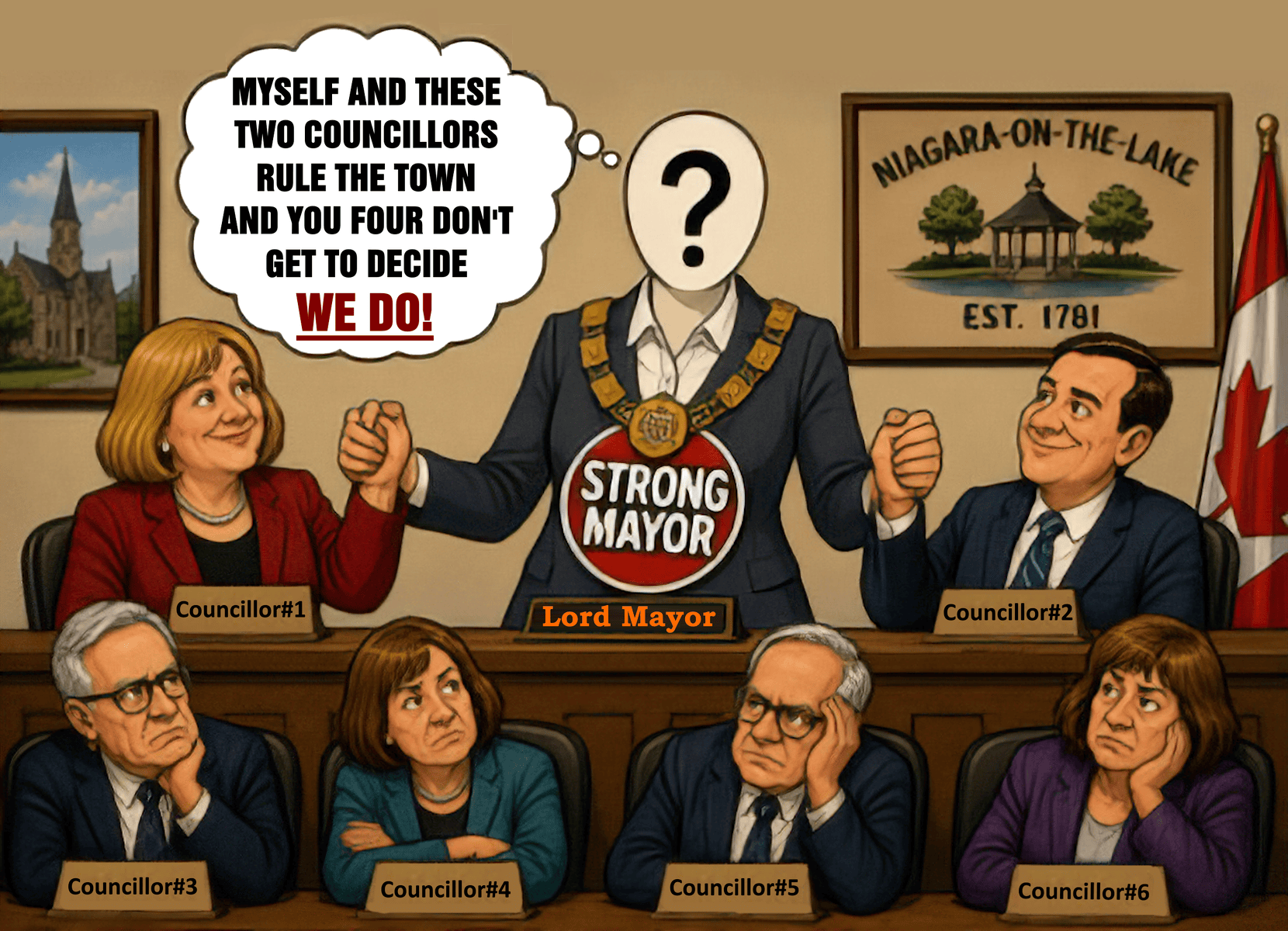
The campaign, accompanied by a striking political cartoon, seeks to educate residents about powers that many people do not realize have already been granted to the office of lord mayor.
These authorities include the ability to propose municipal budgets, veto certain council decisions, direct municipal administration and advance bylaws tied to provincial housing priorities with reduced council support.
Advocates fear that many residents remain unaware of the magnitude of these changes and the potential impact they could have on the character, growth, and governance of Niagara-on-the-Lake for years to come.
“The future of our town is too important for voters to discover these changes after the election,” organizers said. “Every resident deserves to understand what is at stake before casting a ballot.”
Residents are encouraged to review the information below, learn how strong-mayor powers may affect local decision-making, and participate fully in the democratic process this October:
Did you know that, following the Oct. 26 municipal election in Niagara-on-the-Lake, the lord mayor will only need the support of two amenable councillors to make decisions that could have serious impacts on our town and residents for decades?
The combination of strong mayor powers and the reduction in the number of councillors contesting the 2026 election can result in three people having the legal authority to override the will of the majority of council members that we elect this fall.
Two Government of Ontario decisions are responsible for this erosion of democracy.
First, Ontario’s Strong Mayors, Building Homes Act, 2022 legislation became law on Sept. 8, 2022. NOTL’s lord mayor was designated as a “strong mayor” by provincial regulation filed on May 1, 2025.
Second, earlier this year, the provincial government made a regulation reducing the number of NOTL’s councillors to six from eight, making official what the current council decided without due notice to the public at its meeting on March 24 this year.
Ontario’s strong mayor system provides NOTL’s lord mayor with centralized executive powers to act unilaterally in several areas.
Among other things, it will allow our newly elected lord mayor to propose future municipal budgets and veto council amendments to budgets with the support of only two council members.
Our lord mayor can also appoint or dismiss the chief administrative officer and certain other department heads, direct town staff and reorganize the town’s departments. This authority raises the troubling prospect of politicizing our town staff.
Moreover, the new lord mayor will have the authority to propose bylaws related to the provincial priorities set out below and pass those bylaws with the support of two council members.
Provincial priorities set out in the strong mayor legislation are: Building 1.5 million new homes by December 31, 2031 and constructing and maintaining infrastructure to support housing, including: transit; roads; utilities; and servicing.
If the lord mayor is of the opinion that all or part of a bylaw proposed by a council member would interfere with one of these provincial priorities, he or she could veto it.
This veto power could be overridden if two-thirds of council members vote to do so. Shockingly, the lord mayor’s vote counts as a vote on the veto. Thus, the lord mayor, together with two council members, could defeat a veto supported by a majority of council members.
Strong mayor powers erode democracy, diminish residents’ voices and blur lines of accountability and transparency.
Concerned residents are encouraged to write council@notl.com and urge councillors to advocate for removing strong mayor powers from Ontario’s laws and regulations.
This year’s municipal election is unlike any other in the history of Niagara-on-the-Lake.
Your vote could determine what our town looks like in the years ahead.
Be informed before you vote this fall. Vote wisely.
Ron Simkus is vice-chair of the Niagara-on-the-Lake Residents Association, an organization of residents from Niagara-on-the-Lake involved in municipal and regional affairs.