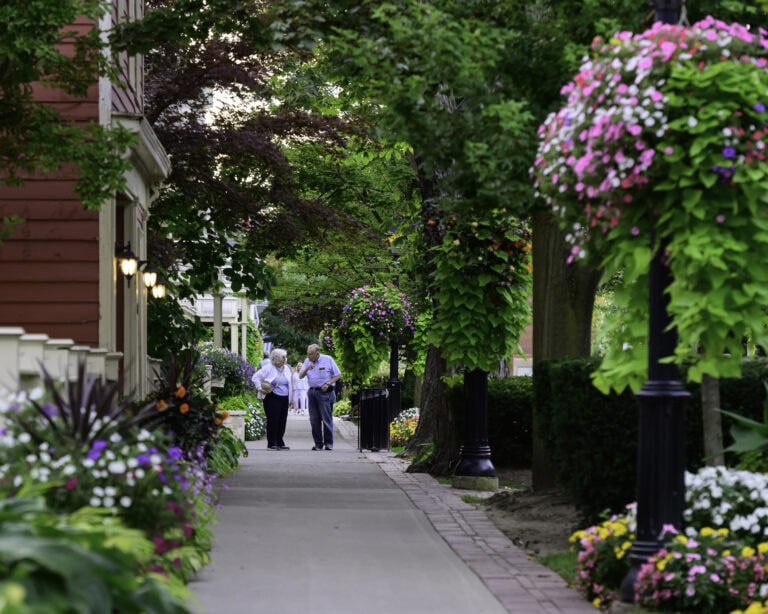

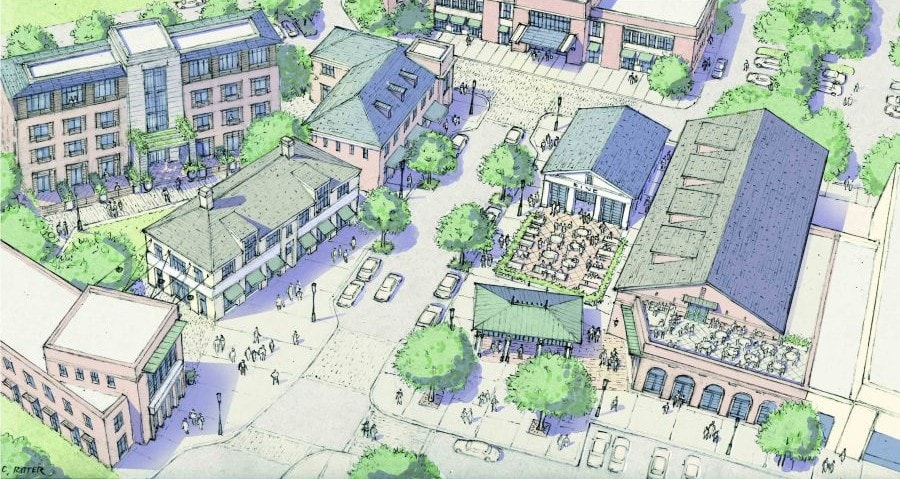


Perhaps one of the finest Canadian late-20th-century developments can be found in Niagara-on-the-Lake. The Village, designed by the world-famous firm Duany Plater-Zyberk & Co., was envisioned to be a human-scaled neighbourhood contextually sympathetic with Old Town in accordance with the best precepts of new urbanism.
The “finished” plan was to encompass a complete range of amenities and services necessary to realizing a well-rounded lifestyle for residents and, further, would include commercial, retail, entertainment and service building spaces that would help to ensure that the new development became an integrated part of NOTL’s Old Town.
By 2003, about 50 homes had been completed and demonstrated the research the designers had undertaken to understand the streetscapes and architectural of the town then subsequently embrace that in the new development.
For the next 14 years, build-out of the residential neighbourhood continued and, while the late phases of the development did not achieve the benchmark of architectural design excellence established in the earlier stages, the resultant streetscapes and character of the Village remained true to Duany’s original vision.
In 2018, the developer, Traditional Neighbourhood Development Inc., applied for rezoning on portions of the property to facilitate the promised commercial buildings and amenities that would contribute to a holistic community.
For the first time, we saw architectural renderings — produced under the direction of Duany — of the proposed commercial spaces which would include a hotel, assembly hall, additional retail (including a grocery store), etc. These illustrations showed a relatively bucolic vision, its architecture and site layout largely in-keeping with the traditional forms and spaces of the residential development.
It was this plan that was used during the applications for lot severances (B-11-20 and B-12-20) in late 2020. By September 2022, in appendix I of the documents attached to the site plan approval application, the hotel building has been altered into a curved L-shaped footprint.
Since the application was introduced “at the last minute” in the final meeting of the previous council — something that the developer apologized for, citing the need to have the entire site plan approved in order to complete the infrastructure and medical building within the 2022 calendar year — it is not surprising that the councillors may have missed this alteration.
Interestingly, there were no architectural renderings included in the application documents but, instead, a “Village Centre code” is provided.
This code, authored by Duany in 2021, was intended to “guide the development” of the commercial spaces and suggested that the individual buildings should “come by the hands of multiple architects”; “adequately accommodate automobiles while being principally oriented towards pedestrians”; and, the architectural design(s) “should grow from the regional climate, history and building practice.”
What is fascinating is that all of the drawings included in the code show traditional building forms and elements. Clearly the intent of the code was to maintain a continuity and cohesive integration with the adjacent residential neighbourhood.
And, I would assume the code was included as part of the application as an implied assurance to council and town staff that new buildings to be constructed, as per the site plan, would be designed in accordance with same — resulting in contextually appropriate architecture sympathetic to the Village.
Instead, what we have witnessed is the construction of a 21st-century modern glass and metal hotel that speaks neither to Niagara-on-the-Lake generally nor the Village specifically.
Just to be clear, I actually admire the design. However, in no way is it imbued with a “sense of place.” Let’s just be kind and just describe it as a great design in the wrong place.
And, however inappropriate in this place, the hotel can claim to be a product of talented design. Unfortunately, this cannot be said for the buildings that line Perez Street and are exposed to Niven Road.
Meant to partially screen the parking lots from the street, these two-and-a-half-storey, flat-roofed assemblies — constructed of grey and buff brick — are, despite having some horizontal articulation, simply boring and deliver the somewhat tacky appearance of a late-20th-century industrial plaza.
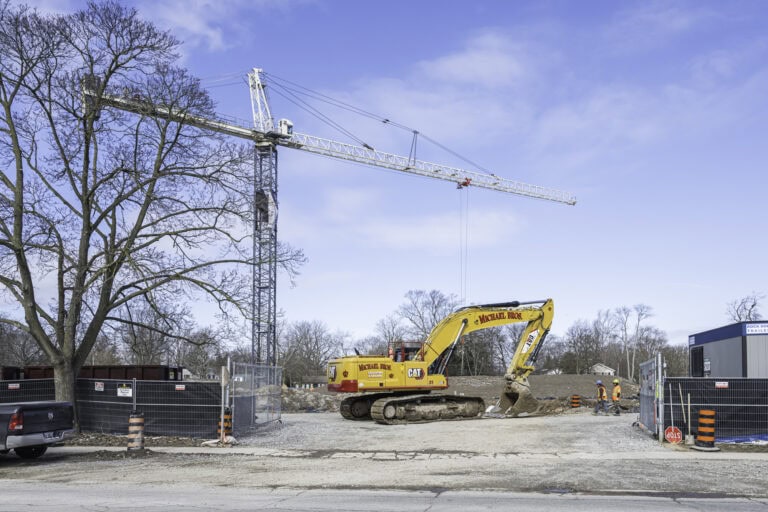
Currently under construction between Niagara Stone Road and the new hotel are two buildings identified on the 2022 site plan drawings as “mixed use – commercial.”
Now, if the sidewall of the new grocery store is any indication — its flat red brick wall showing a feeble attempt at ornamentation via contrasting lintels and gooseneck lamps — the design of these buildings is likely to be nothing to write home about while blocking the streetview of the only decent building design in the new development.
As a final note, the post-2022 architectural drawings were never brought before the town’s urban design committee (prior to council disbanding same) for their input and comments nor aired in public.
Of course, the discarded 2018 plans were — but that hardly counts, does it?
At the gateway to Old Town, side by side, the Stone Eagle Winery and Garrison Centre welcome visitors to NOTL with a statement of architectural bad taste.
Brian Marshall is a NOTL realtor, author and expert consultant on architectural design, restoration and heritage.