



To wrap our arms around the short-term rental issue, it may be worthwhile to look at some hard numbers.
According to the list of licensed short term rentals published by the town on its municipal website, as of June 2026, there are — based on my count — a total of 385 active short-term rental licenses in place; an increase of 95 active licenses over the 290 short-term rental licenses issued in 2022.
Expressed as a percentage, this represents a growth in short term rentals within the municipality of 32.8 per cent over the four-year period between 2022 and 2026. It’s interesting to note that over the same four years, the town’s population grew by a mere 5.3 per cent from 19,200 to 20,220.
Now, to drill down further, it becomes necessary to understand how the administration and current short-term rental bylaw (#2025-032 signed into law on May 27, 2025) of the Town of Niagara on the Lake have defined a “short-term rental” and five iterations of same.
Beginning with the official definition of a short-term rental in the bylaw: “the use of a building for overnight guest lodging for a period of not more than 28 days and includes bed and breakfast establishments, cottage rentals, villas, country inns and vacation apartments.”
So, my quick and dirty interpretation of the official definitions relative to the five short-term rental classifications — using the bylaw’s alphabetical format — that fall within the current bylaw are as follows:
A “bed and breakfast” is a detached dwelling with a maximum of three guest bedrooms for temporary lodging (less than 28 days) for visitors to the town. The owner of the property must use it as a principal residence and the bed and breakfast operation is an “ancillary use” of the dwelling.
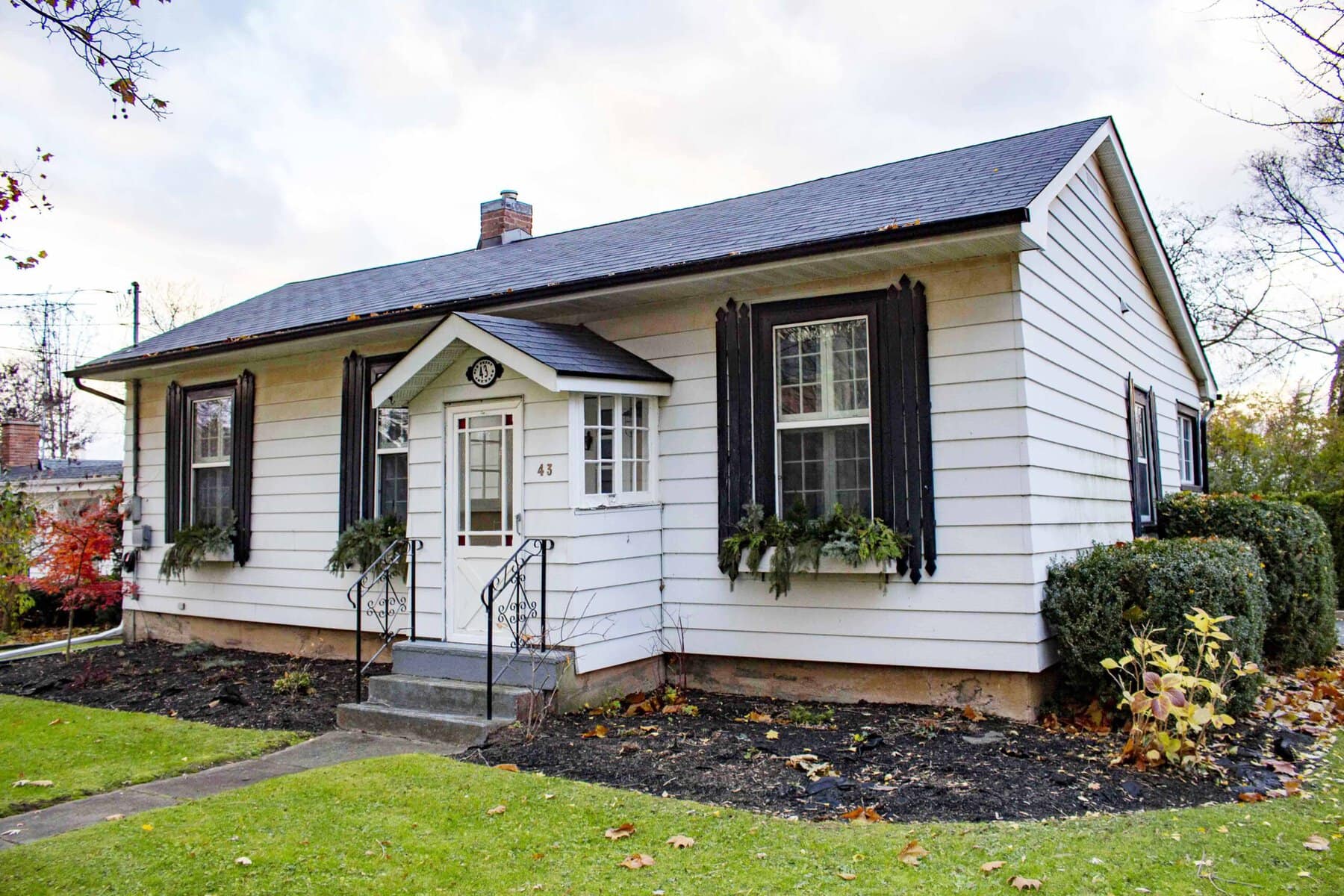
Conversely, a “cottage rental” is a single-detached dwelling of up to three bedrooms, which is not owner-occupied, that may be rented to visitors and vacationers to NOTL under a single booking for a maximum of 28 days.
While a “country inn” must be owner (or contracted operator) occupied and may vary between three and six rented rooms, dependent upon its urban/rural location within NOTL subject to site specific zoning provisions.
The “vacation apartment” category is quite simple: the licensed short-term rental apartment dwelling unit must be above a correctly zoned commercial space and the 28 day single booking limitation applies.
Finally, a “villa” has been defined as a single detached dwelling unit with more than four bedrooms (in the agricultural-zoned district limited to six bedrooms) but without the requirement for owner or contracted operator occupation.
Returning to the official list of licensed short term rentals, by my rough count, the town has issued short-term rental licences for 19 villas, 14 country inns, 25 vacation apartments, 126 bed and breakfast establishments and 201 cottage rentals; the last category representing over half (approximately 52 per cent) of all current licences.
And, while it appears that the number of hosted bed and breakfast establishments has declined since 2022, when the then-president of the B&B Association, John Foreman, pegged the number of licensed bed and breakfasts at 150, the expansion in NOTL’s licenced short-term rental sector is clearly due to a rise in offerings that are not owner-occupied.
This is a trend that robs the community of dwellings that would otherwise be in the long-term rental market, states a 2024 study co-authored by David Wachsmuth of McGill and Cloé St-Hilaire of the University of Waterloo (“Supply, demand, or stickiness? A causal analysis of the effects of short-term rental activity on residential rents”).
Furthermore, their research led them to conclude that “commercial short-term rentals and short-term rental prices each independently cause increases in residential rents.”
Allow me to be very clear, as I pointed out in last week’s column: the plus-100-year tradition of cottage rentals in Niagara-on-the-Lake has put an indelible mark on many streetscapes and certainly those of the Chautauqua neighbourhood.
However, back in the day, a cottage rental was truly that — a family cottage that was rented to vacationers during the times of year when the family did not occupy it. It was certainly not a real-estate investment principally owned to generate a healthy rate of return.
That said, the problem is not cottage rentals per se but rather the uncontrolled proliferation of non-hosted short term rentals — perhaps particularly when there are no controls applied to ensure that short-term rentals are not concentrated in close proximity to one another.
That is why short-term rentals can hollow out a street, a neighbourhood and ultimately a community.
And, why any correctly thinking council — one that represents the good of the town and its residents as opposed to commercial real estate investors — would support proper controls and a cap on the short-term rental market.
Brian Marshall is a NOTL realtor, author and expert consultant on architectural design, restoration and heritage.