


OHIO STATE MURDERS
***** (out of five)
Jackie Maxwell Studio Theatre, one act, 55 minutes, no intermission. Ends Oct. 3. By Adrienne Kennedy. Directed by Philip Akin.
If you have ever experienced discrimination for reasons of colour, language, religion, country of origin, class, wealth, poverty, education, age or gender, “Ohio State Murders” will resonate. If not, there is still much to consider. And why is best said by the renowned playwright herself, Adrienne Kennedy:
“I want them to realize that they’re listening to a very articulate, thoughtful American Black woman and, perhaps, they should pay attention to what she is saying.”
What she is saying is that her plays are “meant to be states of mind.” They are fragmented, non-linear. The imagery is intense. Her lyrical monologues with herself, go back and forth, at times poetic, at other times matter of fact, as she reminisces, switching place, correcting in time and space.
She doubles herself as reader and writer. Her use of twins or doubles in a story is a means of subverting the self within the body. She has said that she doesn’t know who the person is who wrote her plays.
Kennedy has written a powerful story of a Black woman’s lived experience of love and betrayal, of ambition, misogyny, sexism, violent racism and resilience. Racism attacks in this case, traumatize her interior self, she makes that interior visible. One thinks of the writing of Sylvia Plath and Alice Munro. How such psychic anguish is revealed differs when said aloud.
In “Ohio State Murders,” a woman briskly enters the theatre (and our theatre). She is introduced to the audience as an acclaimed guest speaker appearing on a university campus. She is the famous academic and writer Suzanne Alexander whose life resembles that of the author Adrienne Kennedy. She has been invited to speak on why she uses violent imagery, including murder and infanticide, in her work.
She is also in Columbus to confront, understand and reveal what happened to her as a first-year student at Ohio State University in 1949. She was ostracized by white students in her dorm, blocked from paths and group memberships, endured doubt that she had written her brilliant papers herself and denied acceptance to advanced English literature courses. Academic racism was insidious and systemic.
Suzanne has a brief affair with her white professor of English literature, Robert Hampshire. She becomes pregnant. She is rejected by him and her middle-class parents, finds a safe haven in New York City but is compelled to return to Columbus and Ohio State University. This decision leads to murder.
The role of Suzanne is a tour de force for Black women and two celebrated actresses, Ruby Dee and eight-time Tony Award winner, Audra McDonald.
In 2022, “Ohio State Murders” was chosen to open the new James Earl Jones Theatre in New York. It was the 91-year-old Adrienne Kennedy’s debut on Broadway after 60 years of playwriting, essays and influence in the world of theatre and academia.
In this Canadian premiere at the Shaw Festival, Tim Carroll has brought the work of this revered woman of the theatre to our stage.
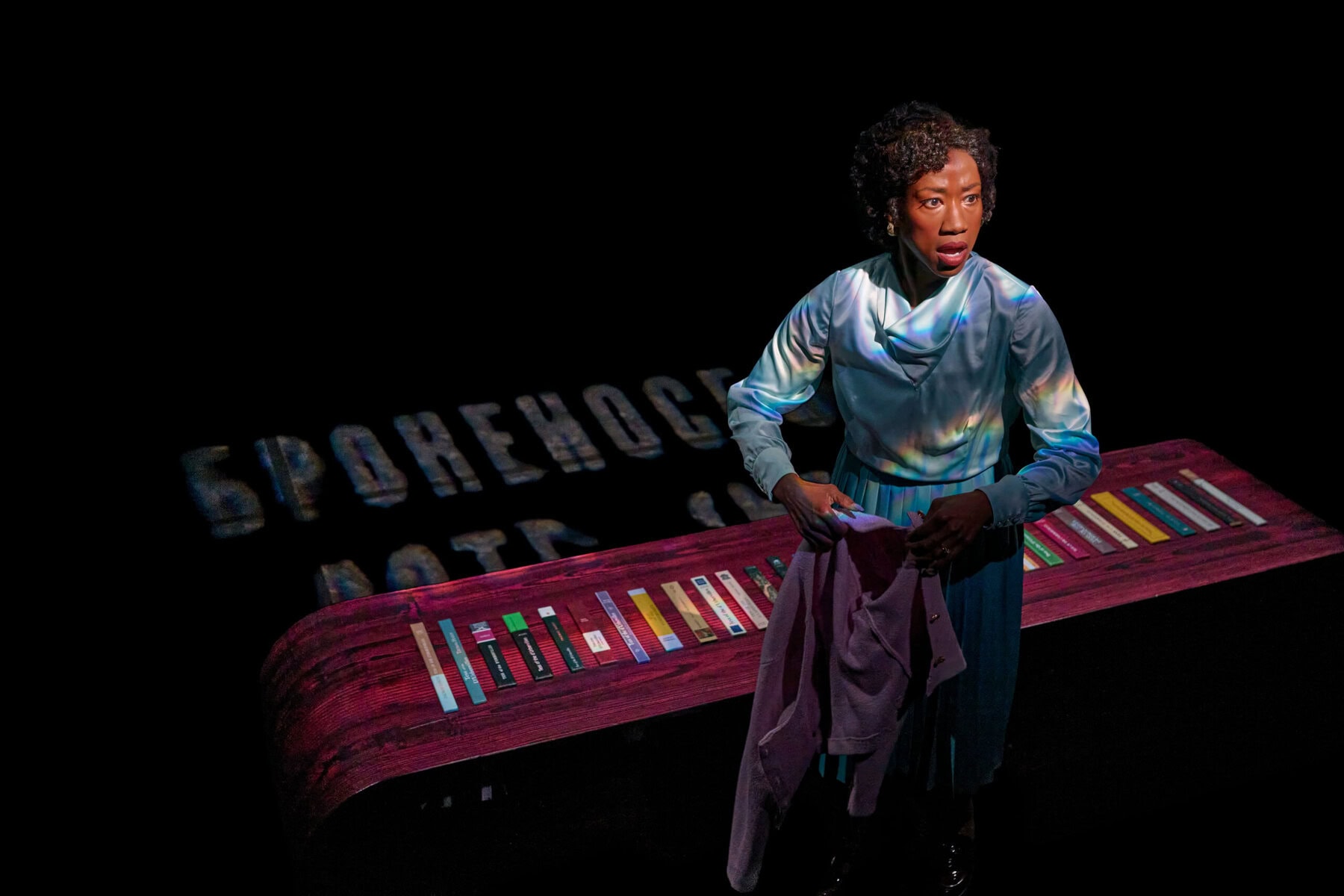
Sophia Walker as the writer Suzanne Alexander proves her mettle. She is outstanding, deftly balancing the double role of the mature, acclaimed Black writer with the naive, gifted student so keen to learn and her later anger and anguish as a mother experiencing the loss of her children.
André Morin is an ideal match for the scholarly type of university professor scorned by students. Young, cold, bespectacled, wearing a three-piece suit (in the 1950s), he irritably reads his notes aloud without addressing the class. He doesn’t look up or engage because he would rather be in his office doing his research. The question of why young female students fall in love with their professors does arise here.
The production values are superb. The intimacy of the play is perfect for the Studio Theatre and the actors play consistently to all sides of the space. Melanie McNeill’s terrific minimalist set is a cherry red painted plywood boardwalk. It weaves like a ribbon, rising and falling, imaginatively becoming a path, a bench, an office, or a library with book spines revealing titles of required English lit reading.
The lighting designed by Jeff Pybus keeps us enveloped in the darkness of the unfolding drama. It tenderly plays on Suzanne’s face during her inner monologues, then shocks us with moments of bright light revelations.
The sound designed by Jacob Lin brings the voices and presence of other characters, not on stage, but caught in memory and, interestingly, not needed in this two-actor production, which is more powerful due to their absence. The original production was written for seven actors. In this production the missing five characters are present in voice-overs that give an added dimension.
Alexis Milligan’s movement direction is to be lauded for the actors’ body language within this minimalist space which keeps us intensely focused. Locations change with “the shift of a hip.”
Adrienne Kennedy’s plays are fragmented, images diffused, the meaning more than literally told, the essence lying in layers of consciousness. Philip Akin’s creative direction builds this mesmerizing story to a recognition of where we end up is often “via the most circuitous route.”
This journey is well worth taking.
Penny-Lynn Cookson is an arts and culture historian, writer and lecturer living in Niagara-on-the-Lake.