
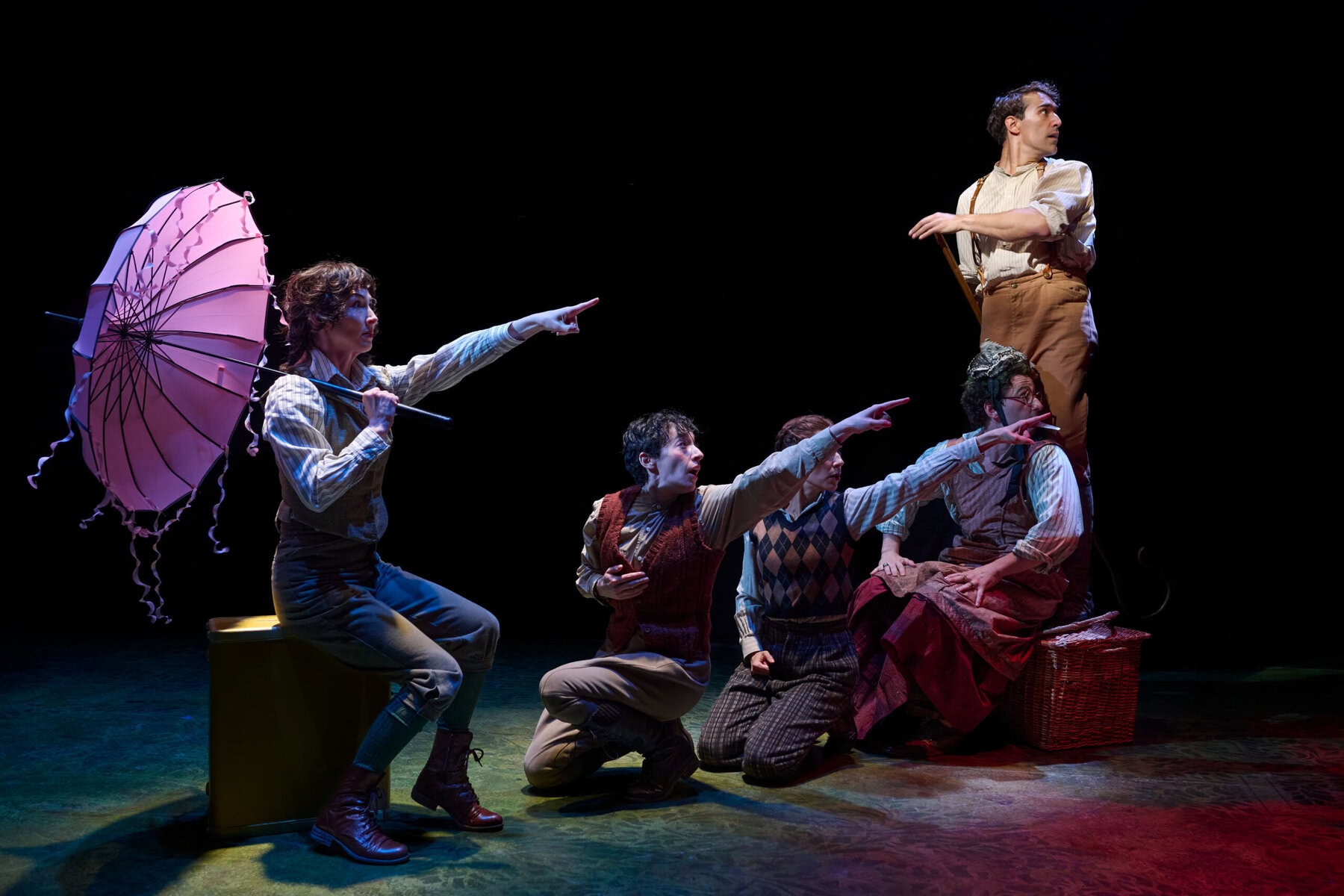


THE WIND IN THE WILLOWS
***** (out of five)
Jackie Maxwell Studio Theatre, 2 hours, one intermission. Ends Sept. 27. Based on the play “Toad of Toad Hall” by A.A. Milne. Adapted and directed by Fiona Sauder.
Indulge the child within you. This joyous production is for all ages and it was pure delight to see children on the edge of their seats, parents and grandparents alert, all responding and laughing in anticipation of what was coming. They knew the characters and the story. And for those, like me, who did not have “The Wind in the Willows” read to them as children, it was a wonderful revelation and great fun.
Mole, Rat, Badger and Toad are the friends we can relate to and treasure. In them, we can see ourselves and others we know with all their fears, foibles, failures, extravagances and triumphs. Lives being lived and shared in a spirit of adventure, kindness and generosity.
This production is a new adaptation by Fiona Sauder of the play “Toad of Toad Hall” by A.A. Milne of “Winnie the Pooh” fame. Milne’s play was based on Kenneth Grahame’s revered novel “The Wind in the Willows” published in 1908 and created to amuse his son, Alastair, at bedtime.
It was also meant to teach manners and the differences between right and wrong and loyalty and betrayal. This outstanding cast and production crew, working with Sauder, has created a nonstop action wonder.
Sharry Flett brilliantly captures every nuance of the clever, responsible, sensitive poet and composer, Ratty. Shawn Wright is excellent as Mr. Badger, the wise father figure, who must counsel and save Toad from himself. A recluse, Badger likes people, is loyal to his friends but prefers not to be involved with society.
The shy and sensible Mole discovers a new above ground world of sun, breezes and water. He is played by the ever one-note Gabriella Sundar Singh. Lawrence Libor as the crazed, rich playboy, Toad, is hyper, frenetic, compulsive, boastful, anti-authority, addicted to new fads and taking risks, yet considerate, affectionate and generous to his friends.
The plot is us vs. them. The River Bankers, which include the water rats, don’t often go to the scary Wild Wood as it is the home of untrustworthy weasels, stoats, ferrets and foxes.
As Toad has inherited Toad Hall, the finest house on the river, he is now the Honourable, Venerable Mr. Toad and the rightful leader of the region. But his wayward behaviour jeopardizes his inheritance and reputation and the Chief Weasel lies in wait for the opportunity to capture Toad Hall.
Oblivious to this impending danger, Toad follows his latest passion, taking to the open road with Ratty and Mole in his new, bright-yellow caravan drawn by his old horse, Alfred. A new motor car whizzes by sounding its “poop poop” horn. Alfred rears, the caravan rolls over and is wrecked. Toad doesn’t care. He now has a new obsession: motor cars.
He crashes seven cars, is arrested for stealing the eighth, for endangering the public and insulting the police. Brought before the judge and a jury of six rabbits, one of whom is the Chief Weasel stating he is a different sort of rabbit, Toad is found guilty and given 20 years in jail. He escapes, dressed as a washerwoman, with the help of the jailer’s sympathetic daughter.
In Toad’s absence, Toad Hall has been taken over by the Weasels, Stoats and Ferrets. Badger, Ratty, Mole and the returned Toad devise a plan to take back Toad Hall by force. A blog of Angry Staff Officer February 2017, states the Battle for Toad Hall is “A Masterpiece of Asymmetrical Warfare,” meaning small-unit warfare. The Weasels are a garrison force within the Hall, the Stoats a sentry force patrolling the main approach.
Badger is a strike force commander who lays out a sound strategy of engagement. Rat oversees the combat load of arms. They approach the Hall by a hidden underground tunnel. Their superior use of intelligence and fighting ability surprise the Chief Weasel’s birthday party. They win the battle. Toad Hall is reclaimed by Toad, who promises to do better.
Was Toad Hall Russell Grahame’s allegory for the state of England in 1908? A view that the social order of the upper class was threatened by its folly, exposing it to danger by the working class, a danger recognized by the bourgeois intelligentsia represented by Badger, Rat and Mole?
In 1908, some relevant legislation occurred. The Passage of Children Act granted authorities the right to take away custody of their children from inebriated parents. There was also the 1908 official inquiry into the Inebriates Act.
Russell Grahame’s mother died when he was five. His father, Cunningham Grahame, had an uncontrollable drinking addiction. Russell was sent to live with relatives whose country house “The Mount” overlooked the Thames River in Cookham Dean, Berkshire.
In Cookham, Lullebrook Manor was rented by Francis Court Ricardo, a colonel in the Grenadier Guards and a brother of the Duchess of Richmond. A larger-than-life character, he was the first in the village to own a motor car. It was a bright yellow Rolls Royce with a large horn on the side that went “poop poop.” Other Toad Hall possibilities overlooking the Thames were Mapledurham House and Hardwick House in Oxfordshire.
Whatever the background stories, plays and many revivals, this combination of superb ensemble acting, Judith Bowden’s imaginative sets and props, costumes designed by Laura Delchiaro suggesting the original drawings of E.H. Shepard, Kevin Lamotte’s lighting, Jeff Newberry’s sounds of birds overhead and spooky whistling in the dark woods, Jack Davidson’s fight choreography and Fiona Sauder’s clear collaborative vision has resulted in a sparkling success.
Penny-Lynn Cookson is an arts and culture historian, writer and lecturer living in Niagara-on-the-Lake.