
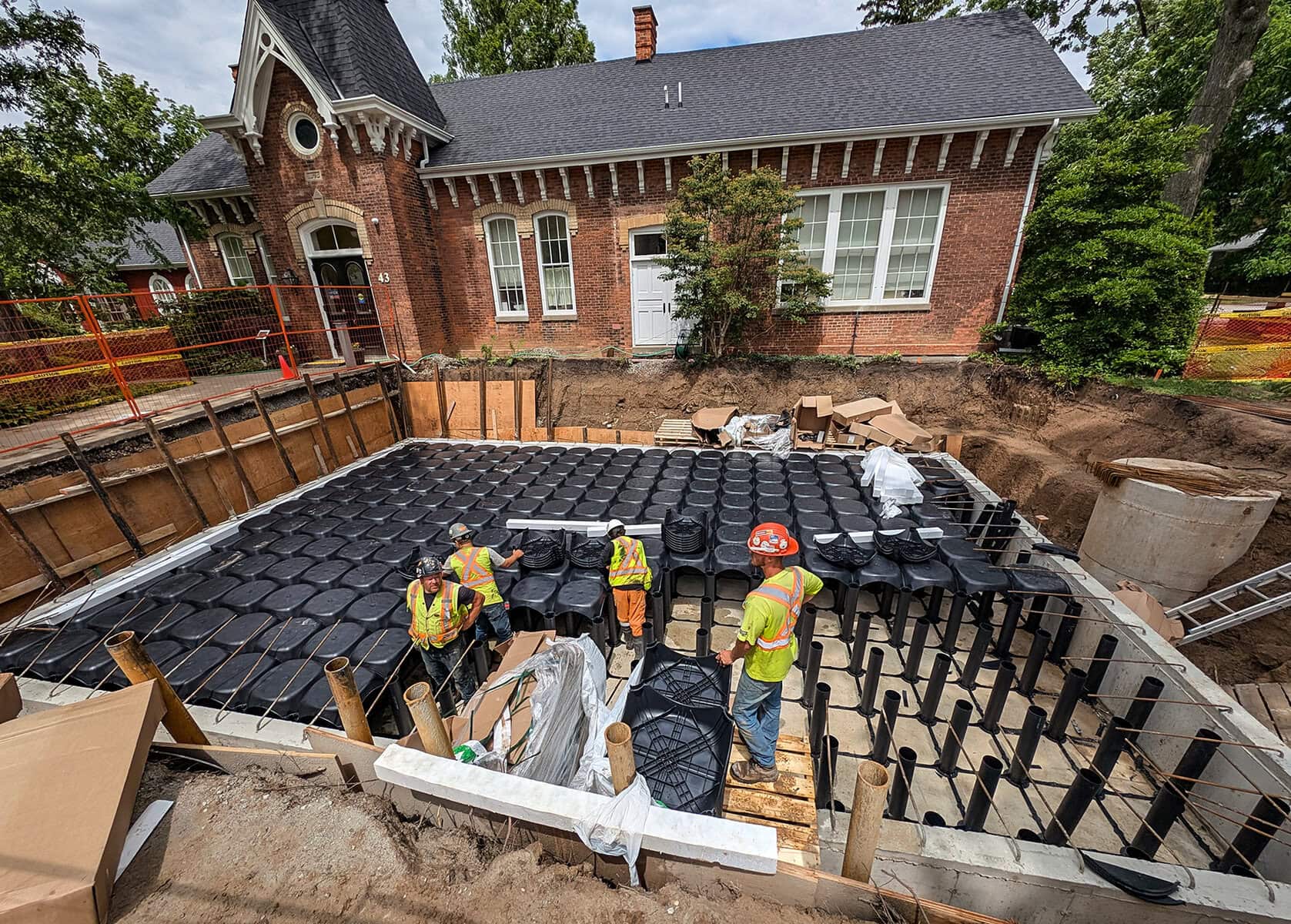


If you’ve been in the neighbourhood of Niagara-on-the-Lake Museum during the past few weeks, it would have been impossible to miss the construction going on in their front yard.
And, you may have wondered: just what is being done here?
The answer to that question is a stormwater management tank.
You see, with the planned expansion of the museum creating additional impervious surfaces (roofs) on the property, current legislation that speaks to the management of stormwater during five- and 100-year-storm events, and the fact that the closest storm sewer on Davy Street is likely undersized, the museum was obliged to develop a solution.
As background, there are two principal methods by which volumes of stormwater are managed in new developments.
Where space allows — such as in a new subdivision — open ponds are frequently deployed. However where space is constrained (such as in the museum’s case) and/or the land value is high, buried tanks are the preferred address.
There are two types of tanks.
The first is a detention style engineered to accept and temporarily store the stormwater generated during a rain event, then slowly release the water into the storm sewers at a rate that does not overburden the capacity of the town’s existing infrastructure.
The second is a retention tank wherein the captured water is used on-site for things like landscape irrigation, grey water systems (such as toilets), etc. A tank of this style is typically larger than the detention option to provide for the projected consumption of the stored water and be engineered to include an overflow drain — connected to the storm sewer — to ensure that maximum storage capacity is not exceeded.
While there are a number of benefits — both environmental and in cost recovery — associated with retention tanks, they are only practical in cases where the property allows for the larger footprint, the anticipated water use is high enough to efficiently utilize the stored water and the construction budget is sufficient to address the capital cost of this more expensive option.
In the museum’s case, a detention tank was the most feasible solution.
Now, please don’t assume that a detention tank is an inexpensive option. Consider the fact that, in the museum’s case, this poured-in-place concrete tank (and the integrated Cupolex structure that supports the cement top slab) with a roughly 40,000-litre capacity will cost in excess of $175,000.
That is not to mention the additional investment necessary to install the on-site storm sewer system required to capture and deliver the rain water that falls during a storm event from all points around the property to the buried tank.
Nor does it speak to ancillary costs such as connecting the tank to the town’s storm sewer, rerouting of existing services and so on, all of which will add substantially to the total bill at the end of the day.
I am forced to observe that a developer can recover the cost of a stormwater management system through factoring it into their future revenues, whether such are generated by eventual property sales or rents or room/event charges.
However, for a non-profit museum, since all the buried infrastructure on the property adds nothing to the actual visitor experience (upon which they depend for current and future revenue generation), cost recovery becomes a very steep (if not impossible) challenge.
Bluntly, I would not want to be the person explaining to a regular visitor that the admission price went up by 25 per cent to pay for something that they will not benefit from nor actually even see.
That said, although this undertaking may be taking a fearful bite into the museum’s budget for its planned expansion, in speaking to Alex Topps, former vice-president and current head of the museum’s design and development committee, he suggested that although the organization really felt the pain of that bite into their fundraising, it was the “environmentally responsible thing to do” and something that “respected and responded to their neighbours and the town’s infrastructure needs”.
And Topps really wanted to do a positive call-out to the work of Scott Construction and the Silverline Group for their outstanding work on this project — something I completely endorse.
In my terms, this non-profit took the bitter pill in favour of supporting the health and welfare of the community they are anchored in. And, that decision, in and of itself, is a shining example of a cultural institution that understands its vital connection to the local greater good.
So, what can you and I do?
Belly up to the bar and pitch a few dollars to the museum’s fund raising efforts. While you may not think so, every $10, $20, $50 or $100 can make a real difference to the future viability of this critically important institution.
If it comes down to supporting a museum that underwrites the character of our unique community vs. one that proposes injury to NOTL’s heritage, you know where my dollars will flow.
Brian Marshall is a NOTL realtor, author and expert consultant on architectural design, restoration and heritage.