


Kyra Simone
Special to The Lake Report
“Go jump in the lake” requires a bit more nuance this summer. Additional guidelines for staying cool and enjoying Niagara’s waters are necessary as climate change exacerbates risks.
Look before you leap
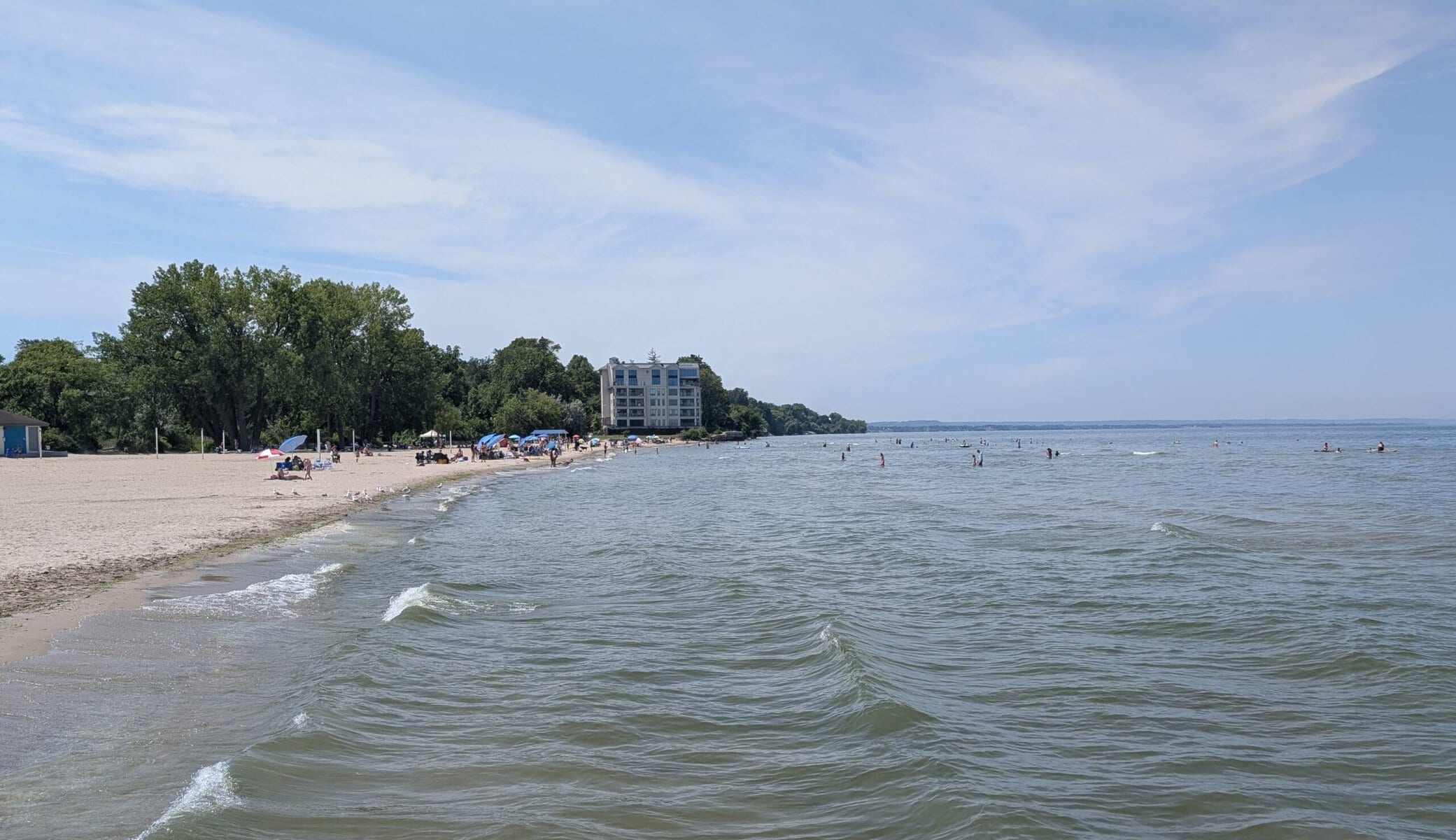
In Niagara, we are lucky to have a wealth of public “blue space,” where we can easily access the water. As periods of prolonged, intense heat become more common, these spots become increasingly important as natural cooling centres.
At the same time, bacterial contamination of natural waters poses risks to beachgoers. To the untrained eye, the water may look perfectly clear — but there are a few important considerations before diving in.
Contact with bacteria like E. coli can cause skin and eye irritation, as well as gastrointestinal symptoms like nausea, vomiting and diarrhea. Storm events elevate bacteria levels in water, both by churning up sediments and depositing runoff from surrounding land areas.
Warmer temperatures and more frequent, intense storms are likely as climate change progresses, both of which will likely increase bacteria levels in water. Indeed, an investigation by Lake Report editor Kevin MacLean found that Queen’s Royal Beach failed water quality standards about half the time last summer, though this did not seem to deter swimmers.
The best advice is to “Know before you go,” says Gregary Ford, vice-president of Swim Drink Fish, a Canadian charity that advocates for clean water. He recommends to always check water quality data before getting in the water.
For Niagara residents, this information is available on the Niagara Region’s website, and the Swim Guide app run by Swim Drink Fish. The latter allows users to “favourite” specific beaches and receive water quality updates directly to their mobile device.
Another best practice is to avoid swimming for 24 to 48 hours after any rain. Because the water is not tested daily, an “all clear” result may no longer apply if it has rained since the last test.
A little bird told me
Aside from watching the weather and checking available data, it’s good to be aware of other pathways of potential exposure.
A new study led by Dr. Ian Young at Toronto Metropolitan University looked at 10 Canadian beaches, including two undisclosed locations in Niagara. The research found that beachgoers were more likely to have gastrointestinal (GI) symptoms after swimming in water containing seagull feces.
This is one of the first studies to link human health impacts to seagull contamination. Though this is emerging research, beachgoers would be wise to avoid swimming in areas with large flocks of seagulls, swallowing any water while swimming, or playing in sand with bird droppings.
There is a risk of bacterial exposure in beach sand and sediment as well, due to water-logged conditions that make them a good breeding ground. It’s best to wash hands after building castles, and to make sure that kids don’t put sand in their mouths.
In the soup
Last, but certainly not least, warmer temperatures will likely bring harmful algal blooms later this summer. Contact with toxins produced by these blue-green algae causes a variety of symptoms in both humans and pets.
The Niagara Region announces confirmed blooms on their website, but knowing what to watch out for can help to keep loved ones safe. Harmful algal blooms are different than the common, nuisance Cladophora algae that often accumulates in piles along the water’s edge at Niagara beaches.
“Cladophora is a filamentous, hair-like algae that clings to rocks and is often long and stringy. Harmful algal blooms look like a split-pea soup,” says Ford.
If you think you spot an unconfirmed harmful algal bloom, you can report it to the Ontario Spills Action Centre, and the Ministry of Environment, Conservation and Parks will send representatives to test it.
“With a warming climate, we can expect to see beach water quality advisories more and more often, so it’s critical that cities invest in monitoring as frequently as possible to keep beachgoers safe,” says Ford.
It’s such a privilege to enjoy these natural waters, and we should definitely continue to do so — with one eye on the data, and the other on the sand and surf.
Kyra Simone is a NOTL native and PhD candidate in environmental science, with master’s degrees in biology & science communication. She researches climate change, wildfire, ecosystem recovery and public environmental communication.