



Who wants to spend time in major airports these days, especially Pearson?
Just getting to the airport can be a struggle given high volume traffic into Toronto at almost any hour, and once there, crowds and lines, and most frustrating, significant flight delays and cancellations. And once up and away and crowded in my seat, there’s not much to see from several miles up.
For 20 years, our family got around by flying single-engine aircraft to and from our cottage in Haliburton, points west as far as Chicago, Florida to the south or to the east, Boston and Halifax.
The whole experience was much better than commercial flying. We could see migrating birds in season, the unfolding country we were crossing, and overall travel times rivaled commercial flying because of all the time gobbled up getting to and around large commercial airports.
Flying small aircraft was also safe because the aircraft we owned were well-maintained and on-board flight-instruments, navigational-aids and real-time weather information rivaled what some commercial aircraft carried in those days.
Powered controlled flight began with the Wright brothers in 1903 with a very fragile-looking aircraft powered by a 12 horse power engine and flights lasting less than a minute.
But it wasn’t long before increasingly reliable and powerful engines and much improved aircraft designs led to the production of close to 200,000 aircraft in the First World War, most single-engined biplanes some of which were capable of level speeds in of 120-130 miles per hour.
Following the First World War, there were steady improvements in aircraft design and the piston engines which powered them spurred on in the 1930s by Germany’s military ambitions and responses by Britain, France, the U.S. and later Russia.
Development continued throughout the Second World War and led to the revolutionary introduction of the first jet aircraft in early 1943-44 in Germany, Britain and the United States, with speeds well beyond those of the most powerful piston-engined aircraft of the day.
These days, there are lots of land-based airports around the world but in the interwar period of the 1920s and 1930 there were few and far between, especially in underdeveloped regions of the world.
Hence the need in the interwar period for large, long-range aircraft designed to take off and land on water (seaplanes), some later were fitted with landing gear, making them amphibians — able to take off and land on land as well as water.
Those intercontinental aircraft were four-engined giants designed to carry passengers, the number of which was dictated by the distance to be flown and hence fuel needed to get to the destination, plus a generous margin for safety.
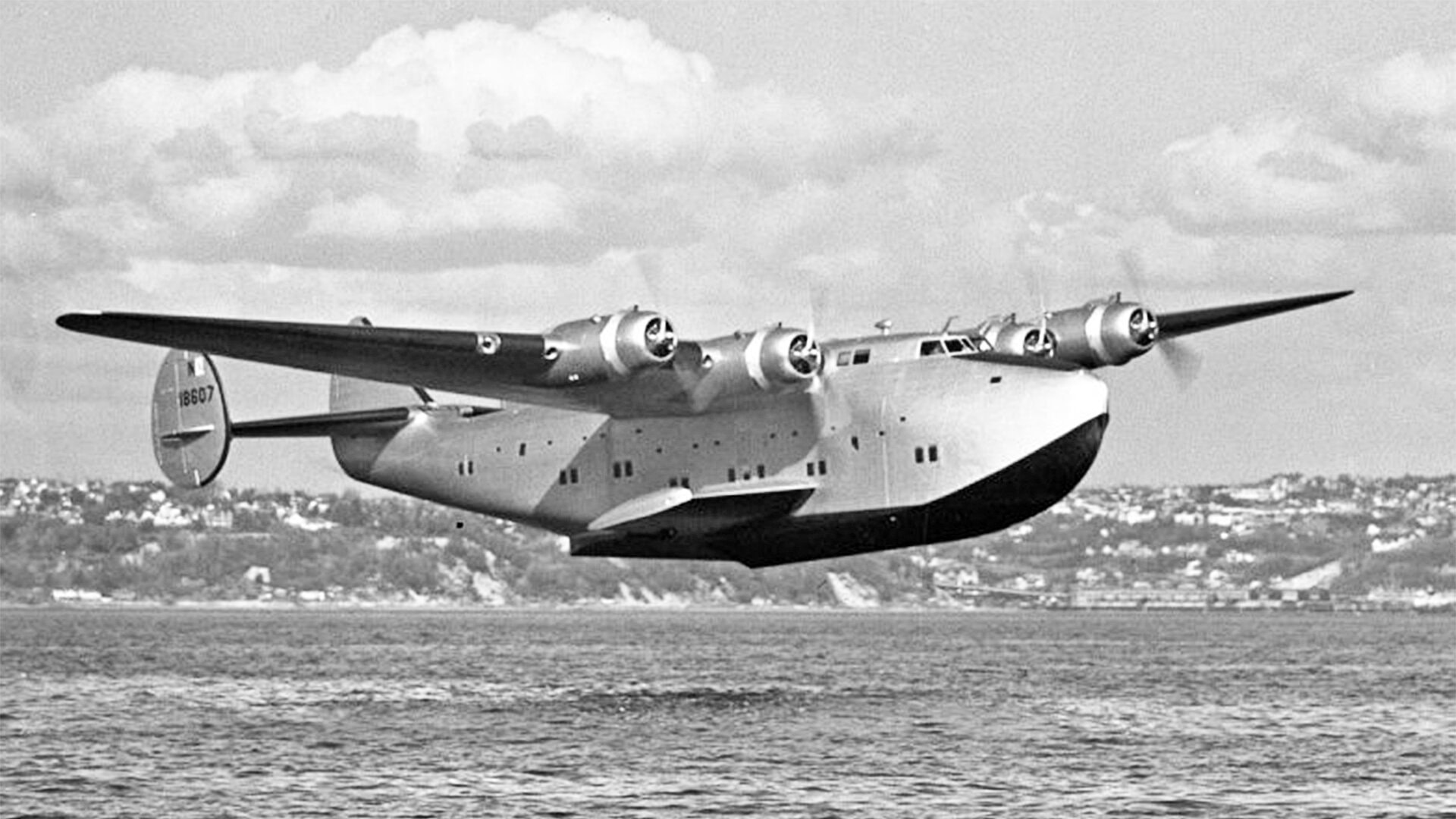
The best of the lot based on overall performance was the Boeing 314 Clipper, which could carry up to 74 passengers. For night flights, there were up to 36 berths.
What’s striking are photographs of the day which reveal a luxury of the accommodation far exceeding what’s available today including generous dining spaces complete with table clothes, flowers, well-dressed passengers and staff and gorgeous meals.
The tables were repurposed for various games between meals. Fights may have been long but there was plenty of space to move about and excellent service. And not a seat belt in sight.
For its day, the Clipper’s performance was excellent. Range was 4,200 miles, and the cruising speed with four reliable Pratt and Whitney radial engines each generating up to 1,600 horse power, was 180 miles per hour — the same as our family four-place lightplanes.
It’s obvious from the numbers that crossing the Pacific from San Francisco to Hong Kong would have taken at least 40 to 50 flight hours, depending on the winds aloft, and several days with two or more enroute stops to refuel and service the aircraft as needed at bases in Honolulu, Midway, Wake, Guam and Manila before reaching Hong Kong.
The bases included classy overnight accommodation provided by the airline. Today’s commercial jets make the trip non-stop in 13 to 15 hours with far less room and luxury.
The British Short Empire flying boats were a little smaller and shorter-ranged compared to the Boeing Clipper and designed to service the far-flung British Empire through a series of stops between the U.K., Egypt, South Asia and Australia.
With the onset of the Second World War in Europe, most of those aircraft were repurposed by the government to maintain links throughout the empire and in the Atlantic provide protection against German submarines by surveillance, sometimes attacking, and even sinking, surfaced U-boats.
By the end of the war and the accompanying huge expansion of land airports, there was little need for giant seaplanes despite attempts to market newer, higher performance designs with turboprop or jet engines for the civilian and military markets.
The result was that most died out except for a few repurposed to fight forest fires.
The passing of those magnificent giant seaplanes mirrors the rapid evolution of aviation, which began with the Wright brothers 123 years ago and much else in science and engineering over the same period.
The pace of this is picking up with RNA and DNA engineering, cosmology through ground-breaking telescopes that allow us to peek to edges of the known universe and AI, the darling or devil depending on your perspective, which, coupled with quantum computing, will profoundly change science, how we live and what we understand.
Dr. William Brown is a professor of neurology at McMaster University and co-founder of the InfoHealth series at the Niagara-on-the-Lake Public Library.