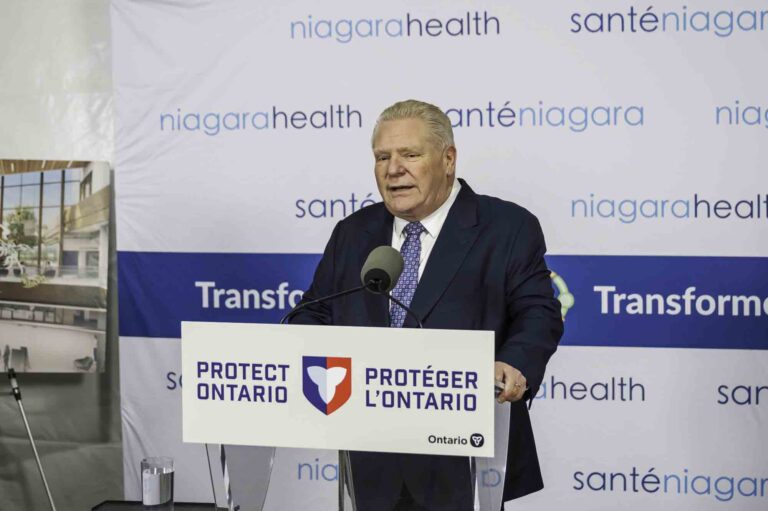


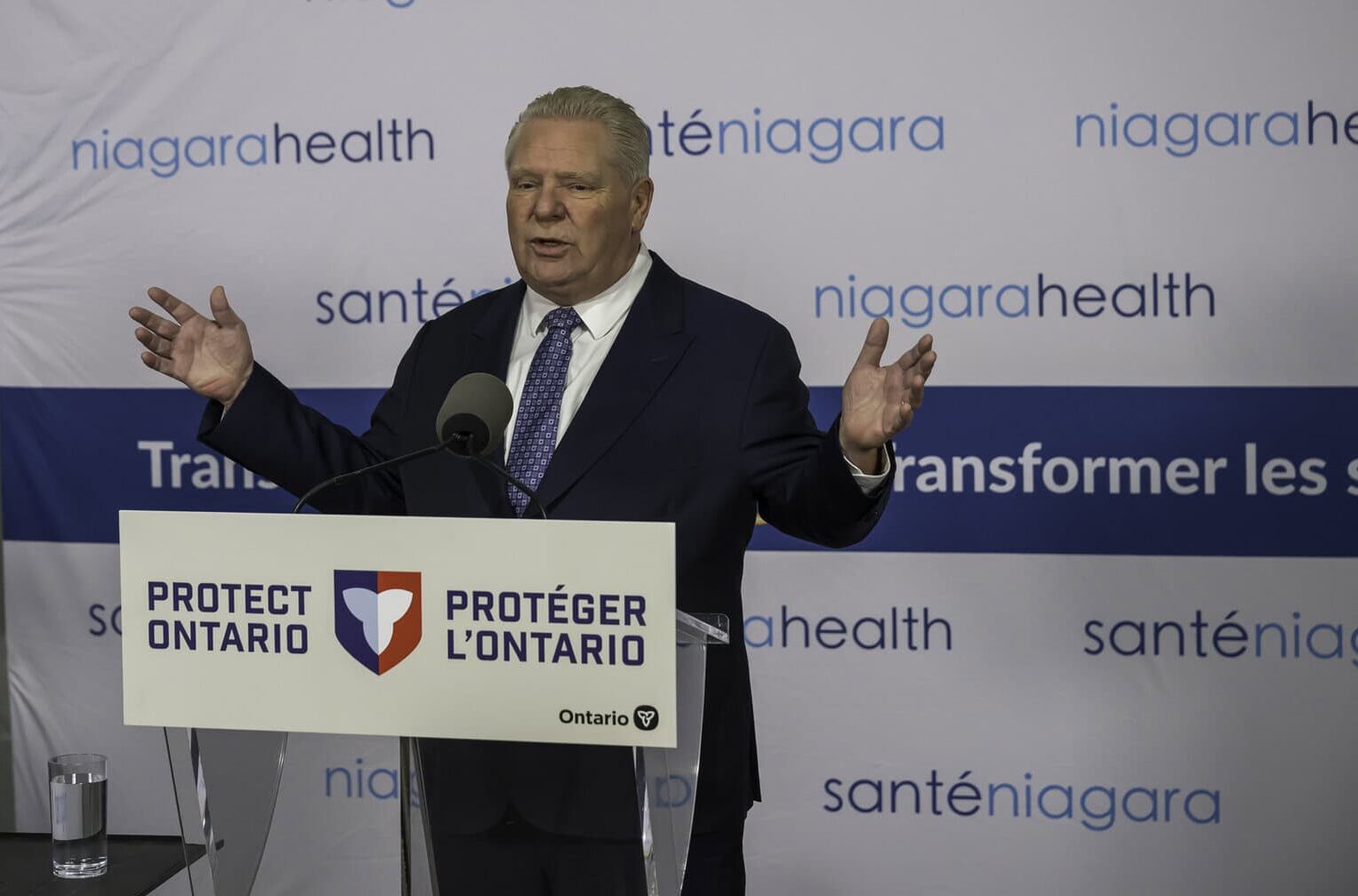


After the lamented passing of our regional chair, Jim Bradley, Premier Doug Ford — exercising his legislative powers — appointed Bob Gale as Niagara’s newly anointed regional head honcho.
Not surprisingly as Ford’s appointee, Gale has undertaken to champion the premier’s expressed direction for regional amalgamation.
Gale claims he has had a “bit of a change in mindset” since assuming the chair’s role, suggesting that he now has to look at the whole picture — although, why an elected regional councillor would not consider the greater good of Niagara in fulfilling his duties remains a mystery.
Now, on the face of it, 126 elected politicians serving on the 12 municipal councils and the regional council seems bloated. However, because the vast majority of Niagara’s councillors and mayors are considered to occupy part-time positions — and their compensation reflects that — the actual cost charged to municipal coffers is only about 1 per cent of total operating.
That said, it should be noted that the cost of regional council in 2024 was $1.411 million — an amount more than double that of the next-highest cost for a council (St. Catharines at $648,000) and nearly seven times greater than the average 2024 budgetary charge for councils across all Niagara municipalities (excluding Niagara Falls, Welland and St. Catharines) of $210,966.
Of course, this leads to the question of whether or not the value conferred by the regional council across Niagara is commiserate with its comparatively exorbitant cost.
But let’s move on to address the question of amalgamation and, more specifically, whether there are any resultant cost savings.
We’ll set aside the experience of Toronto which, during the post-amalgamation decade, suffered an operating budget that exploded by approximately 70 per cent. Instead, let’s consider the data contained within a study (authored by Lydia Miljan and Zachary Spicer) published by the Fraser Institute on May 26, 2015, examining the outcomes of amalgamation on three smaller Ontario municipalities.
In the case of Kawartha Lakes, the municipal employee compensation budget cost rose by 52.9 per cent. In Haldimand, property taxes rose by 50 per cent. While in Norfolk, the long-term debt mushroomed by 111 per cent.
In fact, the published findings of this report resulted in the conclusion that while amalgamation was supposed to bring cost savings, smaller government and lower taxes, it didn’t.
Across Canada and around the world, study after study examining the results of amalgamation have, almost invariably, concluded that it does not reduce costs — it increases them.
Timothy Cobban researched the impact of amalgamation on Ontario municipal governments over a 15-year period. In a January 2014 interview with Global News (“Ontario municipalities spending more since amalgamation: report”), he observed that, “On average all municipalities added employees, but restructured ones, ones that were amalgamated, added employees at twice the rate of unrestructured municipalities, ones that were left alone.”
Quite simply, a bigger organization requires more people, more time and more dollars to produce equivalent results — a phenomenon this columnist delved into in the Jan. 25, 2024 edition of The Lake Report (“Architext: Amalgamation shows bigger is rarely better“).
From a commentary authored by Spicer and Adam Found published by the C.D. Howe Institute (“Thinking Regionally: How to Improve Service Delivery in Canada’s Cities”) and citing multiple research papers, we read, “Municipal amalgamation, in fact, produces few economies of scale, as many studies have shown. Rather, costs generally increase after amalgamation, despite repeated assertions that larger units of local government will result in cost savings. Aside from an increase in costs, research has also found that amalgamation has not led to municipal service efficiencies.”
So, if amalgamation is not the answer to lower costs and smaller government, what is?
First and foremost, allow me to suggest the centralization across multiple municipalities and outsourcing of certain functions to private companies may be part of the solution.
As one example, fleet procurement and maintenance:
Similar to any large corporation, every municipality has a fleet of vehicles, which they acquire and maintain on a year-over-year basis. But, unlike corporations that likely have a single fleet manager (and very small staff) to co-ordinate annual requirements and oversee contractual compliance with their out-sourced fleet provider, each municipality tends to do this all on their own at a significant upside cost.
Why not follow the corporate example (it’s cheaper) and consolidate all of Niagara’s fleet and maintenance under a single contract?
Want to reduce politicians? Look first to the regional council.
I see no reason why regional council should not be structured along the lines of the U.S. Senate: that is, two councillors from each municipality, which would result in a reduction of regional council to 24 members from 32 (more than $540,000 in annual savings), and a significant boon to equalizing democratic representation across Niagara.
And, so many more proven cost saving options to consider.
Brian Marshall is a NOTL realtor, author and expert consultant on architectural design, restoration and heritage.