

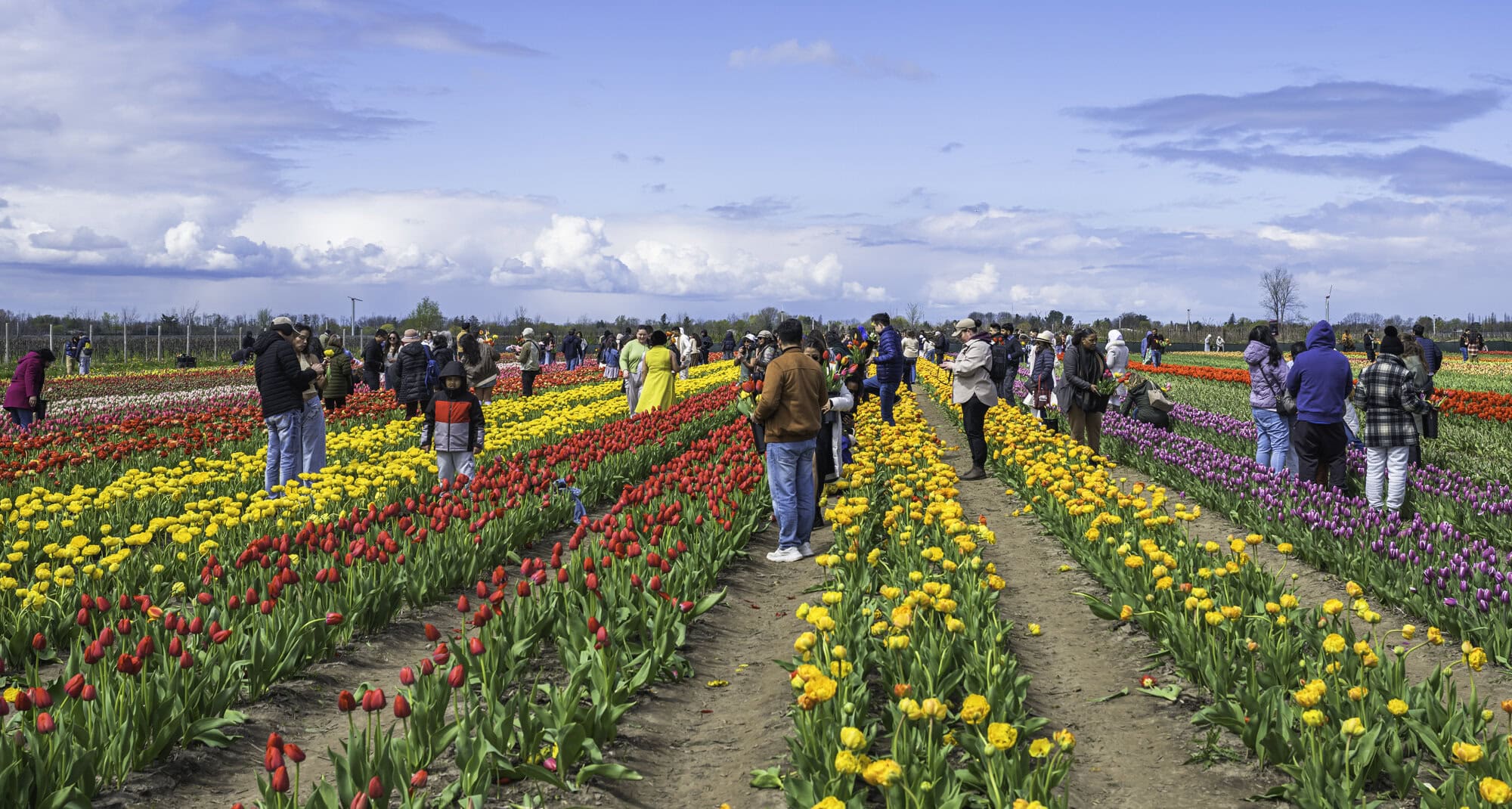


Blue skies brought a smoother opening weekend at TASC Tulip Farm than last year, but a storm is building as the town says the festival is operating in violation of its bylaws.
The TASC Tulip Festival opened last week at Frank Boendermaker and Jill McCourt’s 55-acre tulip farm on Line 3 Road, where three million tulips are planted for viewing and picking.
The town says the festival lacks required municipal approvals, placing the operation under active bylaw enforcement during its peak late-April-to-May season and exposing it to fines under new special events rules adopted after last year’s traffic and mud problems.
Town spokesperson Marah Minor told The Lake Report the municipality has received “a number of complaints” about the festival, including traffic congestion, operating without the appropriate municipal permissions and “issues similar to those raised last year.”
“At this time, the festival is not in compliance with town regulations,” said Minor. “Municipal enforcement staff are actively enforcing the town’s bylaws and working with the organizers to address the concerns and bring them into compliance.”
Coun. Maria Mavridis said in a public statement on April 17 that the festival is proceeding without required zoning approvals and without a special event permit application.
Mavridis said town staff are taking a “measured and progressive enforcement approach,” beginning with a fine for advertising and promoting an event without the required permit. Further fines would follow if the event proceeds without approval, she said.
McCourt disputes the town’s position. She said the farm is zoned agricultural and that the operation has approval for the annual flower-picking event.
“I think (Mavridis) did not do her homework,” McCourt said. “We’ve been working with the town as much as possible, we have hired consultants — we have to try to do everything right.”
Mavridis said the flower-picking event can indeed fall under agricultural use, but the size of the operation, its large attendance, vendors and commercial activity make it a special event that requires municipal approval.
“If proper site-specific zoning were approved, this type of event could proceed,” Mavridis said in the statement. “But without those approvals, the current operations are considered non-compliant.”
McCourt said the dispute has been worsened by poor communication among town departments and a lack of direct contact with the business.
“We applied for our permit in April and October,” McCourt said. “And then we just get this thing posted on Facebook and we actually didn’t appreciate that.”
The enforcement dispute follows a difficult 2025 spring opening, when heavy rain left vehicles stuck in mud and traffic backed up near the farm. Boendermaker later apologized to council and said the business had spent $40,000 to address the mud problem.
Council later rejected TASC’s request for a fall festival permit. Councillors who voted against that request cited the spring traffic problems, the size of the proposed operation and its potential impact on neighbours.
McCourt said TASC has invested far more since then. She said drainage work, hay, wood chips and parking improvements have cost TASC close to $100,000.
The festival site is also larger this year, with a 1.5-acre show garden, more space for visitors and parking changes meant to reduce backups. She said the farm has a plan to reschedule tickets if heavy rain threatens the site again.
“Mother Nature is the deciding factor,” McCourt said. “When it’s a nice, dry, cool day like this, it’s more pleasant for the flowers and more pleasant for everybody to participate.”
The farm will skip its summer flower season this year, McCourt said, so staff can work on agricultural improvements to the clay-heavy soil that made drainage difficult last year.
The spring festival is expected to continue until the Victoria Day weekend, depending on bloom conditions, as town enforcement continues.