


As the federal government moves forward on plans to continue cutting Canada’s immigration levels, migrant farmworkers and their advocates pressed Ottawa for permanent residency at a Virgil rally, arguing the workers who sustain Niagara’s farms and elder care are being driven out of Canada.
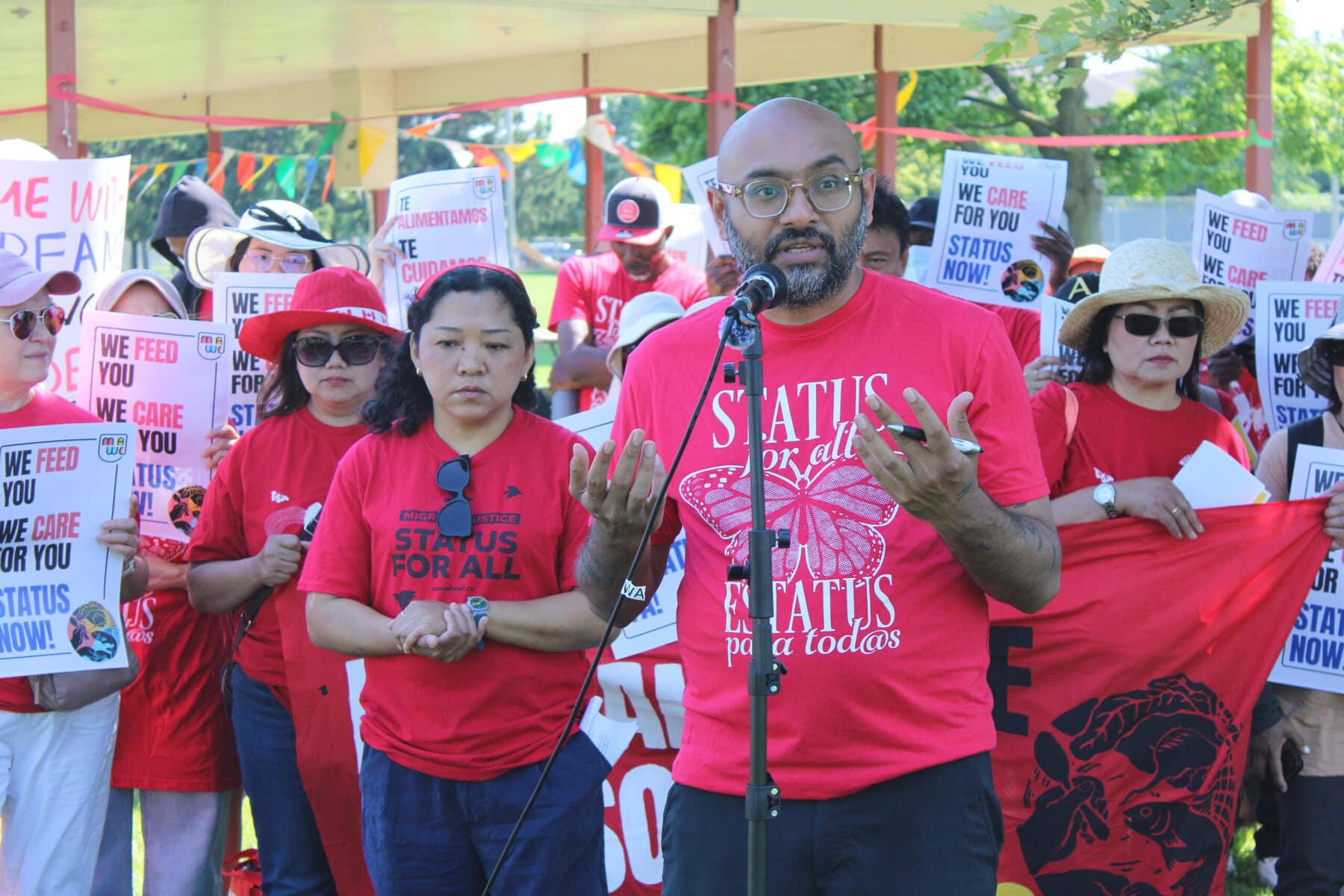
The Migrant Workers Alliance for Change gathered farm and care workers from across Niagara on Sunday at the Centennial Sports Park pavilion in Virgil, where speakers warned that the federal government’s plan to cut the temporary resident population below five per cent and hold permanent resident admissions under one per cent will drive out the workers who feed the region and care for its seniors.
Syed Hussan, executive director of the Migrant Workers Alliance for Change, said the government is forcing roughly a million people out of the country each year by recruiting essential workers on temporary permits, and cutting any pathways to permanent residency they were led to expect.
More than two million people will leave Canada between 2025 and 2027 under the changes, he said. Canada’s population fell by about 102,000 in 2025, the first decline since Confederation.
“It is irrational to bring in people to do incredibly essential jobs, promise them permanent resident status and then change the rules in the middle of the game,” Hussan said.
More than 4,000 seasonal workers come to Niagara each year to plant, tend to and harvest its crops and grapes. The region holds one of the highest proportions of seniors in the country and faces a growing shortage of elder-care staff.
Teresa, a migrant care worker who first arrived in Niagara in 2019, spoke at the rally about how she works 10-hour days caring for a two-year-old boy in Canada while her own family remains in the Philippines.
She said care workers hold together a system Canada leans on while denying them permanent status and the right to bring their families.
“While I am raising someone else’s child, my own family is far away. I left behind people I love,” said Teresa.
A migrant farmworker, who identified himself as Devon, read a statement written collectively by Niagara workers, many of whom feared speaking publicly because of possible reprisals from their employers.
The statement described disrespectful treatment at the hands of employers, unsafe heat conditions and illnesses suffered through under threat of replacement.
“We are not treated like workers. We are treated like machines, but even farm equipment gets better treatment,” Devon read.
Temporary status gives employers control over their employees, because workers fear losing their place on the farm for the next season, the statement said. Permanent residency would let them change jobs, get health care, attend school and reunite with family.
Hussan said heat stress is a growing danger in worker housing that often traps heat worse than the fields, and that employers have pulled out air conditioners and fans bought by workers.
A provincial NDP private member’s bill in Ontario on heat stress for outdoor workers and worker housing has passed first reading at Queen’s Park, but it will require the Ford government’s support to become law.
The rally landed days after Ontario rejected the federal government’s offer to let rural employers raise the share of low-wage temporary foreign workers in their workforce to 15 per cent from 10 per cent, with Labour Minister David Piccini rebutting that domestic youth unemployment is currently above 15 per cent.
Hussan said rural Ontario faces a care crisis if the workers who staff its health and elder care are forced out, because replacing them will not be simple.
“The more we continue to blame migrants and push for their exclusion, or tie them to temporary status, the worse our overall economy is going to get,” said Hussan.
The federal immigration consultation process that closed June 30 will shape Canada’s next immigration plan, setting targets for 2027 through 2029. The current plan already cuts temporary resident arrivals to 385,000 this year from 674,000 in 2025.
“Migrants must have a say,” said Hussan. “A stable society is one in which everyone has stable rights.”