
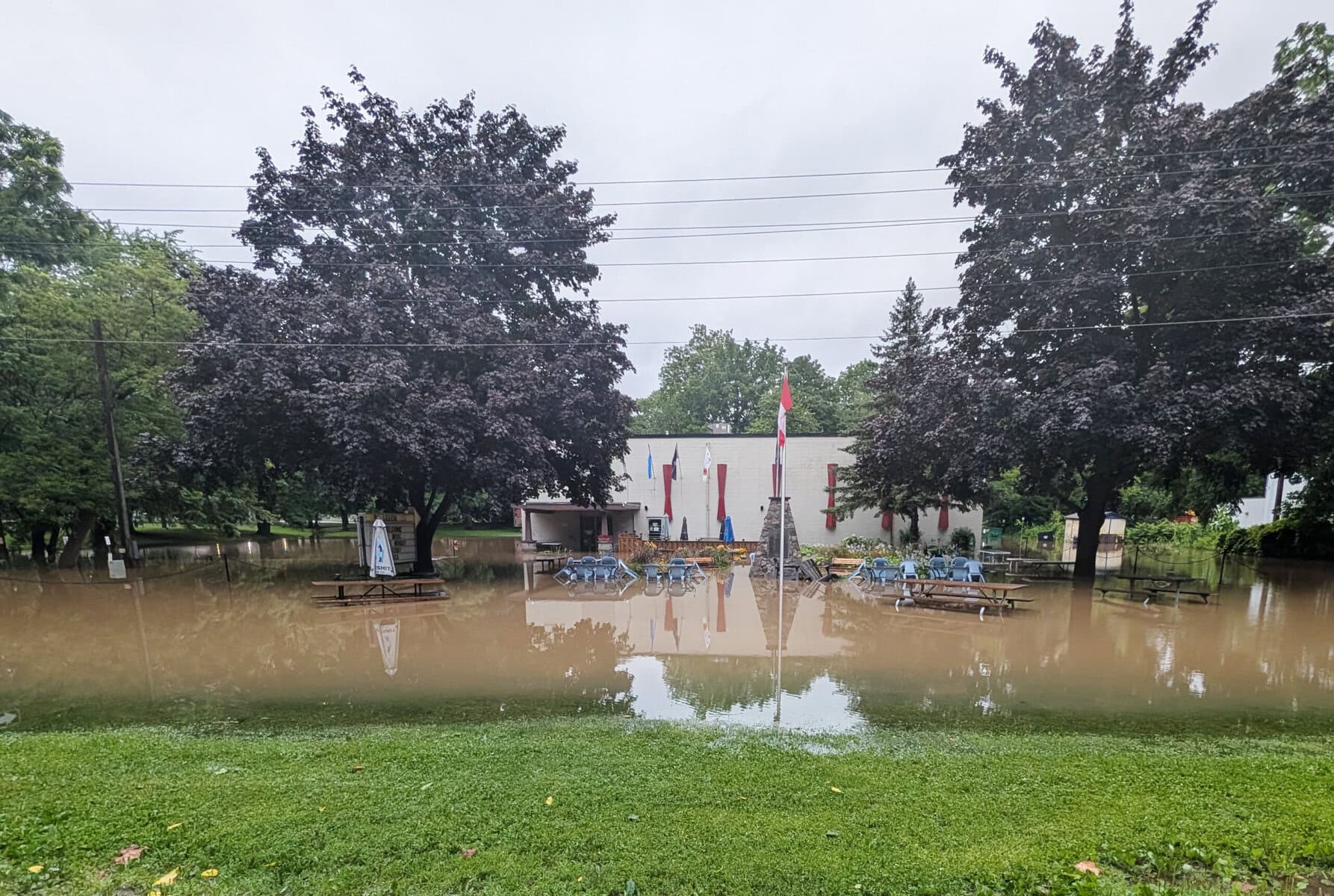


Sunday’s deluge sent knee-deep floodwater through the Royal Canadian Legion Branch 124 in Niagara-on-the-Lake, destroying main-floor drywall, toppling freezers and damaging a century-old flag, photo albums and historical records.
“It was disbelief,” said Megan Vanderlee, the Legion’s first vice-president and bar chair, of the feeling at the Legion as the flooding took place.
The Legion was among the several homes, farms and businesses hit by two major storms that flooded NOTL within six days.
Residents tore out soaked belongings and waited for restoration crews while confronting sharply different insurance realities — from confirmed full coverage to unanswered calls, a decision not to file a claim and one homeowner being told her property was “blacklisted” from obtaining overland-flood protection.
One questioned whether his home was safe, while another grabbed a beer and tried to laugh through the cleanup.
The Legion’s insurance policy appears to cover the damage, but every August event it had scheduled has been cancelled. There is no reopening date and Vanderlee said it could take three months or longer, particularly with restoration companies handling widespread damage across town.
On Tuesday, the town said it removed a temporary obstruction that significantly reduced flow through the King Street culvert during Sunday’s storm. The culvert remained structurally sound, but staff are investigating how the obstruction occurred and its role in the flooding.
At Branch 124 — which sits at 410 King St. — the water has since receded, but the damage remains, Vanderlee said.
A roughly 100-year-old flag was water-damaged, along with photo albums, paperwork and some of the organization’s extensive paper records. Electrical equipment and a newly installed furnace are also among the losses.
The flooding has forced the Legion to cancel all its events this month, including its fish fry, food-truck nights, musical performances and a large outdoor party that was planned for Monday. Vanderlee said the loss extends beyond the building.
Vendors will lose revenue, residents will lose regular events and members will temporarily lose a place many consider a second home.
“We’re gonna do our best to get up and running as fast as we can, but that’s out of our control,” she said.
Municipal and hydro workers were already responding when Vanderlee arrived around 6:30 a.m. Monday and had reportedly worked through the night, she said.
As word of the damage spread, volunteers rushed to the Legion.
“So many volunteers showed up to help. It was amazing,” Vanderlee said, adding that members eventually had to stop them because there was nothing more they could safely touch until professionals assessed the building.
But despite the damage, Vanderlee said no one was hurt and members had not lost their homes or personal possessions, as many residents had.
On Firelane 13, Rene Flear said Desjardins Insurance informed her and her husband that their property is “blacklisted” from obtaining overland flood insurance because of its location.
Desjardins would not discuss Flear’s individual policy, citing client privacy, but said it does not use that terminology.
“Desjardins does not use the term ‘blacklisted’ to describe properties that are ineligible for overland flood coverage,” said Maria Benjamins, vice-president of corporate underwriting and coverages with Desjardins General Insurance Group, in an email to The Lake Report.
Eligibility is determined using several factors, Benjamins said: a property’s characteristics, location and exposure to flood risk, and that clients are informed about available coverage and any exclusions or limitations while receiving a quote, buying their insurance and through their policy documents.
Flear said the insurer told them that limitation was disclosed when they bought the policy, but said she does not specifically recall being told the coverage was unavailable. But she said she now understands it is not offered for properties in the area.
The couple has since added sewer-backup coverage in case their septic system backs up.
“I do not believe it is fair that insurance companies can deny flood coverage to homeowners in certain areas while still charging significant premiums,” Flear said.
“We have paid insurance for many years, and despite paying considerably more than we did for homes we owned in other cities, we are still unable to obtain this important coverage.”
Ralph Rickard was assured his losses would be fully covered, but his finished basement remains soaked and he does not know whether his home is safe.
Rickard woke after the first storm to a neighbour’s text asking whether he had flooded. He checked downstairs and found two to three inches of what he believed was sewage and water.
He filed a claim that day and said his insurer confirmed full coverage. A restoration project manager inspected the home Saturday and an electrician found no exposed electrical issues Monday.
But no cleanup crew had arrived.
He said his greatest concern is whether the wet carpet and lingering smell have made the home unsafe and that he wants the air tested before deciding whether he and his wife should remain in their bungalow.
“I don’t know if we should be staying in our home here or not.”
Rickard said he cannot smell the odour well himself because of his old age — “I don’t have a very acute smell” — but visitors have noticed it.
He used a shop vac and washed the basement himself because he did not want sewage sitting inside his home.
Water had climbed about a foot-and-a-half up the drywall. Rickard said he was told workers would need to remove its bottom two feet.
The carpeting, bathroom vanity, doors, sofas, chairs and other belongings that absorbed water or odour will likely have to go too, he said.
Madis Tambre was also doing the work himself, but was waiting to learn what his insurer would cover.
There are 13 steps leading to Tambre’s basement floor. After floodwater poured into his home last week, only five remained above water.
Floodwater rose at least 69 inches — more than five-and-a-half feet — through his home, swallowing furniture, electronics, clothing and even a pump needed to drain it.
“I understand that they’re probably overwhelmed with calls, but it would have been nice to get the water pumped out in a day rather than over five days or four days that it took me,” Tambre said.
He spent about an hour “to get somewhere” with CAA, but said no adjuster had called or visited by Tuesday.
Tambre said the conversation left him hopeful that CAA might pay his coverage limit, minus the deductible. He was waiting for confirmation before tearing out damaged insulation.
While waiting, he sprayed mould killer on the damaged insulation.
His couch, chairs, sewing machine, television, entertainment unit and winter clothing are among the expected losses.
Tambre called it “forced decluttering.”
“I guess there was initial shock,” he said. “Then you have to [say], ‘OK, it happened. Life doesn’t always go your way. Have a beer and think about it.”
A sense of humour, he said, is helping him push forward.
“If you can’t laugh at it or find some humour in it, then you’re going to get depressed,” Tambre said. “So grin and bear it and clean up as much as you can and carry on.”
At 1289 Larkin Rd., Shawn Comfort had six sump pumps running around the clock during the first storm. They could not keep up.
Three inches of water spread across his basement, while about six inches covered his shop driveway.
“There was nothing I could do but sit there and watch it flood because I couldn’t pump it fast enough,” Comfort said. “I had nowhere to pump it to.”
During the second storm, Comfort ran four sump pumps but said he had nowhere to send the water because town and regional drainage systems were not moving it away “fast enough.”
He and his parents cleaned up the damage themselves. Comfort chose not to make an insurance claim, saying immediate cleanup was necessary to prevent mould and mildew from setting in while he waited for assistance.
“The thing you have to do when you’re in this situation is get rid of the water as quickly as possible and start drying it out,” he said.
Comfort said his household has not made a claim since moving there, but its annual insurance cost rose by about $2,000 last year.
“If you think your house insurance isn’t going up, newsflash,” he said. “The insurance companies have now rendered the whole area a flood concern.”
On Colonel Butler Crescent, Sue-Ann Ramsden’s home flooded for the second time while restoration equipment from the first flood was still running.
Hoses stretched across the floors and into sinks changed where the water travelled Sunday. Ramsden said neighbours whose homes already received new materials were less fortunate.
Her restoration company is handling five NOTL homes that flooded again. Ramsden is still awaiting an assessment to determine what can be saved, restored or written off.
“A learning curve I would have preferred to have done without,” she said.
The second storm also hit Vaughn and Lauren Goettler’s farm harder than the first.
At 2:30 a.m., Vaughn and three others again moved four frightened sheep into a safer barn, while two goats were placed with the pigs.
“They get along so they can stay together for the night,” Lauren said.
But this time, water also entered the farmhouse — “a double whammy,” she said.
In response to significant rainfall and widespread flooding throughout Niagara-on-the-Lake, the municipality is establishing a temporary waste transfer station at the Town Operations Yard, located at 1565 Four Mile Creek Rd.
With the immediate need for residents to dispose of flood-damaged materials, the temporary transfer station will provide a controlled and accessible location for receiving eligible material while supporting the timely cleanup and recovery of affected properties.
“Providing a temporary location for flood-damaged waste will help affected residents move forward with cleanup and recovery,” said Lord Mayor Gary Zalepa in a media release. “We appreciate the community’s patience and cooperation as Staff work to operate the site safely and efficiently.”
The temporary transfer station will operate Aug. 6 to 8, 9 a.m. to 4 p.m. daily, and Saturday until 3 p.m.
The site will accept non-hazardous, flood-damaged residential waste, including: furniture; carpeting and underpadding; drywall and damaged building materials; household contents; non-refrigerated appliances, where permitted; and comparable non-hazardous materials damaged by flooding.
In addition, the town has directed residents with flood damage to contact their insurance providers and posted recovery information and available supports on its website.