

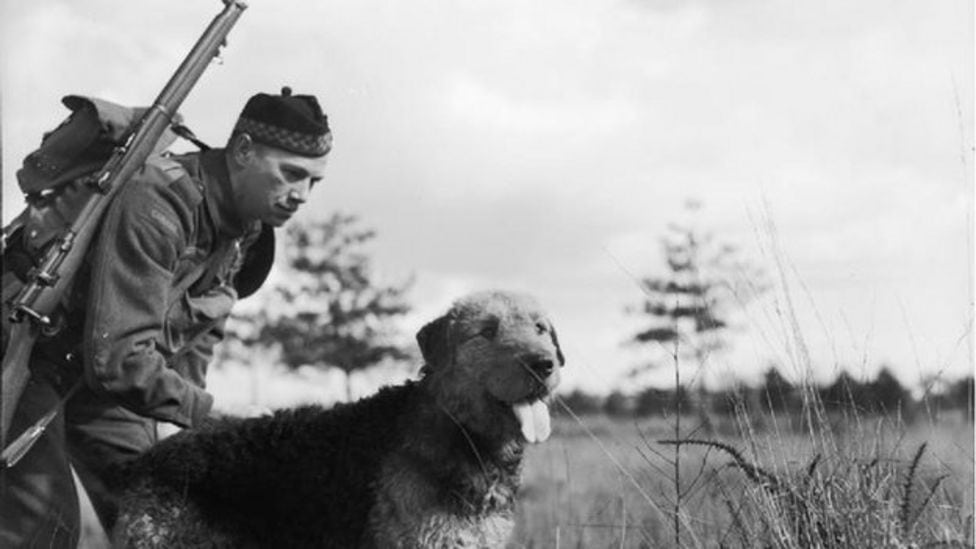


A article in the New York Times published on Feb. 8 chronicled changes in formerly domesticated dogs lost or abandoned by their masters in war zones in Ukraine caught my eye recently, because of corresponding physical, behavioral and emotional changes in soldiers exposed to violent combat in the First and Second World Wars, Korea, Vietnam and countless other conflicts in the 20th and now 21st century.
Some readers may remember the movie “Saving Private Ryan,” which vividly captured the violence on Omaha Beach on D-Day and the following few weeks as seen through the eyes of a fictional small unit.
When I practised in Boston, it was a safe bet with men of a certain age that most would have served in some capacity during the Second World War. I remember asking one man whether he had seen “Saving Private Ryan.” Those words barely left my lips before his head dropped between his knees, and he began to sob to the stunned surprise of his wife.
It turned out that he had been in the third wave to land on Omaha Beach and within minutes his unit lost a third of the men with whom he had trained. He was soon wounded severely enough to warrant transfer back to the U.S. for care.
Later when he settled down in my office, he revealed that he had never shared that chaotic few minutes of terror so well portrayed in the movie, with anyone except a few surviving buddies.
It was the chaos and sounds in that opening scene of that movie which recreated those few moments that triggered his response in my clinic. It doesn’t take much imagination to realize that similar terrifying experiences were common, sometimes lasting many weeks and even a few months for front line troops.
A similar tale was shared with me by a Canadian scientist with whom I worked at Western University one summer. He too was terrified by his experience as an infantryman in Italy and northwest Europe, and many years after experienced nightmares. My great-aunt’s first husband share similar traumatic experiences at the Battle of the Somme in the First World War.
Similar physical and emotional trauma involved many millions of civilians in the 20th century and conflicts in this century, the worst of which recently involve Ukraine, the Middle East and Africa.
So, is it any surprise that pet dogs might be affected by violence of the kind reported by the author of the New York Times article?
The article reported that “dogs on the front line, in a remarkably short period time, had become more like wild dog species, such as wolves, coyotes or dingoes — even their ears took on a different shape, with more pointed ears more frequent than floppy ears.”
The author’s observations reminded me of studies by the Russian geneticist Dmitry Belyaev in the 1950s.
Belyaev changed the behavior of wild foxes — normally wary and aggressive — into domesticates, whose behavior was transformed within a few generations into pet-like behaviours by mating the most docile foxes of both sexes in successive generations.
Just as striking were changes in the appearance of the foxes: their snouts became shorter and rounder, the legs shorter and stouter, the ears floppier, the tail curlier and the colour and pattern of their fur changed — all in less than 30 generations.
Similar, even more rapid changes have been observed with some birds on the Galápagos Islands, whose beak size and shape can change in a season or two in response to environmental change.
A similar mechanism probably explains changes within a few generations in the size, shape and colour of cichlid fish in Africa’s Lake Victoria in response to environmental changes.
The changes in the foxes were much too quick for natural selection acting on random mutations. Such rapid and dramatic behavioral and physical changes suggest the strong hand of epigenetics — the selective activation and silencing of suites of existing genes.
In the case of the foxes, epigenetic changes silenced genes associated with natural “wild” behavior and associated anatomical traits, while favouring “docile” traits. And those epigenetic changes were passed on from generation to generation. That makes sense to me and offers a plausible story.
However, the behavioral changes in formerly domestic dogs within a generation or two in Ukraine can’t be explained by natural selection or epigenetic changes. They reflect adaptive changes from a safe, coddled life to a life where hunger, wariness and fear are constant companions.
No wonder some dogs hang out with other dogs and humans who might offer companionship, safety, warmth, food and water. Wouldn’t we in similar circumstances?
The behavioral changes induced in dogs in combat zones are consistent with similar behavioural and emotional changes in humans faced with violence in Africa, Israel, Gaza, Lebanon and Iran, which, like the experiences of so many veterans in so many wars, can emotionally scar people for a lifetime.
And it’s certainly possible that continued violence over several generations could change the behavior of affected successive generations.
The present is bad enough but, as Bill Gates once pointed out, what happens now, whether starvation or constant fear, can change later generations in the way foxes were changed by epigenetic changes, but might prove harder to reverse. Think later generations of Palestinians in Gaza here.
Dr. William Brown is a professor of neurology at McMaster University and co-founder of the InfoHealth series at the Niagara-on-the-Lake Public Library.