


Creation stories have been a feature of most human societies, and most have a beginning. So also with science although Isaac Newton’s universe had no beginning or end and was true for cosmology for the early 20th century.
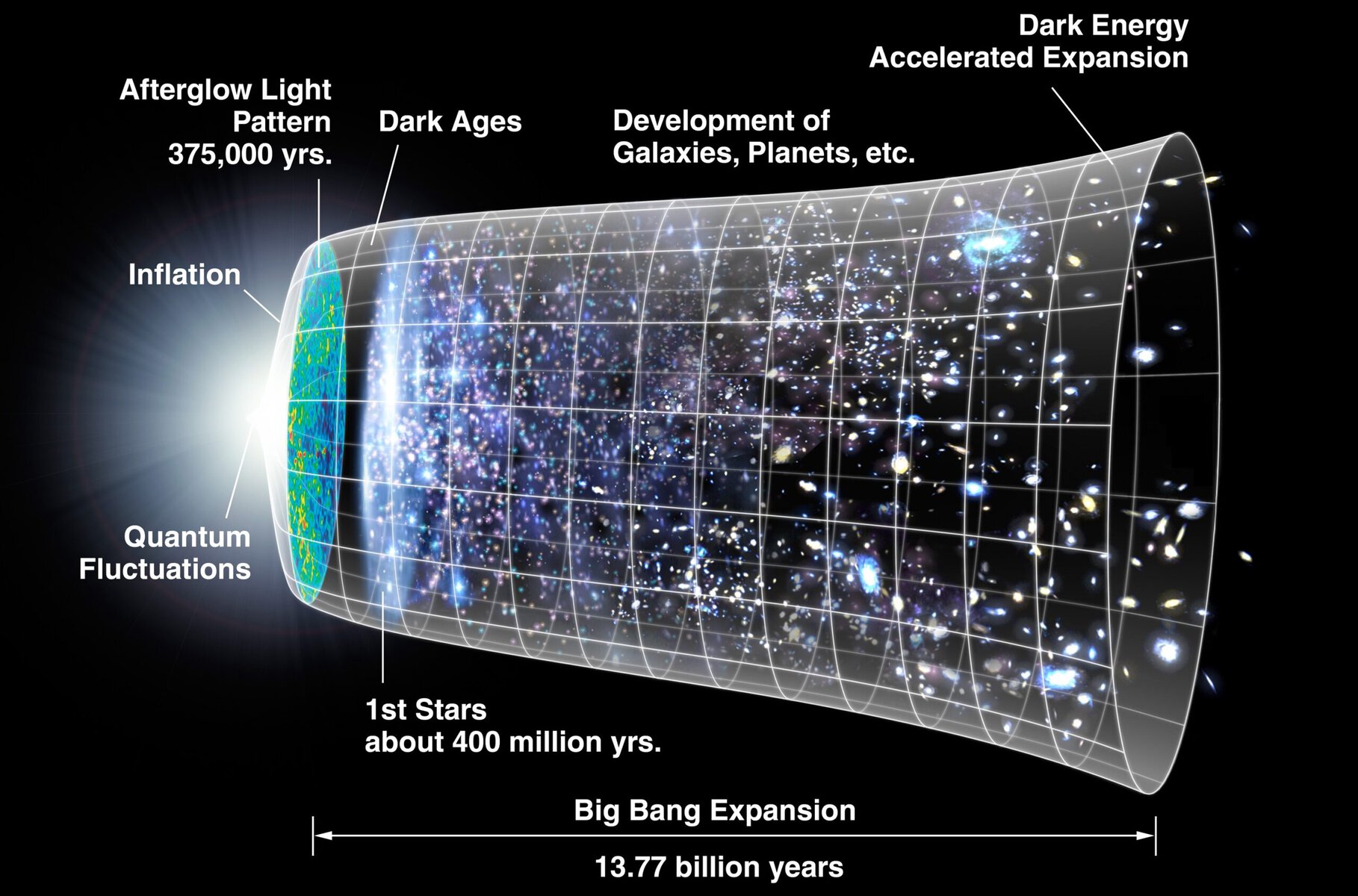
However, theoretical physics, especially Albert Einstein’s general theory of relativity published in 1916, and observations that galaxies were speeding away from each other, and faster the further they were away, strongly suggested the universe was expanding and if so, must have had a beginning — which, today, we call the Big Bang. The title was Big Bang was coined by Frank Hoyle, a well-respected physicist in his day who famously derided the whole idea of on BBC television.
In 2019, James Peebles, a theoretical physicist, won the Nobel Prize in 2019 for his “decisive discoveries about the universe’s origin and evolution,” a foundation which would shift the evolution of the universe “from speculation and religion to science” according to the Nobel committee.
Peebles was a thorough, imaginative scientist (and a Canadian by birth) who with others, suggested that if the universe began with something incredibly hot and energetic, later expansion of that universe would be accompanied by cooling, which once the temperature dropped to a few thousand degrees Celsius, would free photons of energy whose wavelengths would be stretched into the microwave range by continued expansion of the universe.
If the theoretical speculations of Peebles and his colleagues were right, traces of that microwave energy coming from all directions of the universe should be detectable to this day. The group also speculated that quantal variations in energy at the moment of the Big Bang would be reflected in variations in temperature and especially mass, the latter of which would be essential for gravity to shape mass into stars and galaxies and eventually life and us.
Enter Arno Penzias and Robert Wilson, two physicists working for Bell laboratories, who were puzzled by microwave radiation seemingly coming from every direction, for which they were unable to any identifiable cause, including their own equipment.
Frustrated, they were directed by colleagues to Peebles and others with the happy result that Penzias and Wilson won a Nobel Prize in 1978 for their discovery of cosmic microwave background radiation.
Evidence gathered with satellites confirmed the cosmic origin for that microwave radiation and led to another Nobel Prize, this one shared by John Mather and George Smoot in 2006, their discovery of the blackbody form and anisotropy of the cosmic background radiation.
This was followed by later evidence for dark matter and dark energy in the universe. The former is five times more common than ordinary matter and thought to play a huge role in the gravitational shaping of stars, galaxies and black holes. Dark energy is thought to play a key role in the accelerated expansion of the universe. Both are “dark” because they do not interact with the electromagnetic spectrum.
The collective studies were a masterpiece and led to the creation of a “standard” model for the universe’s origins which is probably incomplete but serves as a useful model for directing and interpreting observational studies gathered with telescopes such as the James Webb telescope and the recently commissioned Vera Robin telescope.
All of which work invites unresolved questions: What is dark matter? We don’t know and not for lack of trying. The same might be said for dark energy and given that taken together, dark matter plus dark energy make up 95 per cent of the universe, that’s a gaping hole in the standard model and our understanding of the universe.
What was present before the Big Bang?
One of the best books on the Big Bang, “The First Three Minutes” was written by Steven Weinberg, a Nobel laureate (1975) for his work on the standard model for particle physics.
The numbers are staggering. Quoting Weinberg, “At about 100th of a second after the Big Bang, the earliest time about which we have any confidence, the temperature of the universe was about 100,000 million (1011) degrees Centigrade, and the density of this cosmic soup was about 4,000 million (4×10⁹) times that of water.”
Given that the temperature and density would have been exponentially much greater at time zero, it’s impossible for me to believe that anything so incredibly energetic and dense could be stable, even for a second.
And if that’s true, the Big Bang must have started with the terminal collapse of all the energy and matter of an earlier universe to provide the energy and mass for our universe. My speculation of course, but consistent with the speculations of physicists like Roger Penrose who won a Nobel Prize in 2020.
Finally, among several reasons why I so enjoy Weinberg is that he, like Richard Feynman, another famous theoretical physicist, felt that the best way to learn something was to teach it and that’s precisely what both men did repeatedly with success throughout their careers and we in our way, try to convey through The Lake Report and various science series at the NOTL Public Library.
Dr. William Brown is a professor of neurology at McMaster University and co-founder of the InfoHealth series at the Niagara-on-the-Lake Public Library.