



AMADEUS
*** (out of five)
Festival Theatre, 2 hours, 35 minutes, one intermission. Ends Oct. 4. By Peter Shaffer. Directed by Tim Carroll.
In 1979, the renowned English playwright Peter Shaffer (1926-2016), created two of the most powerful theatrical experiences of our time: the stage play “Amadeus,” followed by the Academy-Award-winning film of the same name in 1984.
“Amadeus” is the story of the rivalry of two celebrated composers at the 18th-century Hapsburg court of the Holy Roman Emperor, Joseph II in Vienna. Those two men were Wolfgang Amadeus Mozart (1756-1791) and Antonio Salieri (1750-1825). Salieri represented the established Italian classical school of music whereas the Salzburg-born Mozart the newer German style.
This rivalry, in fact, was collegial, respectful and gracious, although Mozart was convinced that Salieri was obstructing his appointments and possibilities at court. As outwardly secure as Salieri seemed, inwardly he was deeply threatened by the genius of Mozart.
It was also a time of political and economic uncertainty. France defeated Austria in battle, the Turks were encroaching from the East, epidemics and smallpox raged and opera and music commissions were increasingly unavailable for lack of funds.
Mozart died at 35. The authorities said the cause was acute miliary fever, described as causing symptoms such as a high temperature, heavy sweating and an aggressive skin rash with blisters resembling millet seeds.
He was buried in a common grave, meaning for a commoner, not a communal grave. Only five men accompanied the coffin to the St. Marx Cemetery in Vienna. They were turned back by officials at the gates, supposedly due to a severe thunderstorm, but evidence has shown the day as pleasant. One of those men was Salieri.
Mozart’s death was mourned and many memorials took place during the following days. Salieri retreated to brood as rumours, once whispered, spread that Mozart had been poisoned because, in Mozart’s delirium, he had shouted out that he had been poisoned.
But if true, by whom? Was it Salieri? He subsequently suffered nervous breakdowns due to the rumours and with early dementia was confessing that he had destroyed Mozart.
Peter Shaffer was obsessed with Mozart’s music. Once he read Alexander Pushkin’s 1830 one-act play “Mozart and Salieri” and studied Nikolai Rimsky-Korsakov’s opera, “Mozart and Salieri,” based word-for-word on Pushkin’s tale, Shaffer grasped the idea of injustice, envy and revenge forming in Salieri’s mind.
But why against Mozart? They were ostensibly equals, successful in the royal courts, but Salieri was careful, prolific, priggish, a small-town boy, an orphan, from the Venetian Republic brought to Vienna by a mentor because of his musical promise.
Mozart had been a child prodigy, touring from the age of five with his father, Leopold, throughout the royal courts of Europe. He wrote his first symphony at eight, his first opera at 14. He certainly was not a buffoon, but he was pampered, excitable and infantile, with a coarse Bavarian humour. He loved punning, rhyming and telling dirty jokes.
For Salieri, why was this obnoxious creature given the gifts of genius by God?
Salieri’s quarrel is with God. He says that he “feels his emptiness as Adam felt his nakedness.” Mozart creates complete scores in his head and finds writing them down a tedious bore. Salieri rages that Mozart’s casual notes turn his own into mere scratches.
He bitterly thanks God, “Grazie,” for making him want to praise God, but then he is made mute in return. “Why?” “Why?” he shouts. He worked hard that he might hear God’s voice and the only voice he hears is “Mozart!” “Mozart.”
Salieri’s fury is within himself, a self-flagellation and recognition of Mozart’s genius, his spirit and inspiration.
At the end of the play, Mozart has been dead for 32 years. Salieri sits alone, spent, in his wheelchair, reminiscing with guilt that he was the grey-masked figure that haunted, threatened and terrified Mozart, leading to his creation of the “Requiem.”
He admits that he tried to destroy Mozart because of his fury with his own mediocrity. Near death, he addresses the audience as God, absolving us of our own mediocrities.
Did I leave this production feeling stunned by its power, its theatricality, its music, its message? No. I left feeling detached, that form had superseded content, that the visceral theatricality that Shaffer so brilliantly offers by his gifts of storytelling had been denied.
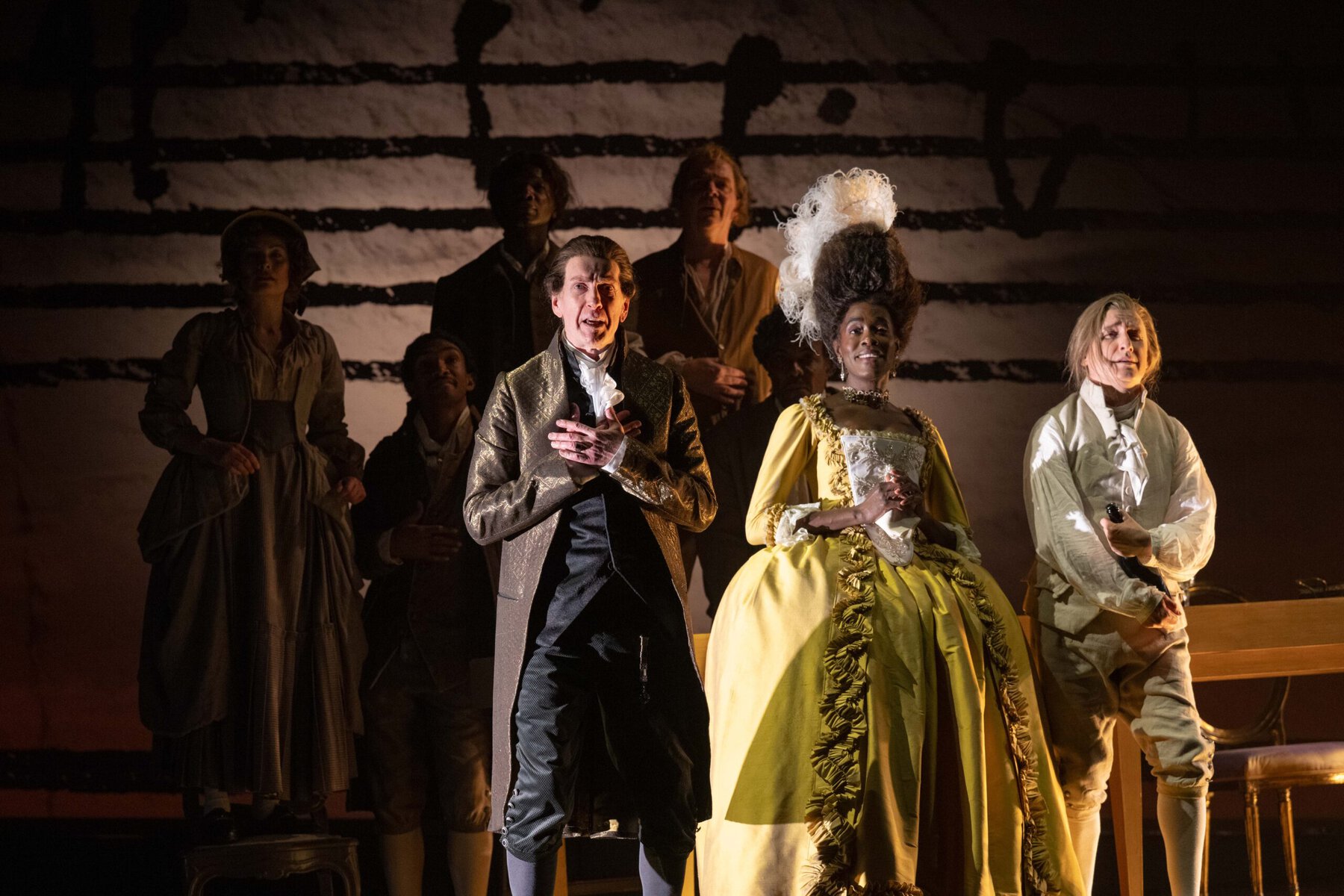
The set was minimal: a ramp, a wheelchair, a wooden table that became by turns a pianoforte and a coffin. Lighting was very effective especially when the court figures were silhouetted against a backlit screen. The costumes were sumptuous. The music far less apparent than desired.
The choreography was excellent. Julia Course and Sochi Fried were outstanding as the Venticelli rumourmongers. Graeme Somerville was every inch the most powerful monarch of Europe moving calmly, but authoritatively, demanding less complexity, fewer notes and giving a one liner that settled all discussion, “Well, there it is.” Allan Louis gave a strong performance as Baron Orsini-Rosenberg, an officious senior courtier determined to prevent Mozart’s upward trajectory at court.
Kristi Frank as Constanze, Mozart’s wife, achieved a fine balance of girlish fun in romping, laughing, scolding and wordplay with her husband. Her grief at the end was less raw than expected but she was a shrewd businesswoman who ably became the guardian of Mozart’s legacy after his death.
Michael Therriault as Mozart was more contained than the “potty-mouthed,” whinnying giggler of the film, refreshingly revealing a more ambitious, determined and sensitive man.
Tom Rooney as Salieri was curiously flat, more monotone and emotionally withholding, a more cerebral approach, presumably the choice of the director, Tim Carroll. Perhaps it was a choice to make Salieri less of a blackguard and more human, but it left a void, a disconnect, an ambivalence.
Penny-Lynn Cookson is an arts and culture historian, writer and lecturer living in Niagara-on-the-Lake.