



Benny Marotta’s latest plan for the Rand Estate received a frosty reception Tuesday night, as not one public speaker backed his proposal to build a five-storey hotel on the historic site.
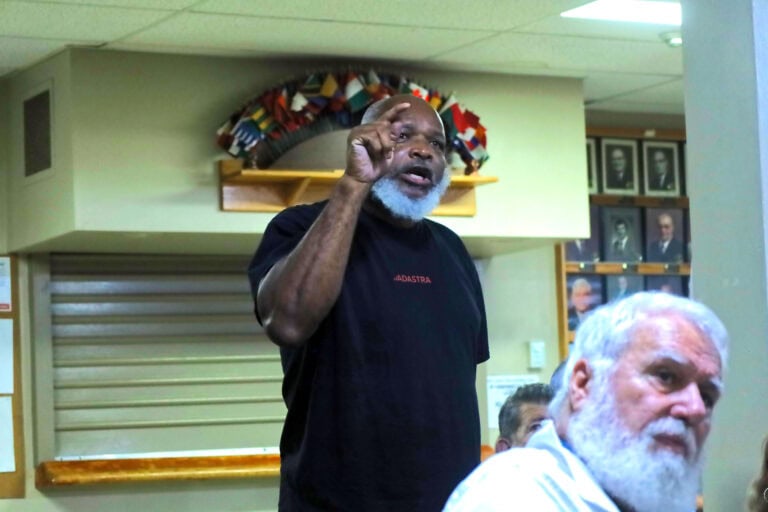
For almost three hours, residents, neighbours, lawyers, planners, engineers, business owners and heritage advocates packed council chambers to oppose the plan, arguing it would fundamentally change Niagara-on-the-Lake’s Old Town and revive a development fight many thought had already been settled by the Ontario Land Tribunal.
The proposal would allow a five-storey hotel with 111 rooms, a spa and commercial uses, five three-storey residential buildings with up to 270 units, underground parking, a stormwater management pond and a sewage pumping station.
The applications, submitted by Two Sisters Resorts Corp. and Solmar (Niagara 2) Inc., cover 144, 176 and 200 John St. E. and 588 Charlotte St., collectively known as the Rand Estate.
Not counting town staff or the applicant’s representatives, 22 public speakers addressed council.
Members of advocacy group Save Our Rand Estate were there, backed by lawyers and planning, transportation, forestry, civil engineering and drainage consultants retained by the group.
Heritage advocates, business owners, neighbours and nearby residents also took the microphone, adding to the opposition.
The turnout was large enough to set up an overflow viewing room in the basement of town hall.
Coun. Gary Burroughs told The Lake Report it was not the most speakers he had seen speak at a public meeting, but that it “ranks up there.”
Before hearing from the public, council voted against a motion to double speaking times from five minutes to 10 minutes. Several councillors argued it would be unfair to those who had already prepared for the five-minute limit.
Staff will now continue reviewing the application and public feedback before bringing a recommendation report back to council at a later date.
Access road remains key fight
Much of the debate centred on whether the proposal respects a 2024 tribunal decision that sent the applicant’s previous proposal back to the drawing board because of concerns raised about protecting the estate’s heritage and using the 200 John St. E. panhandle.
Solmar planner Paul Lowes said the plan for the site has changed since the earlier application.
He said the hotel has been pushed back, the Rand main residence would be reused as a spa, Devonian House would become a restaurant and the Whistle Stop and Bath Pavilion would be restored.
Lowes said all access options had “impacts on heritage attributes.”
“The most preferred was the access that we’re providing now,” he said.
But several speakers said the panhandle remains the issue.
David Nelligan, a lawyer representing Blair and Brenda McArthur, whose McArthur Estate property at 210 John St. E. borders the proposed development, said the tribunal “outright refused the panhandle.”
“Yet, the application has ignored its clear direction and returned to you with a road that is effectively the same and effectively in the same place,” Nelligan said.
Kathryn Podrebarac said the tribunal gave Solmar “an opportunity to return with a compliant proposal,” not a blank slate.
“The taxpayer dollars that the town spent prevailing at the tribunal were spent on the premise that a binding decision means something,” she said. “If this application is approved, these dollars were wasted.”
A transportation consultant retained by the McArthurs, David Argue, said the applicant should be studying how all vehicles will move through the estate — hotel guests, residents, emergency vehicles and deliveries — before deciding which access points should be used.
Resident Brian Lewis added that he believes the proposed access road is also too narrow for the amount of traffic expected to use it.
Speakers ask what NOTL is becoming
Many said the proposal raises a bigger question about what kind of town NOTL wants to be.
Sonia Gionet, who owns and operates a bed and breakfast in Old Town, said visitors do not come here looking for large-scale urban-style development.
“It’s not going to be beneficial for anybody that lives in town, only for the person that’s building it,” added Brenda McArthur.
Architect Michael McClelland said the proposal would remove heritage landscape features, including the estate’s pool garden, which he described as “very carefully organized.”
“Not just the pool itself, it’s the garden around it,” he said.
Anne McIlroy, principal of Brook McIlroy, said Solmar’s plan is larger than the 2011 Romance Inn proposal. That proposal would have brought a 106-room hotel, spa and restaurant to the site and also drew concerns about scale.
Neighbour Sally Miller said part of the estate’s historic boxwood hedge was removed and the remaining hedge has been tied up and left unable to thrive. She also said trees on the Solmar property are “suddenly falling down.”
“My trees are up,” she said. “The (boxwood hedge) is completely dead.”
“I don’t know if it’s diseased, but I think it’s by design,” Miller said.
Gracia Janes urged council to protect the estate, calling it “a wonderful example of current provincial descriptions of cultural heritage landscapes.”
Vaughn Goettler also urged council to reject the proposal.
“Is this what we want in our beautiful town?” he asked.
Promises and protections questioned
Speakers also questioned the weight given to the town’s planning policies, the enforceability of heritage preservation protections and the certainty of the proposed Ritz-Carlton partnership.
Blake Lyon, chief executive officer of Two Sisters Resorts and Solmar, told council he first approached Marriott more than a year ago about the possibility of a Ritz-Carlton on the site.
Lyon said Marriott has provided verbal conditional approval, written confirmation regarding the facilities program and a confidential term sheet.
Marriott was not present at the meeting and did not respond to The Lake Report’s questions about its involvement with the proposed Rand Estate hotel by press time.
Peter Rand, who has no relation to the Rand family despite sharing a last name with the estate, raised a pointed concern to council: how would the town enforce preservation conditions in the event that they are not followed during development?
“I have observed that stop work orders have been inadequate impact,” Rand added.
He said the town should turn down the application “until it can find adequate means of enforcing its conditions and its bylaws.”
For Steve McGuinness, the proposal does not offer enough public value to justify setting aside the town’s official plan, he said.
“In fact, it may have less merit than previous proposals.”
McGuinness said the plan increased the numbers, whether that be of hotel rooms, maximum building heights or commercial-zone density.
“Around every corner, the envelope is stretched,” he said. “If you pack an envelope too tightly, it is bound to burst at the seams.”