




The subject of this essay wasn’t a question in 1900. What was known then about the universe was confined to that part of the Milky Way closest to us and, moreover, was a stable, predictable affair.
Stable enough to navigate open oceans by sighting certain stars, a form of navigation probably used in some form by migrant humans many thousands of years ago and in more precise form by ships and later by aircraft, crossing the vast open seas of the Pacific Ocean as late as the Second World War and thereafter until inertial guidance systems, loran and satellite-based tools such as GPS came along.
However, with the discovery by Erwin Hubble in the late 1920s of separate clusters (referred to as nebulas or these days galaxies) of stars too far away to be part of the Milky Way, came the realization that the universe was very much larger than previously imagined.
Hubble’s studies also showed, using the Doppler effect, that those galaxies were speeding away from one another, faster, the farther away they were. Hubble initially resisted the suggestion that the reason galaxies were moving away from one another was they were being carried by an expanding universe.
Earlier, Alexander Friedman used Albert Einstein’s newly developed (1915) theory of general relativity to formulate a mathematical theory for the expanding universe first in 1922 and again in 1924. Later, Georges Lemaitre, a Belgium priest and physicist, rediscovered Friedman’s theory and added the all-important concept that the universe may have started with what he called a “primaeval atom” 1927.
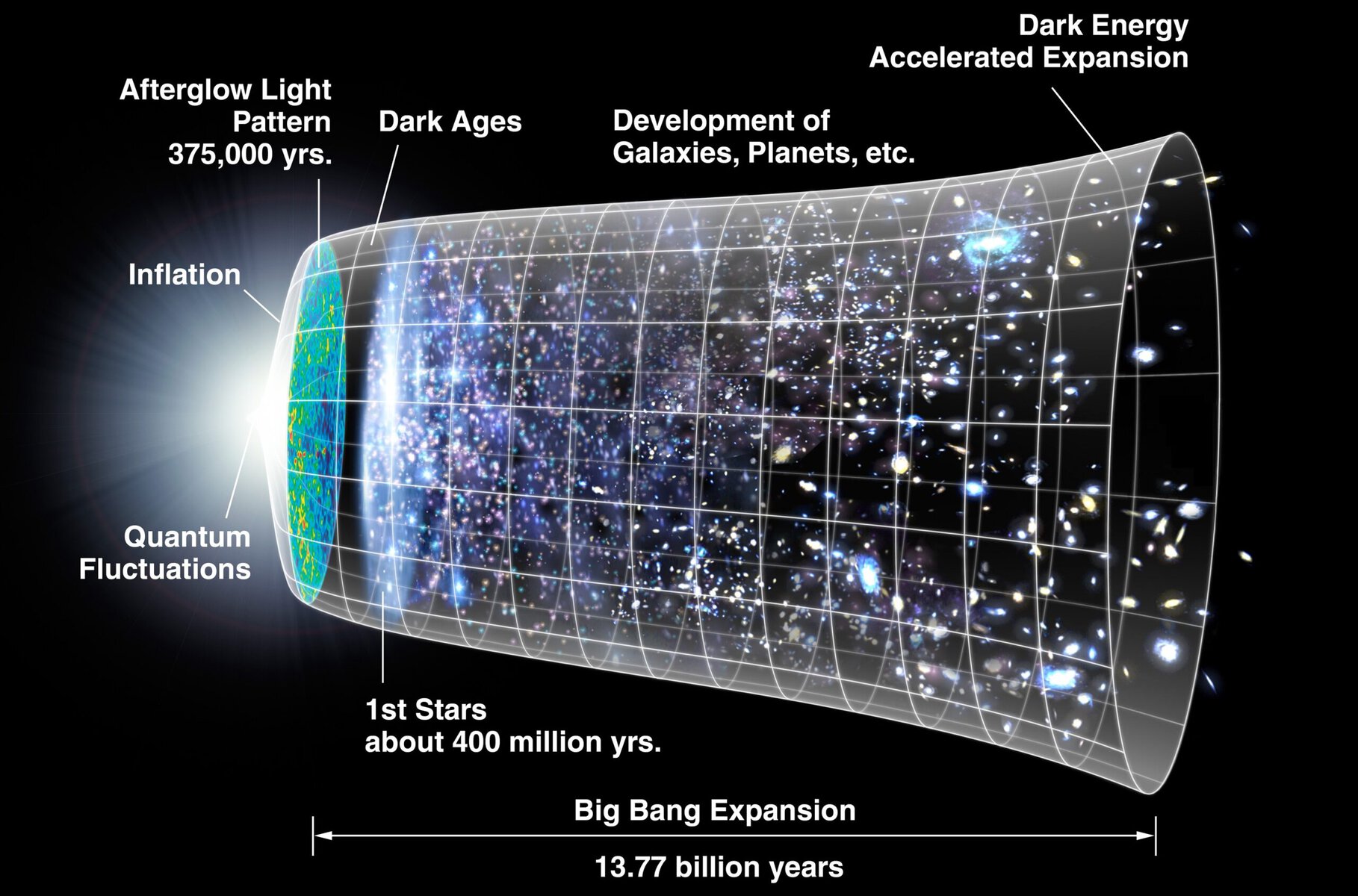
The theoretical and observational evidence that the universe was not only expanding but might have been very much smaller and energetic led to the theory that the universe began with something extraordinarily small and hot, which, for reasons yet unknown, suddenly expanded creating a very hot plasma soup of elementary charged particles trapping photons of light in the soup.
The universe continued to expand and cool to a time roughly a third of a billion years later, when the universe had cooled enough for opposite charges to link up forming hydrogen, helium and a bit of lithium atoms, which freed up photons to escape and, for a while, literally light up the universe.
Continued expansion of the universe stretched the remaining dispersed heat energy eventually into the microwave range with temperatures just a few degrees above absolute zero.
All this theoretical speculation came to a head with solid evidence — as theoretically predicted by James Pebbles and his colleagues: cosmic radiation in the microwave range was found by Penzias and Wilson. The collective work led to three separate Nobel Prizes, first to Penzias and Wilson, (1978) then for confirming satellite evidence for the cosmic radiation my Mather and Smoot (2006) and finally to Peebles for his theoretical work on the cosmic radiation and dark energy (2019).
This masterful body of research both theoretical and observational in cosmology was capped by the theoretical predication and then observational support for minute variations in the density of matter, without which gravitational clumping to form stars and galaxies would been impossible from the outset.
Except for a very brief period of very rapid inflationary expansion the universe was assumed to expand at a constant rate, as inferred by the name “Hubble constant.” As Pebbles pointed out, the expansile force equaled the cosmological factor Einstein had introduced into his equations to restore stability to the universe, only for him to withdraw the constant when he realized the evidence for an expanding universe was overwhelming.
However, the 2006 Nobel Prize in physics to Saul Perlmutter, Brian P. Schmidt and Adam G. Riess suggested the universe is accelerating. Which led to the stunning theoretical suggestion that the universe might be made up of dark energy (69 percent), responsible for accelerating the expansion of the universe, dark matter (26 per cent) and ordinary matter — the kind we’re familiar with making up a paltry five per cent of the total.
Dark energy and dark matter are “dark” because they don’t interact with the electromagnetic spectrum — we can see their effects but not the dark energy or dark matter. That’s poses a real problem for physics because it suggests that 95 per cent of the universe is a mystery.
That mystery is one of the reasons why so much time on the James Webb Space Telescope and the new Vera Rubin Telescope is committed to sorting out what’s what when it comes to measuring the rate of expansion of the universe — is expansion the same everywhere and for all times in the universe or are there variabilities and if so, why?
The implications are dramatic. An accelerating expansion of the universe without any obvious cosmic brakes, except possibly giant black holes, is a universe whose matter is so dispersed that stars can’t form, with the result that the universe eventually goes dark and cold with no place for life.
Those questions won’t be answered in my lifetime but perhaps in my children’s time, although funding these days for expensive ventures like telescopes is shrinking fast.
However, whatever the mysteries of dark matter and energy, we’ve made incredible progress in the last century and a quarter and a huge achievement for our species.
Dr. William Brown is a professor of neurology at McMaster University and co-founder of the InfoHealth series at the Niagara-on-the-Lake Public Library.