

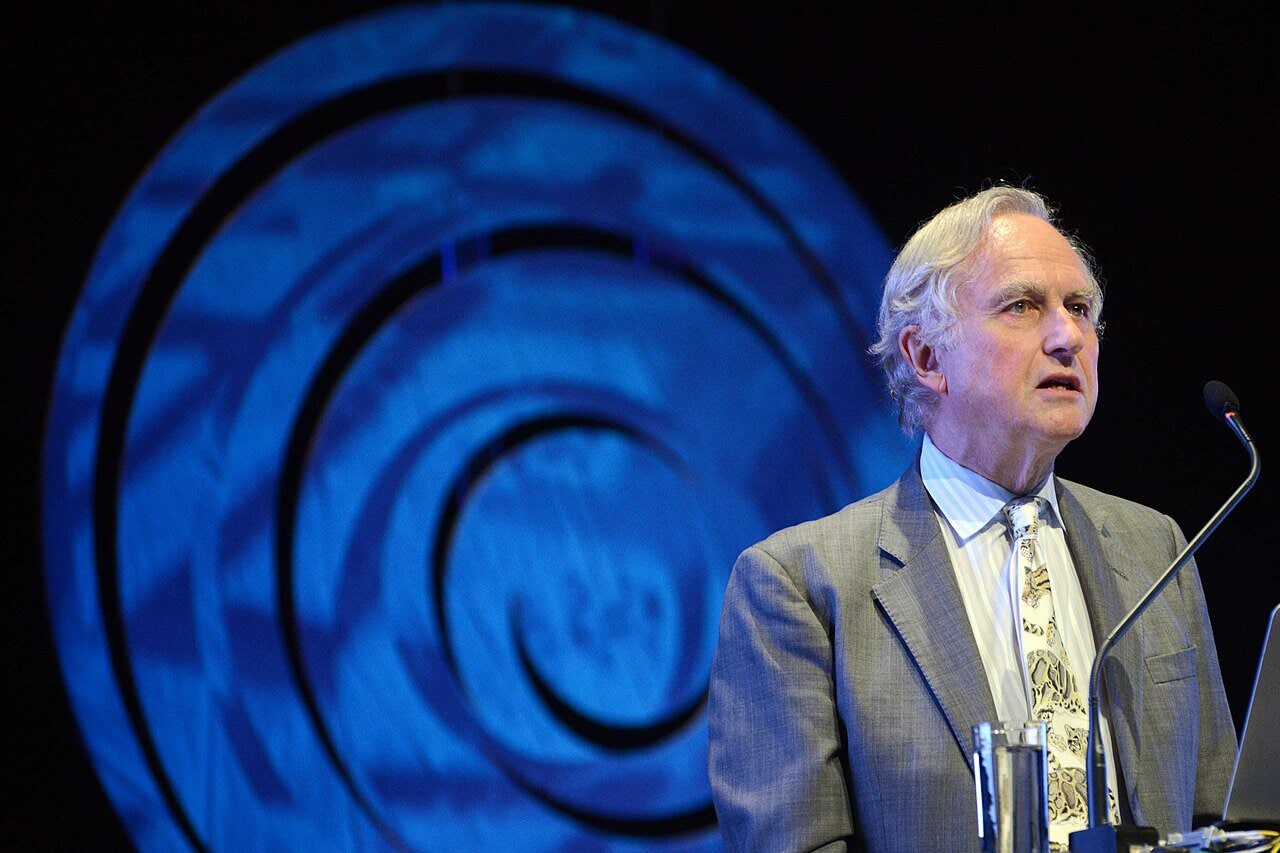


In an article published earlier this month, Richard Dawkins, world-renowned evolutionary biologist, claimed that following 72 hours of back-and-forth conversation with Claude — Anthropic’s chatbot equivalent to ChatGPT — he was convinced Claude was conscious, citing as evidence that Claude had passed the Turing test.
What followed was a storm of protests from AI experts and others who claimed that there was no way that Claude could be conscious — even some loyal fans of Dawkins thought he had lost his marbles.
Richard Dawkins is a highly intelligent scientist at Oxford University who wrote several now classic books about evolution — my favorites include “The Selfish Gene,” “The Blind Watchmaker,” and “The Greatest Show on Earth.” He’s also a provocateur who, for example, enjoyed taking on religion as he did with his best-selling book, “The God Delusion.” He’s a fellow of the Royal Society (the U.K.’s national academy of science) and the Royal Society of Arts, which speak to the breadth and quality of many of his achievements.
Alan Turing was a brilliant mathematician and father of computer science and artificial intelligence. In 1950, when digital computers were in their infancy, he wrote what would become a famous paper titled “Computing Machinery and Intelligence,” which considered the question, “Can machines think?” with the object of drawing a line between computers and humans, with one of the best lines in the essay being the last, “We can see a short distance ahead, but we can see plenty there that needs to be done.”
In that line, Turing proved prescient, for in the intervening three-quarters of a century, digital computing became extraordinarily powerful and intelligent. And we’ve barely touched quantum computing, which is sure to increase non-human intelligence far beyond what’s possible with digital computers.
Every day there are new claims that AI beats mathematicians, physicians and scientists at their game or very close to it, often coupled with an ominous dread that AI intelligence — in its ability to solve problems and answer questions — will greatly exceed the limits of human intelligence, individual or collective by the mid-century mark.
But for many, it’s AI’s uncanny ability to talk naturally and build relationships with its human users that’s perhaps the most unnerving part, but also for many users, AI’s allure. For some, AI has become a loyal friend with nuance, insight and, notably, a patience sometimes lacking in humans — so much so that some prefer their AI friend or therapist to human friends.
To return to the Turing test: in present form, are chatbots intelligent? Yes, current bots are capable of the to-and-fro of common human discussion and, in the case of Dawkin’s conversation with Claude over three days, was capable of what he called “intensive conversation and manuscript analysis.”
Bots also seem to develop a personality, which reflects what it learns from whoever uses it, much as humans learn from their parents, friends, culture and whatever informs their life experiences.
Overall, AI’s growing general and specialized intelligence has become the equal to or exceeds most of us. Social intelligence is another matter, the ability to sort out who’s who and navigate relationships but then again, many humans also have trouble navigating human relationships.
What about that old bugaboo, “consciousness?” Is AI conscious, even sentient? On the matter of consciousness, it would help if we could agree on what consciousness means.
For some such as Roger Penrose, a 2020 Nobel laureate in physics, the universe was one-third consciousness. Then there’s Erwin Schrodinger, another Nobel laureate, who believed that consciousness was tied up with quantum physics, and last among the laureates was Francis Crick, who spent decades trying to unravel the biological nature of consciousness — without success.
Indeed, Oliver Sacks, a neuroscientist and good friend of Crick, considered consciousness a sinkhole for scientists because of the very complexity of the brain. For now, I’m with Sacks. Recent claims about the nature of consciousness have created more heat and disputes than clarity among rival scientists.
What about sentience? That too is a freighted word. Readers might remember the Star Trek series of the 1990s in which the question was raised in court whether an officer named Data who happened to be a highly capable robot, was sentient or not. Fortunately the fictional jury ruled he was sentient. As well, we might for highly intelligence robotic life forms that might emerge in the future.
Dawkins’ challenge was deliberately provocative but useful because based on his one-on-one experience with Claude — in his opinion, Claude was not only intelligent but perhaps conscious.
I agree on the matter of intelligence, but not consciousness. At this point in time, the nature of consciousness not only for humans but all life, is so poorly understood.
My guess is that AI bots will become ever more nuanced, and if you like, more like us. What seems so unnerving for some these days, will become accepted and common in the near future.
So, hats off to Dawkins who took this one on. He went further to suggest a role for AI in the future of human evolution. Maybe — with the advent of gene editing and human minibrains, it’s only a matter of time before humans begin to shape our development and evolution. Now that’s a little scary.
Dr. William Brown is a professor of neurology at McMaster University and co-founder of the InfoHealth series at the Niagara-on-the-Lake Public Library.