


With daytime temperatures sometimes hovering well below zero some days, it’s hard to imagine how local squirrels, birds, raccoons and coyotes manage to survive without shelter.
Based on footprints in the snow, several raccoons and perhaps a ground hog shelter under my snow covered back deck.
And as with springs before, new offspring will soon emerge — a testament to survival of the group, if not all family members.
Most survive by finding just enough shelter, shared body heat and food to get by, and for some species like bears, even slowing down their metabolism.
One of my favorite books is “Cro-Magnon,” written by Brian Fagan, professor emeritus of anthropology at the University of California. Here he imagines a group of modern humans huddled together in midwinter a long time ago.
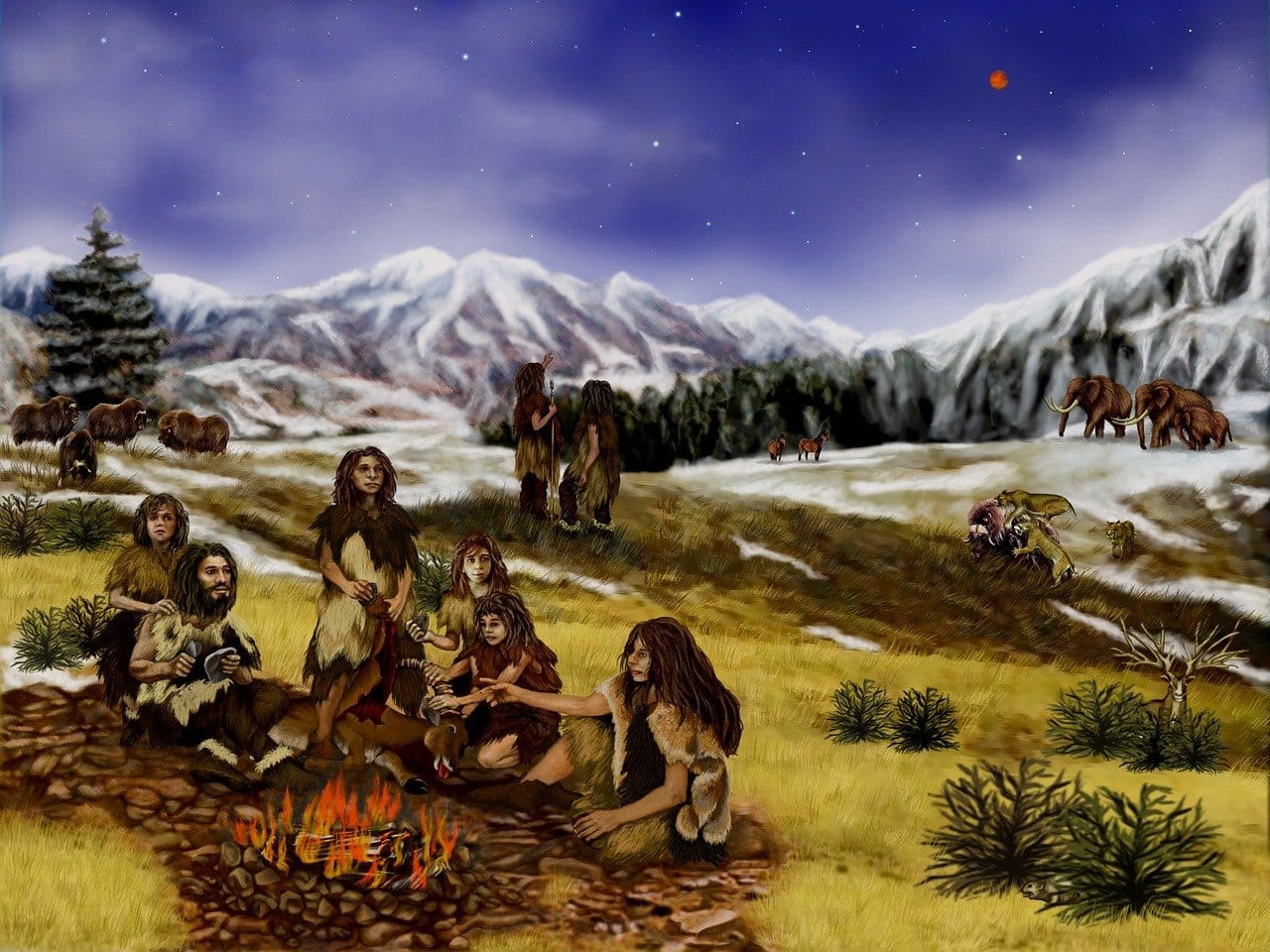
“Czech Republic, midwinter, 35,000 years ago, huddled together around a blazing hearth under a rock shelter’s over-hang; the band is swathed in furs inside the hide-tent pitched against the back wall. Children snuggle up against their parents. Outside the temperature is well below zero. Inside it’s just above freezing, but smoke hovers near the smoke hole high overhead. Most of the small band are young, the older ones in their early 20s.”
He continues: “One man stands out, his weathered face visible under his parka hood. He is older; one arm stiff from a hunting accident long ago and his expression conveys the wisdom of years. He is a storyteller, a mentor for the band. He tells of the ancient days when the world came into being, created by intelligent common place animals. In time, these animals fashioned not only rocks and valleys, rivers and forest, but also human beings, men and women. The elder speaks for hours, his voice rising and falling as he pauses for emphasis, gestures dramatically or describes the character of a human or an animal.”
In those two paragraphs, Fagan, an experienced anthropologist, imagines what life might have been like for small bands of modern humans in the dead of winter. It was clearly very cold, but everyone was well-dressed, huddled together and mesmerized by a shaman holding forth with their shared creation story.
One thing made survival possible: fire.
This brings up the question of when and how humans and our ancestors created and controlled fire on demand.
There’s no shortage of YouTube videos on how to survive in the outdoors in the winter, which involve creating shelters from whatever’s nearby such as branches or whole trees and a fire to keep them warm, dry their clothes and cook their food.
But however tough it looks, most outdoors experts bring a saw, axe and large, well-honed knives with them, as well as matches or a lighter to start a fire.
A meticulous study from December last year of how neanderthals controlled fire as early as 400,000 years ago in east England was reported in Nature. What the investigators discovered was a site where fires had been created on demand by striking flint with pyrite (also called fool’s gold) to generate sparks and thus ignite wood.
This gave them mastery over fire and the means to stay warm and cook their food. The reason for choosing the site was a nearby watering hole that attracted game, a real plus and reason enough for neanderthals to occupy the site off and on over many generations.
The ability to create fire on demand was a huge evolutionary step, because cooking breaks down meat and other foodstuffs, making them easier to digest and extract more dietary benefits from their food.
Sitting around a fire is also a social activity, not doubt prompting story-telling as Fagan imagined in his account. Fire is also a good way to keep predators at bay, a real plus with the likes of cave bears and lions around and even sharing the same cave.
If controlled fire was a huge plus for neanderthals 400,000 years ago, how far back does controlled fire go?
There’s some evidence that homo erectus, a million years ago or more, used fire, but prompts the question: how?
Pyrite, though a common enough mineral worldwide, was not common at the site studied but was probably transported — perhaps traded from the nearest site 40 miles away.
One hypothesis suggests that early hominins such as erectus didn’t create fire but took advantage of fires generated by lightning. That makes no sense to me.
Sure, it’s possible that some early hominins took advantage of natural fires to create their own and kept the latter going by adding flammable material, but lightning as a source of fire, any place I’ve been, is rare.
Hominins needed a way of generating fire on demand, if not by striking flint with pyrite as many aboriginal groups do, then by rubbing sticks together to create enough friction to trigger a fire. Even YouTube illustrates that method.
But nix to the idea of lightning as a source, although lightning is a common way of triggering forest fires under dry conditions.
On another note, Fagan’s second paragraph describes what he sometimes witnessed in his travels through Africa: shamans enthralling audiences with creation stories.
Dr. William Brown is a professor of neurology at McMaster University and co-founder of the InfoHealth series at the Niagara-on-the-Lake Public Library.