
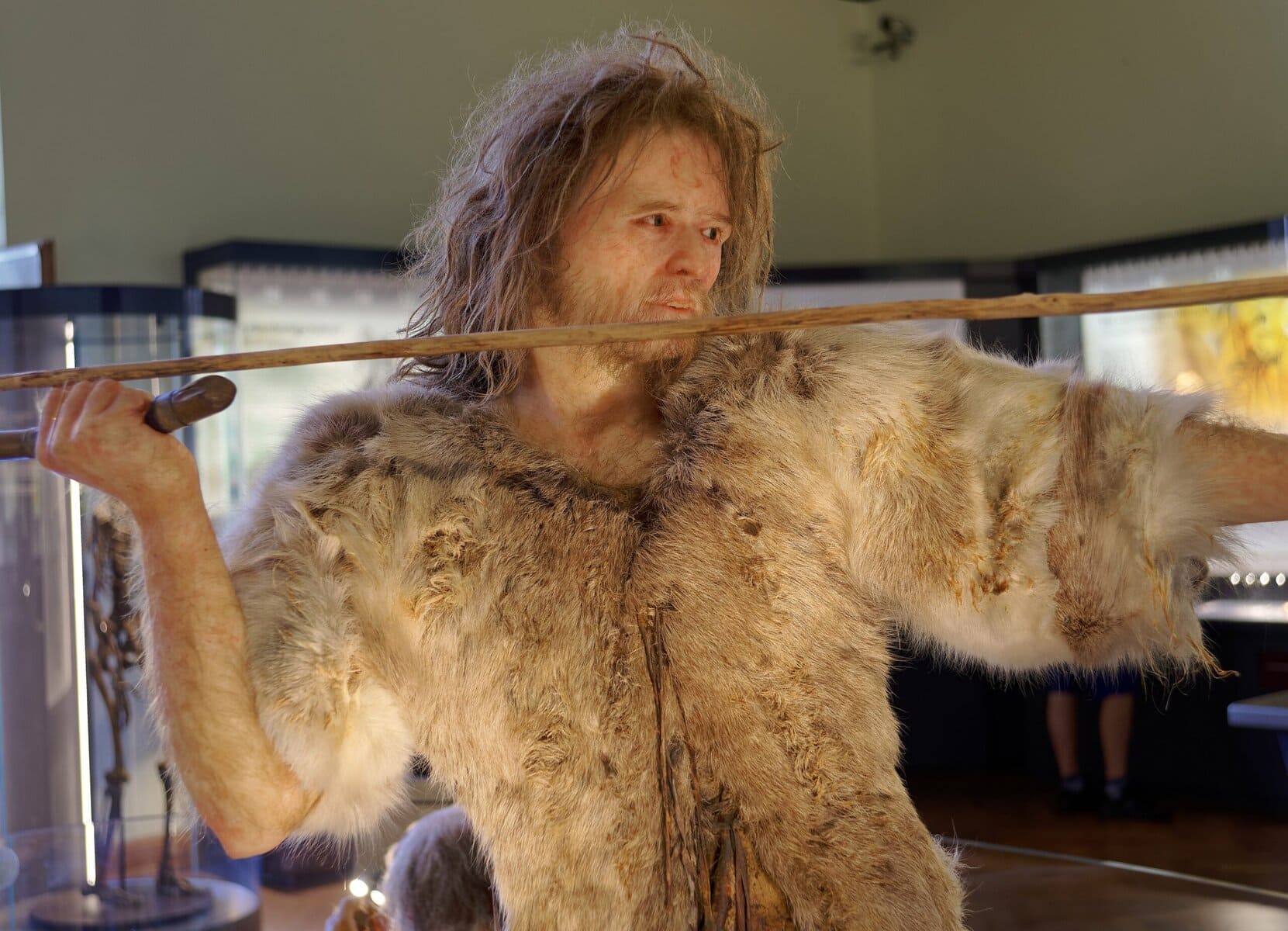


For almost a century following the discovery of neanderthals, controversy surrounded them. Were they related to us? How clever were they?
Because of their heavy-boned features, most anthropologists of the day and the public concluded they were dimwitted brutes, distantly related, if at all, to humans.
In recent decades, several discoveries combined to debunk those belittling conclusions, such as the discovery of flutes and cave art created by neanderthals long before modern humans in Western Europe.
These and other related findings, and evidence that genetically speaking, neanderthals and their cousin species the denisovans, were both closely related to modern humans, strongly suggest that the cognitive powers of our cousin species were probably similar to modern humans.
And if that is true, how far back does evidence of human-like cognition go?
Apparently, a long way.
For example, there is solid evidence that 400,000 years ago in east England, neanderthals or a predecessor species, were fully capable of creating and controlling fire with all the warmth, social and nutritive benefits that would have accrued to those groups.
Going further, it’s not hard to imagine that some form of symbolic language and story-telling might have been fostered by those fires.
There’s also evidence that humans mortised wood in Africa — perhaps to create shelters, 500,000 years ago — long before neanderthals.
Sophisticated tools created from stone, ivory, bone and wood have all been identified going back at least 500,000 years. That’s a long time ago but as one anthropologist put it, “The oldest record for any development is often temporary,” suggesting that any precisely dated artifact is just that — it doesn’t exclude earlier dates.
One example of which was the discovery of a human hand print 67,000 years old on a cave wall in Indonesia all but hidden by artwork created 20,000 years earlier, a study of which was published in Nature in January.
Which suggests that well-developed social cognition, imagination, creativity, symbolic oral language, a sense for the spirit world, forward planning, reasoning might have preceded the advent of modern humans and perhaps, even our cousin species.
Colonizing Europeans often encountered what they considered primitive peoples in Africa, the Americas, southeast Asia and Australia. One obvious example of which were the discoveries by Europeans of many previously undiscovered tribes in the interior of Papua New Guinea living what their discovers considered stone-age existences.
Yet, within a few generations, those so-called “primitives” mastered European languages, cultures and technologies — proving their brains were every bit as capable of as those who discovered them.
The same mistake was made over and over again when and wherever Europeans encountered native in new worlds for the Europeans.
That’s the dilemma, isn’t it; how can the cognitive powers of ancient peoples be assessed when there’s little go-on in the form of artifacts such as tools or art that, by our standards, would suggest cognitive powers matching or close to our own?
It’s all too easy to forget that almost everything we wear, and use is created by other humans — not us.
The technological revolution closely paralleled the exponential increase in the world’s human population beginning roughly 10,000 years ago, which allowed humans to specialize while outsourcing other tasks to others.
That was certainly the case with science writ broadly, in which discoveries and inventions has dramatically increased in the last 200 years, and especially last 100 years.
Most advances were collective achievements of humans who diversified their interests and skills while depending on others to meet other needs.
For most of human history, the population of modern humans, or for that matter pre-humans, was tiny — tops one million and only began to climb steeply approximately 10,000 years ago.
This means that for 95 per cent of the history of modern humans, they were widely scattered and lived in small overnight groups with few tools and weapons to call on and when small advances in the fabrication of shelters, materials, tools and weapons were made, they probably weren’t widely shared, if only because there weren’t many neighbors.
Advances in technology of major importance, would require settling down, and specializing.
My guess is that like the tribes in New Guinea I alluded to above, many of those early human and pre-human species were far more clever than many of the artifacts they left behind might suggest and applied much of their cleverness to surviving sometimes harsh environments.
What technological advances took place such as building shelters and fashioning tools were purpose-built for survival.
Looking at the fossil record and artifacts they left behind, they probably possessed brains as capable as ours or nearly so, perhaps as early as half a million years ago.
Imagine how we might manage if a major disaster struck which separated us from all that we depend on day-to-day to survive.
We might manage a few weeks, perhaps a few months with stores at hand, but probably not much longer because unlike our ancient ancestors, we have none of the daily survival skills they possessed to survive in their time.
Dr. William Brown is a professor of neurology at McMaster University and co-founder of the InfoHealth series at the Niagara-on-the-Lake Public Library.