
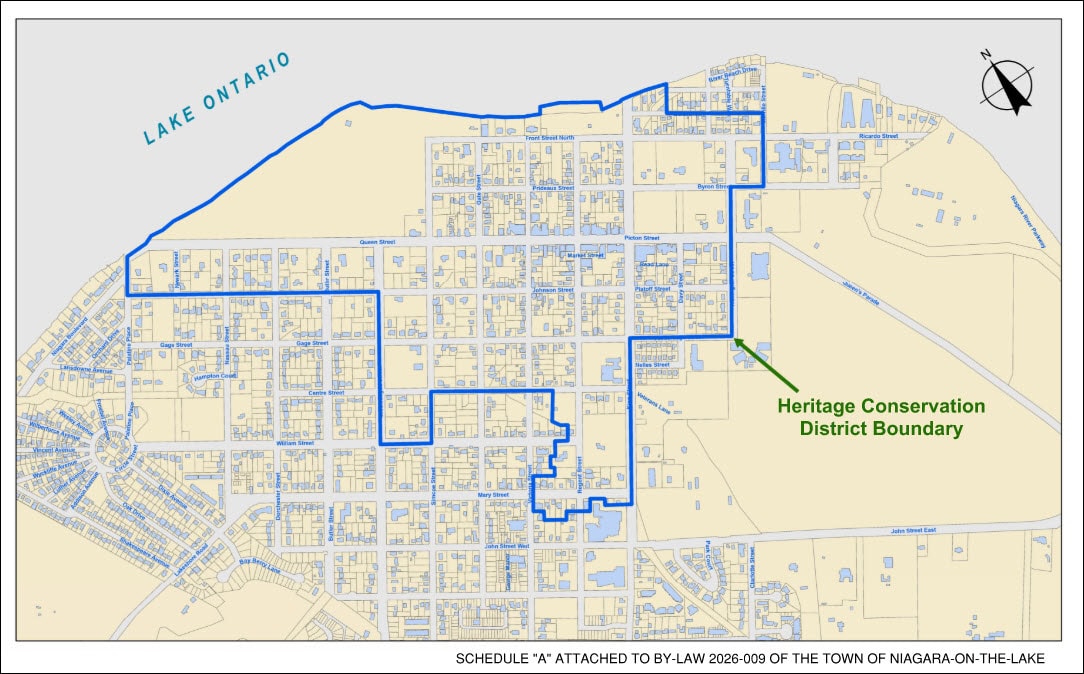


After nearly two years of study, research and work by the consultancy firm Cultural Spaces (along with many volunteers and town staff), in February, Niagara-on-the-Lake’s town council voted to approve a new expanded heritage district in Old Town.
Bluntly, this action should have been taken 30 years ago and failure to do so by many previous council has resulted in the gradual erosion of Old Town’s historic fabric.
But, better late than never — I applaud the current council for its action to protect NOTL’s irreplaceable heritage assets.
However, as outlined in Debra Rowe’s letter to the editor published in the Feb. 26 edition of The Lake Report (“Letter: We need clarity around heritage designations“), for those who live in and/or own property within the boundaries of the new district, confusion abounds vis-à-vis how this will impact them in the go-forward.
As a broad general statement, if you own a Part IV individually designated property, I’m sure you already understand the rules of engagement regarding the stewardship of your heritage asset, however, the new heritage conservation district boundaries have introduced a whole new cadre of owners into a new and unknown paradigm …
So, let’s see if we can navigate the new heritage conservation district plan (and guidelines) in usable terms.
Off the top, you can find the heritage conservation district plan by going to the Town of NOTL’s website, notl.com, searching “Old Town Heritage Conservation District Plan” in the search bar and clicking the link “Phase 2: Plan Report.”
Now, if your property is within the new boundaries, it may be either “contributing” or “non-contributing” — there are different policies for each, with the latter being notably more flexible — and the simplest way to identify your classification is by going to appendix E in the plan and looking up your address.
If your property is included on this list, you own a “contributing” property and, if not, it is “non-contributing.”
Of the 533 properties located within the boundaries of the district, 255 were found to be “contributing,” which the authors of the study defined as a property that “add(s) to the overall cultural heritage values, character, and integrity of the district, and also possess(es) architectural merit and design value in themselves.”
But, for simplicity purposes, as a rule of thumb, the study suggests that if your property was constructed prior to 1915, illustrates an architectural style of the period and has maintained its historic integrity or is one of a group of historic buildings, chances are that it will likely be “contributing.”
Contributing or not, if you are in the new district and want to do work on the property, you will need to contact one of the town’s heritage planners in order to review your proposed plans with them and apply for the necessary permission to proceed.
Just as a point of reference, there have not been (to date) any fees associated with this process — it’s free — and has been conducted on a pretty efficient timeline.
Still, I can hear the question now: “If I own a non-contributing property, why is it necessary to add this extra step into the permitting system?”
There are a number of reasons explained in section 7, “Policies and Guidelines for Non-contributing Properties,” of the plan, but these really boil down to ensuring that any changes to a given property do not adversely impact the established character of the streetscapes or adjacent contributing properties.
We have seen this occur far too many times, when alterations to an existing building or, often more egregiously, when the design of new infill construction disrupts a historic streetscape and is a detriment to neighbouring characterful properties.
Yep, sigh of relief: if the plan is followed and enforced, there should be no fear of having an inappropriately designed monster McMansion squeezed into the lot next door.
In this columnist’s opinion, introducing this extra step into the permitting system for non-contributing properties is well worth the preservation of Old Town’s historic streetscapes and character — your property values will thank you for it.
In section 6 of the plan, one can find the policies and guidelines that apply to contributing properties, which are sharply more defined and restrictive than those addressing non-contributing properties.
For example, whereas demolition of all, a part of and/or accessory buildings is permitted on non-contributing properties; after the “plans for the replacement building(s) or structure(s) have been approved, and requisite permits issued by the town”; demolition on a contributing property “should only be considered as a last resort, when the property or element is proven to be beyond repair and all conservation alternatives have been exhausted.”
The policies and guidelines contained in section 6 deserve to be examined more closely. Stay tuned and we’ll do that in next week’s column.
Brian Marshall is a NOTL realtor, author and expert consultant on architectural design, restoration and heritage.