


Keith McNenly
Special to Niagara Now/The Lake Report
“We negotiate with bombs!” said a top military official as his president looked on — but which of the world’s three nuclear superpowers did it come from: Russia, the United States, or China?
It was U.S. Secretary of War Pete Hegseth on March 24. If statements like that leave you wondering who our closest neighbour is becoming, you’re not alone — and you’re in a growing club.
Vladimir Putin has spent 25 years rebuilding Russian leverage over neighbouring states while framing the Soviet collapse as a historic wrong — “the greatest geopolitical catastrophe of the century.”
The Kremlin’s method blends force with patronage, security and energy dependence, disinformation and election meddling, to win de facto veto power over nearby countries — and blunt their drift toward Europe and NATO.
In Russia’s orbit, Belarus is the clearest Kremlin-dependent case; Ukraine shows the project in its most overt aggression; and Georgia and Moldova have faced sustained pressure and influence operations. Beyond the region, Russia also props up friendly regimes through arms, mercenaries, and bases, including its long footprint in Syria.
This matters for the United States because the same playbook — erode trust, delegitimize opponents, punish independent institutions, and normalize “might makes right” — travels well.
And Donald Trump has repeatedly used rhetoric that echoes spheres-of-influence politics: territorial pressure, transactional alliances and personalized leader-to-leader diplomacy.
A key example is Trump’s posture toward traditional allies and international rules. On NATO, he has said he would not defend “delinquent” allies and would “encourage” Russia to “do whatever the hell they want,” language that invites adversaries to test the alliance.
He has also revived expansionist talk against friendly states. Asked whether he would rule out military or economic coercion to take Greenland or the Panama Canal, Trump responded: “No, I can’t assure you on either of those two,” while arguing “we need them for economic security.” He mused about Cuba: “Whether I free it, take it — think I can do anything I want with it.”
He has also floated annexation-style rhetoric about Canada, calling the border an “artificially drawn line” and saying “They should be a state.”
Trump’s pattern of personal diplomacy with Putin adds another layer. Trump has acknowledged contacts while refusing to fully disclose details, at one point saying, “If we are talking, I don’t want to tell you about the conversations,” and declining to say how many times they had spoken.
The net effect is the same: a relationship framed as leader-to-leader dealmaking rather than transparent institution-led statecraft.
In the western hemisphere, Trump’s most dramatic boast has been the U.S. operation that captured authoritarian President Nicolás Maduro in early 2026 and then installing Maduro’s authoritarian vice-president Delcy Rodríguez as “interim” authority, while prioritizing control of Venezuelan oil sales. Trump could have installed the democratic opposition leader but chose not to.
Most explosively, Trump has now linked U.S. power to regime outcomes in the Middle East. In late February, he announced “major combat operations in Iran,” urged Iranians to “take over your government,” and said Iran’s Supreme Leader Ayatollah Ali Khamenei was dead — framing assassination and continued bombing as an opening for political transformation.
At home, the parallel to Putinism is not that America has become Russia, but that Trump’s governing style has increasingly treated democratic guardrails as obstacles: mass loyalty-driven staffing efforts; pressure on law enforcement independence; a persistent effort to cast elections; and institutions as illegitimate unless they serve his coalition.
With a Republican-appointed Supreme Court majority and a Republican-controlled Congress largely aligned with his agenda, institutional resistance is weakened, and the boundary between party advantage and state power blurs.
The Republican elephant has slipped its tether to reality — stampeding ahead as it strains alliances, courts authoritarians, and tramples sovereignty in pursuit of a new American empire. The “artificially drawn line” is our lifeline.
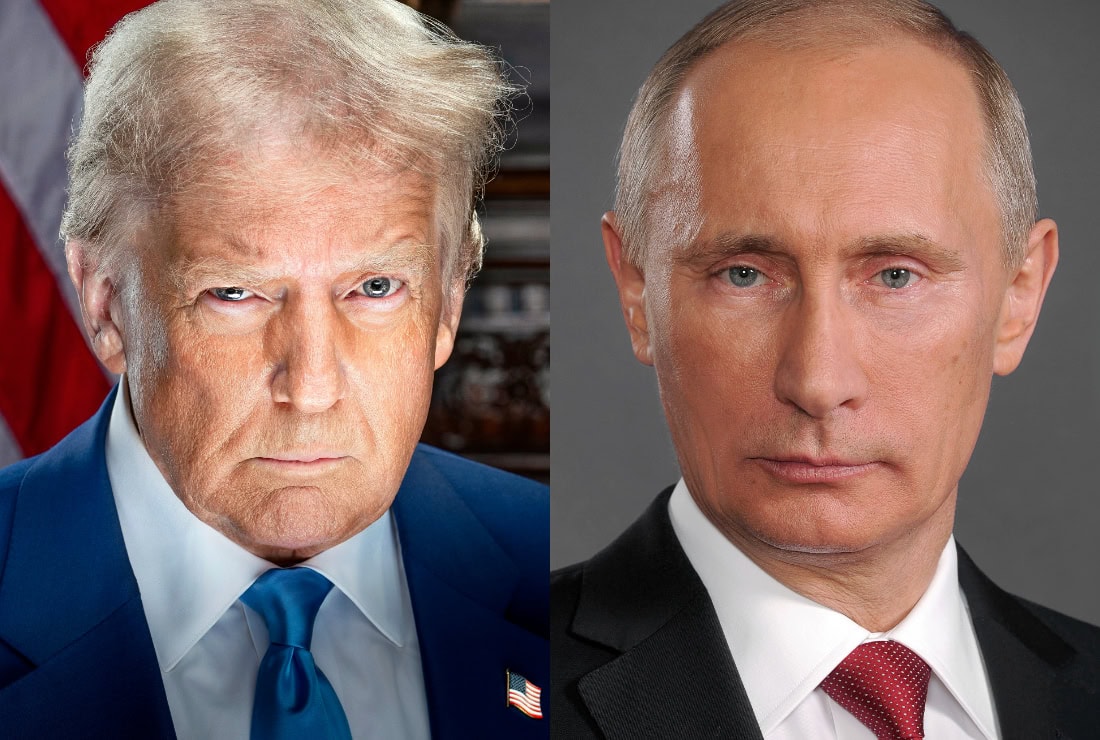
Taken together, Putin and Trump can be seen as pursuing compatible projects in different hemispheres: consolidating influence through coercion, leverage and military aggression; treating sovereignty as negotiable; hollowing out democratic accountability; and replacing rules with personalized power.
One does it from Moscow’s “spheres of influence,” the other from Washington with a hemispheric “pre-eminence” — but the logic is strikingly similar.
Niagara-on-the-Lake resident Keith McNenly was the chief administrator of the Town of Mono for 41 years.