




Sometimes people stop me in the street, grocery store, post office or community centre and ask me where the ideas for my columns come from. Fair enough.
Most come from surveying recent articles in medical and science journals or reviewing a subject for a long overdue update to a book I wrote in 2016. The book had the wordy title “Perspectives: The Evolution Of the Cosmos, Life, Humans, Culture and Religion And a Look Into the Future.”
That was a lot for a book, but signalled a major change in my interests, from a very satisfying but narrow career in neurology and neuroscience to a much broader interest in the universe, how life began, evolution, especially human evolution and culture including religion.
I kept notes and as ideas jelled it made sense to pull them together into what birthed a book.
It helped along the way to summarize some of the material, hence the many short articles in local newspapers and several series of talks at the library, which helped me pull the material together inspired somewhat by Steven Weinberg, a physicist and Nobel Laureate who once quipped that if you wanted to understand some area in science, teach it.
And that’s precisely what he and another Nobelist in physics Richard Feynman did by teaching courses in biology and other, off the usual track for them, subjects.
In a small way, that’s what I’ve done — used the opportunities for teaching something, to learn about it.
That’s what happens every year with the Nobel series in which, more often than not, I wasn’t familiar with the subject of the award until I dug into what the laureates achieved in physics, chemistry and medicine.
Over the years, I’ve become more familiar with cosmology and quantum physics as well as modern-day chemistry. Even so, it’s often a scramble to figure out what the laureates did and why.
It’s also a marvellous journey every year to master enough of the material to understand what they did, how they went about it and why the nominating committees thought their work was so outstanding.
The last is very important because it’s a way into the mind of the committees in the sciences to how they decide what were and are truly outstanding foundational studies in the sciences.
The website Nobel.org is a treasure trove that reaches a century and a quarter back into the past to highlight key stepping stones for how science evolved in the past, and a glimmer into future directions.
That’s certainly the case in recent years for physics in which year after year some aspect in quantum physics has been highlighted and heralded in some fashion the coming era of the quantum computer.
What about other sources? My primary sources include top notch journals such as Nature and Science in which many a laureate’s work was published, the Proceedings of the Royal Society in the U.K., the Proceedings of the National Academy of Sciences in the U.S., and in medicine, the New England Journal of Medicine and the Lancet.
The National Institutes of Health website in the United States used to be very useful, but funding cuts have hurt the quality of their product.
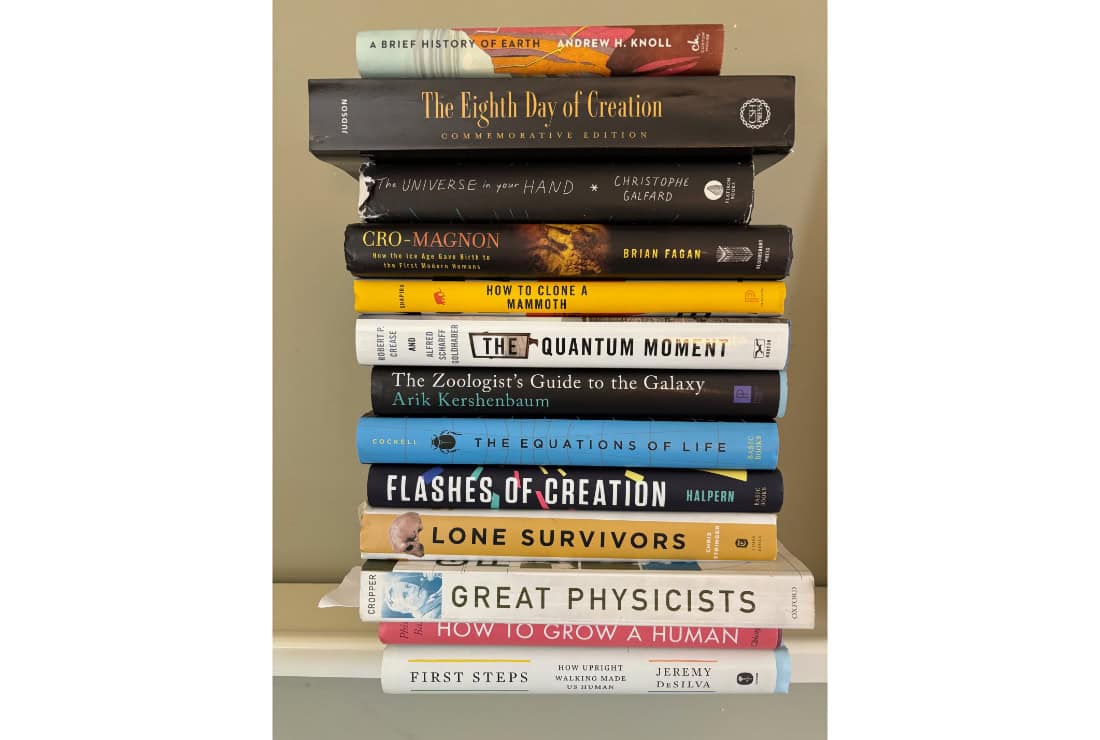
For books, I often turn to those written by excellent authors such as Brian Greene and Steven Weinberg, or multi-authored texts by leaders in their fields and books with which I’m not familiar but whose reviews in Nature or Science were compellingly interesting to me, one example of which was Andrew Knoll’s 2021 book “A Brief History of Earth: Four Billion Years In Eight Chapters.”
Another dependable source has been the New York Times, especially for articles written by Dennis Overbye about the cosmos or Carl Zimmer on biology, evolution and human origins.
Indeed, it was Zimmer’s interview with Chris Stringer over Stringer’s 2012 book, “Lone Survivors,” that launched my interest in human evolution. I couldn’t put it down.
One recent example too was Zimmer’s article on how such a complex organ such as the mammalian eye evolved. It’s a great story.
Driving everything in my quest for understanding nature have been recuring themes for me: the evolution of the universe writ on the largest and smallest scales, the origin and evolution of life, the evolution of hominins including humans, human culture and religion, what makes science different, the rise of artificial intelligence and how all of those interests interact.
Those are the prime movers behind what I understand about the evolution of everything, why I read and write what I do, and my answer to those wonderful questions people ask when we bump into one another.
For their interest, I’m very grateful.
Dr. William Brown is a professor of neurology at McMaster University and co-founder of the InfoHealth series at the Niagara-on-the-Lake Public Library.