

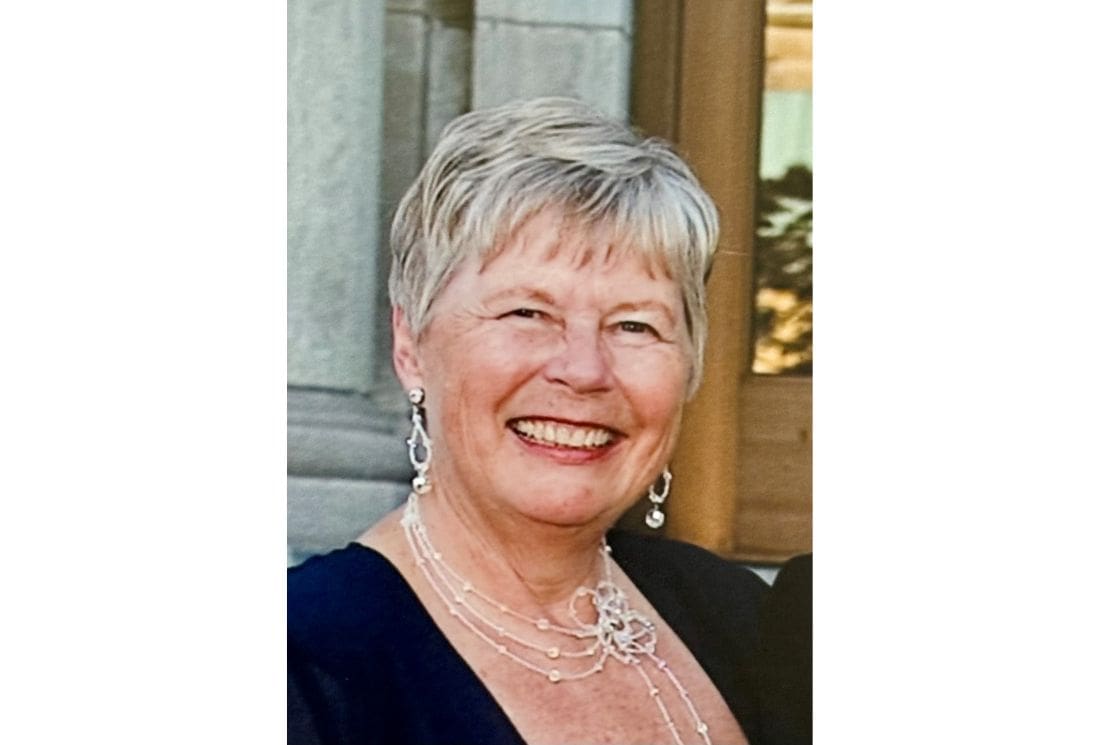


My wife Janet, in the 59th year of our marriage, died in the evening of Nov. 22, 2025, unresponsive after many hours of effortful, tiring cyclic breathing — deep breaths punctuated by long pauses — before the final and last pause.
For that final evening and the several days which preceded it, Janet, our daughter, Martha, and son, Tim, and I were supported by the exemplary professional and sensitive care provided by the staff at Radiant Care Pleasant Manor.
Jan’s end was a fitting end to the high-quality care provided by all those who cared for her and me throughout the 38 months she lived in Pleasant Manor.
The first indications of Jan’s faltering cognition go back at least 15 years, signalled by forgotten appointments, losing track of characters in books she read, errors weaving which she struggled to identify and fix, and increasing quietness and anxiety punctuated by migraine-like visual auras and mild headaches, losing her way returning from a visit with her daughter in Fonthill and many months later losing her way home in the Old Town.
Then, Jan experienced what we in the family called “the slumps” when she might slump to one or the other side, unresponsive for a minute or so before recovering.
These events became more frequent and longer lasting, which, together with increasingly severe cognitive decline, were the chief reasons Janet was admitted to Niagara Long Term Care Residence in fall 2019, just before COVID-19 struck with a vengeance in early 2020.
In her last three years at Niagara Long Term Care, Jan’s language skills withered and, like many residents, she eventually all but lost her ability to speak more than a few words, although her understanding was better preserved.
Like many residents with dementia, she also lost her talent for making friends — in this case, with other residents, although throughout her long illness, Jan never lost her sunny disposition, innate cheeriness and sense of humour.
In 2022, Janet was transferred to Pleasant Manor and continued to slowly decline cognitively. In 2023, she developed episodes when she became unresponsive, only to come to several hours later.
Similar events occurred every few weeks with the same outcome. These events were probably epileptic in origin — an example of non-convulsive seizures, but the collective best decision was to forgo using epilepsy drugs because of their propensity to make patients drowsy.
In the final several months, swallowing and drinking became increasingly challenging and finally, impossible near the end, when Jan became increasingly drowsy and less responsive.
She had Alzheimer’s disease, based on much of the history. But she also had cerebrovascular disease based on the MRI finding of several infarcts. Atypical too for Alzheimer’s disease were the early “slumps” and the later, longer-lasting periods of unresponsiveness, which were probably epileptic in nature, but not a feature of Alzheimer’s disease.
I mention this because assigning specific causes to some dementias is problematic in cases such as Jan, who had atypical features.
Would the new monoclonal antibody drugs designed to clear beta amyloid from the brain have made a difference? On the evidence I’ve seen, no.
What I know is that when Jan had all her considerable senses about her, she would not have wanted to go through the last eight years, although throughout her care, especially at Pleasant Manor, my sense was that Jan wasn’t unhappy with her lot — bored maybe, but not unhappy.
If Jan was unhappy, it was early on when she was frightened by the prospect of literally losing her mind. Through it all, Jan never lost her sense of humour, playfulness and endearing affection, which made her such a wonderful wife and partner to be with.
In that sense, “Jan” was never lost, including her most deeply embedded memories of her father — a warm, joyful man wired just like his daughter.
If Jan could speak, she would want me to thank everyone who helped her, and others on similar journeys. It’s not easy for those who have dementia or their caregivers, whether they are at home or in long-term care facilities.
Except for visitors and families, and long-term care workers, what goes on in long-term care facilities is out of sight and mind for most in the community.
Over the last six years, I’ve witnessed their hard work, dedication and faithfulness to care for their charges much as they would their own. That’s been a privilege to witness first-hand, and never more so than in Jan’s last few days.
For all the loving care everyone in long-term care shows for their charges, Jan and her family are very grateful and thank you. And remember, Jan and others you’ve cared for might just be watching and cheering you on.
Keep that thought in your hearts and minds as you go about your very impressive work of caring for those unable to care for themselves.
Dr. William Brown is a professor of neurology at McMaster University and co-founder of the InfoHealth series at the Niagara-on-the-Lake Public Library.