


SLEUTH
*** (out of five)
Courthouse Theatre, 1 hour, 55 minutes, one intermission. Ends Oct. 9. By Anthony Shaffer. Directed by Peter Fernandes.
You can leave the magnifying glass and deerstalker hat at home, but a stethoscope might be useful. Anthony Shaffer’s “Sleuth” is quite unlike any mystery thriller you might have seen before, including Agatha Christie. And, as it happens, Shaffer was a screenwriter on three of Christie’s films featuring Hercule Poirot.
“Sleuth” is another cup of English tea. More gin, with twists and turns shaken in a plot of ferocious gamesmanship between two highly competitive males over a woman. The game may be satirical, but it is also deadly. If well-played, it will also be a game between stage and audience. If there has been a murder, where is the body?
Andrew Wyke is an aging mystery writer ensconced as lord of his Norman manor house in rural Wiltshire. His life is to live the part of the clever detective of his award-winning stories, St. John Lord Merridew. He is Wyke’s alter ego.
As the ring-master of inventions and deceptions, Wyke is supremely confident that in the real world of crime, who could possibly outthink him? Certainly not the plodding police. They are sure to be baffled. But what if there is more than meets the eye, even if private?
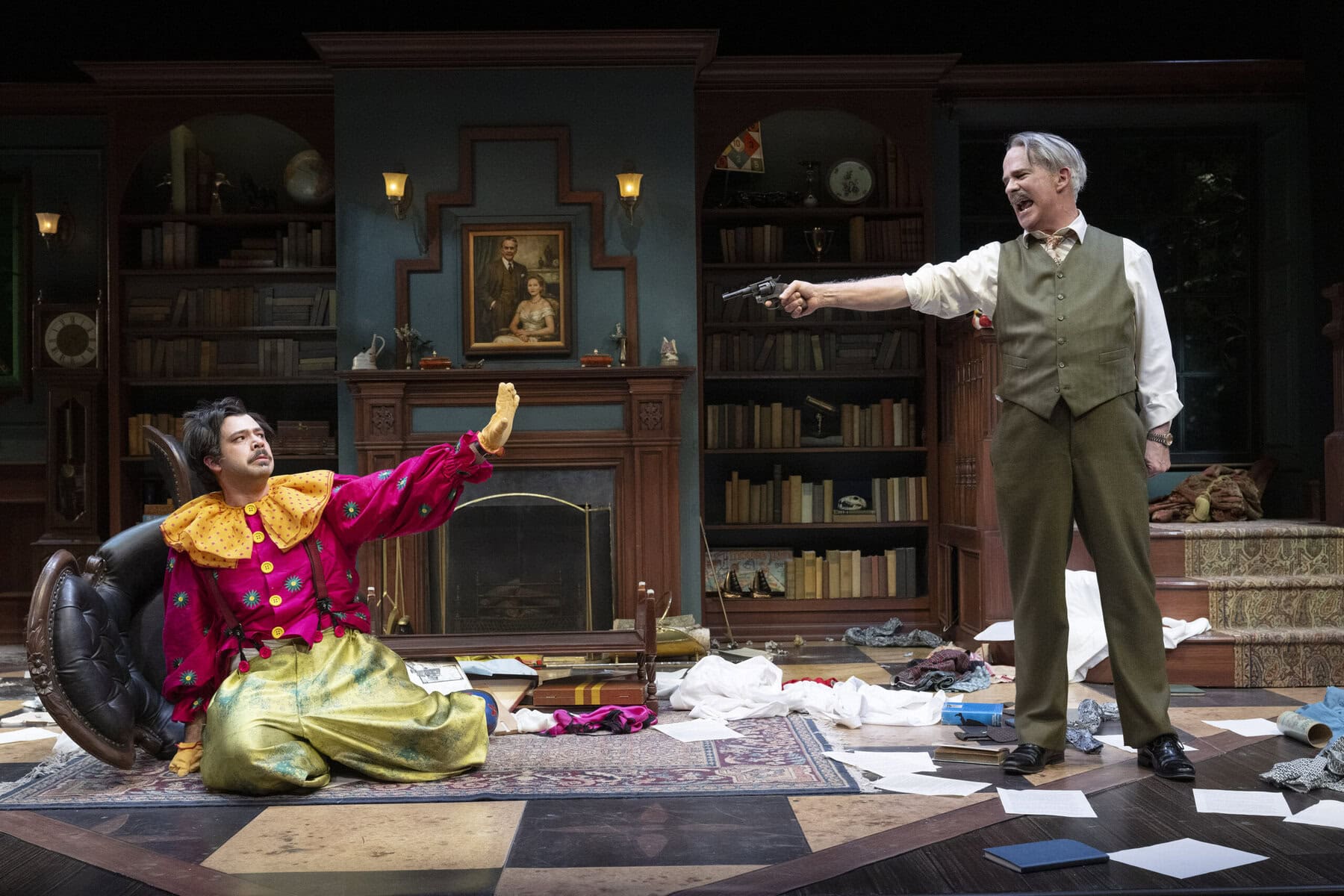
Wyke is a man full of jealous rage. He is an insufferable, bigoted, upper-class snob writing for noble minds and intent on committing the real-life murder of his wife’s ignoble lover. He has invited Milo Tindle, the young, suave and successful son of a poor, Jewish Italian immigrant, to the manor to challenge him. Wyke will play games, nasty mind games of control and humiliation to put this jumped-up pantry boy in his place.
The charade plot is simple. Just follow the rules of the game. Entice Milo with a big money reward to stage an act of burglary. Milo will find the hidden safe and steal the wife’s jewels which will be fenced. Wyke will claim the insurance. Milo will have money to support the wife and Wyke will be free to be with his mistress. What can go wrong? Plenty.
Shaffer brilliantly uses a theatre technique for a complex plot requiring two elements: discovery and reversal. The discovery of information about a character changes the situation to its opposite and in “Sleuth,” those reversals make a captivating play.
Patrick Galligan is all in and forceful as Andrew Wyke. He is clearly having a great ruthless romp with this role. Sepehr Reybod’s casting as Milo would hardly entice an entitled wife to abandon silks, furs, champagne and her Harrod’s account.
Philip Mayfield’s rumpled Inspector Doppler was not always understood due to his slumped back to the audience and an exaggerated gruff voice meant to be authoritarian but soon found tedious. This was unfortunate in a script where class accents, grammar and enunciation are relevant.
Sim Suzer’s set design of a cozy Norman-style cottage with wood paneling, a leaded window, fireplace and stairs, worked well in the confines of the Courthouse space. Given Wyke’s obsession with games, why so few board games or toys?
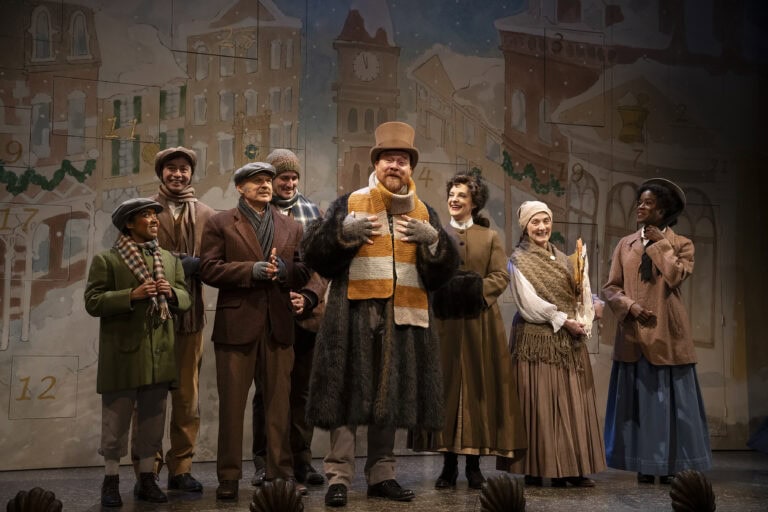
The Jolly Jack Tar puppet, supposed to shock when animated by a hidden button, was almost a non-event. He seldom laughed and perched inertly on a bureau, looking suspiciously like the Tiny Tim puppet rejigged in a sailor suit. John Gzowski’s original music and sound were effective.
Anthony Shaffer wrote “Sleuth” with the encouragement of his identical twin, Peter Shaffer, the famed playwright of “Amadeus” and “Equus,” both writing studies of the male psyche in conflict with another.
Sleuth premiered in 1970 in Brighton, followed by 2,359 performances in London and 1,222 on Broadway receiving the Tony Award for best play in 1971. Shaffer’s acclaimed 1972 film adaptation starred Laurence Olivier and Michael Caine.
Anthony Shaffer always considered “Sleuth” to be his main event, a metaphor for pre and post-war British society. The pre of the upper classes being those supportive of fascism and attracted by Nazism and Hitler as a bulwark against rising communism. Hence, the subtle toast of “prost” instead of “cheers.” Post-war Britain was economically broke, and immigration was increasingly feared as a lower-class threat to white status and privilege.
“Sleuth” now appears prescient to “mogging,” a trendy term used in the current misogynist, online manosphere. It refers to the highly competitive, aggressive gaming of individual men who seek alpha superiority to dominate other men based on physical “looksmaxing” appearance and status.
No clever dialogue required. See the play instead. Much more fun.
Penny-Lynn Cookson is an arts and culture historian, writer and lecturer living in Niagara-on-the-Lake.