

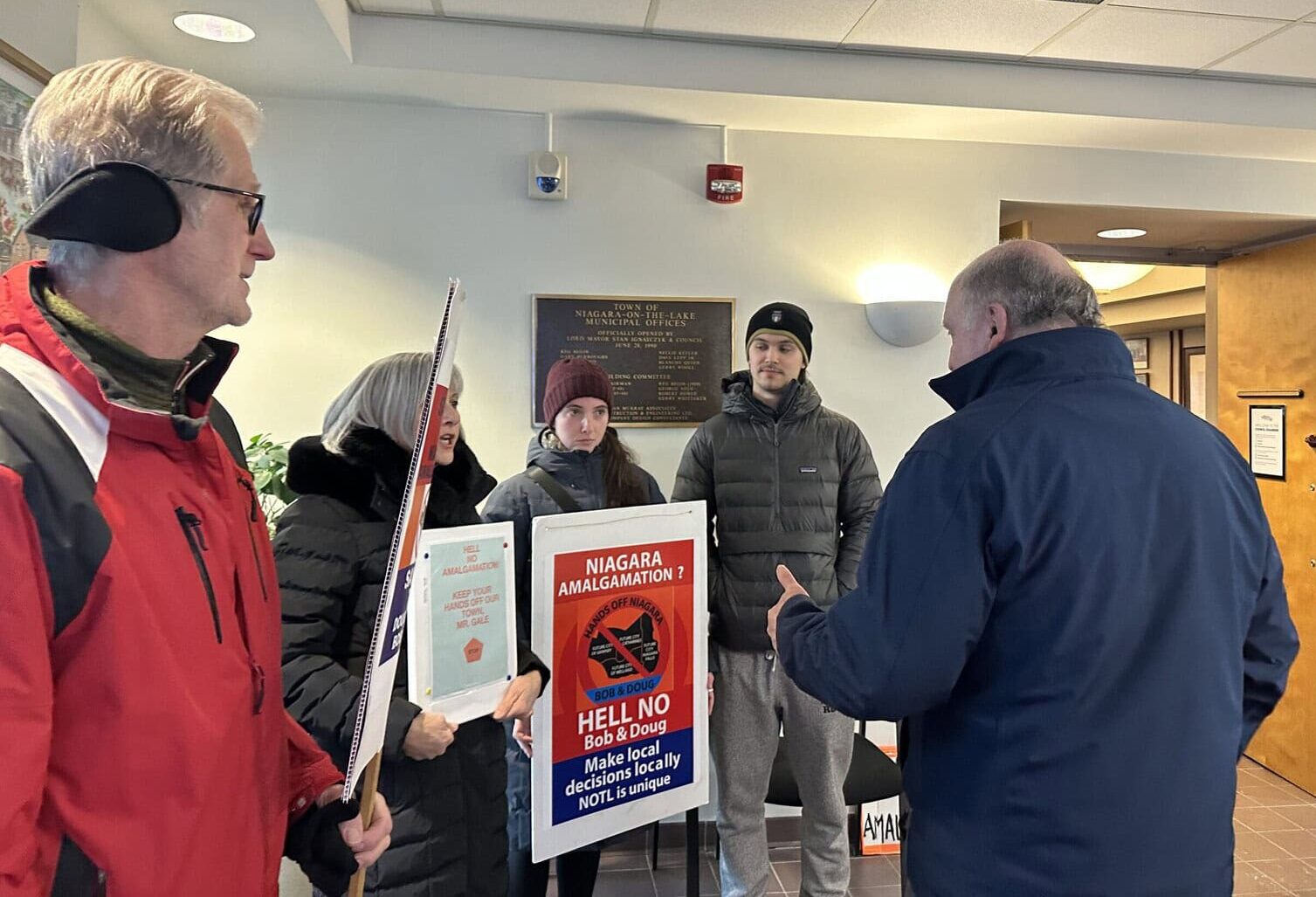


A packed Niagara-on-the-Lake council chamber, and a protest at town hall, made one thing clear Tuesday night: many residents fear merging Niagara’s cities and towns would shrink local representation and change the town they chose to live in.
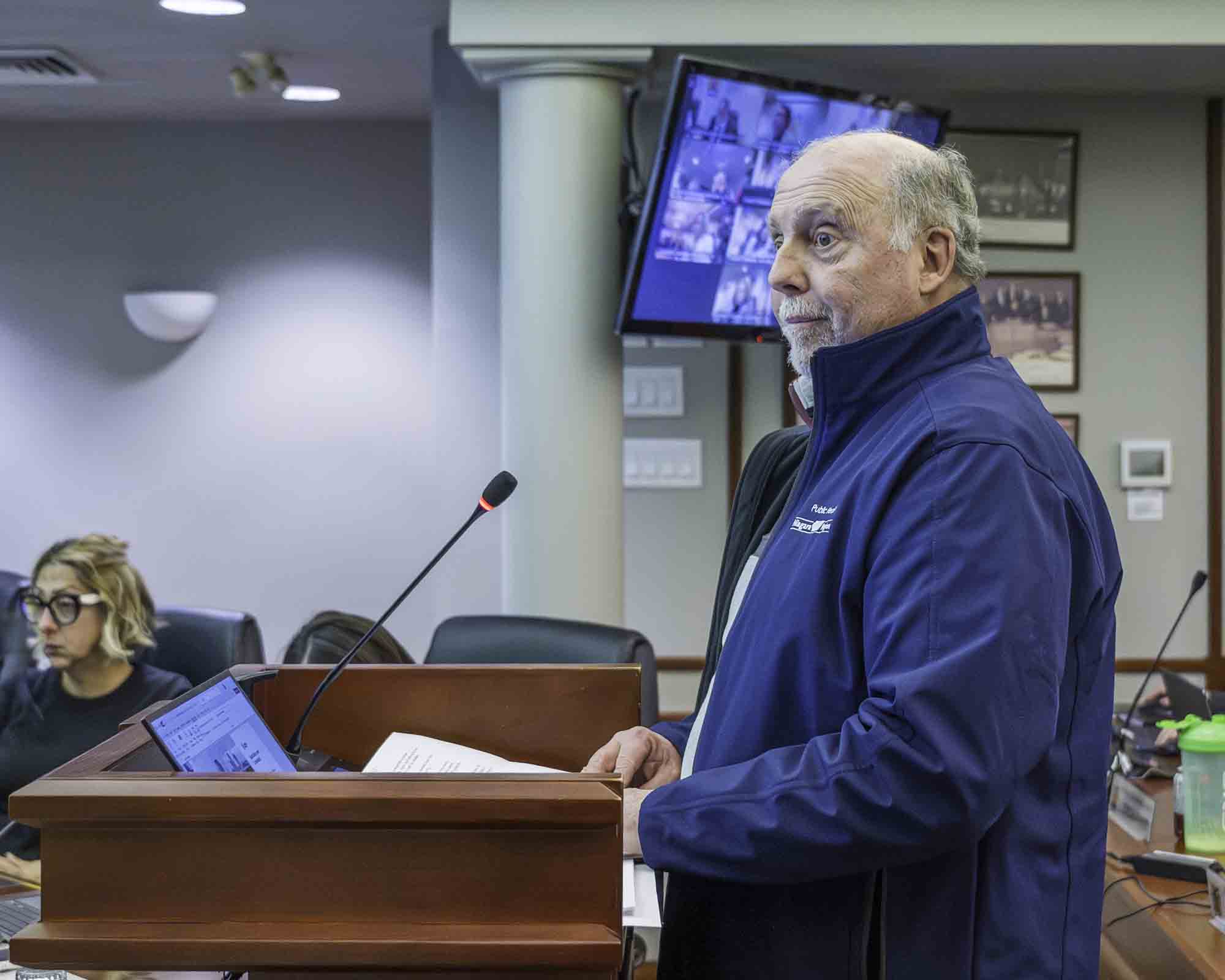
Councillors pressed Niagara Region chair Bob Gale on the financial case behind the proposal to amalgamate Niagara’s municipalities, with one describing it as an “existential threat” to the community of NOTL.
“When you get amalgamated, certain areas get priority and your voice gets smaller,” said resident Anita Barber, who was among those with protest signs opposing the idea.
“Governance is smaller and it’s less representative.”
Gale is proposing a region-wide governance review that could reduce the number of elected officials — noting the Niagara region, collectively, has 126 municipal politicians, two more than the number of members of provincial parliament at Queen’s Park — and potentially restructure municipalities through four-city or single-city amalgamation.
A crowd of about 50 residents gathered ahead of the 6 p.m. meeting.
The push for amalgamation became public knowledge after Gale sent a Feb. 19 letter to Ontario’s Minister of Municipal Affairs and Housing calling for a review of Niagara’s governance structure — including possible amalgamations — and later that day asked Niagara’s mayors in a separate letter to provide feedback on potential structural changes, attaching his letter to the minister.
Gale asked Niagara’s mayors to submit their feedback to him by Tuesday, March 3 and said he will forward initial recommendations to the province no later than the first week of March.
At Tuesday’s meeting, Gale said the review is being driven solely by him and his office because of what he described as regional tax increases in recent years and a $2.7-billion shortfall in infrastructure projects.
“We are broken right now,” he said.
At a press conference Wednesday, Premier Doug Ford said a Niagara amalgamation would be led by Niagara itself. When The Lake Report asked whether his government had tasked Gale with pursuing amalgamation, Ford said it would be up to Gale and the mayors to decide on it.
When asked about studies suggesting amalgamation does not produce cost savings, Ford said, “I’ve never seen that.”
Ford said he has “not specifically” met with Gale about the proposal. At council, Gale said he has spoken by phone with ministerial staff on the matter.
Several councillors acknowledged ongoing fiscal and infrastructure pressures, but questioned whether merging Niagara’s municipalities would address those challenges.
Gale said he did not have new data to support amalgamation and argued his “data” was based on the issues he described and discussions he’s witnessed over the past 27 years that repeatedly raised governance models such as four-city or single-city structures as possibilities.
Council also raised concerns about the short turnaround and asked why March 3 was selected.
Gale said it “was a Friday” and that he believed the date “set enough time to provide the mayors to respond to us.” A councillor pointed out that the date falls on a Tuesday.
But when pressed on who would ultimately decide whether amalgamation moves forward, and how, he said he did not know.
“I know that I have been tasked with bringing in the results from the citizens,” he said.
“What does local decision making and local representation look like in your minds?” Zalepa asked. Gale said a council no greater than eight members.
“I can’t see any councils being any bigger than that, because the ‘more’ doesn’t make it efficient,” he said.
A few minutes later, Coun. Sandra O’Connor asked Gale, based on his wording, who had “tasked” him with the amalgamation idea.
Gale responded, “I never used those words.”
“This was my idea,” he said. “Nobody told me to do this.”
To Zalepa, Gale “opened a significant can of worms” without providing evidence of restructuring being financially beneficial.
Zalepa said the regional budget managing operations and administration has been at or below inflation for the last four years and questioned whether provincially mandated expenses are the real cost drivers.
“I think your letter claims that there’s a dysfunctional governance system that’s leading to high taxes,” said Zalepa.
“The taxes actually are being driven by things like provincially initiated items that don’t have assigned revenue to them, such as police.”
O’Connor referenced Ottawa’s amalgamation as an example where, she said, “local democracy suffered.”
Coun. Wendy Cheropita argued the town’s move to regionally run on-demand transit demonstrates how amalgamation can increase costs and reduce local control, pointing to NOTL’s service being less efficient and more expensive after regional integration.
“I think the final cost at the end of that program was somewhere around $900,000,” Cheropita said. “Now it costs us $3.5 million, $62 a ride.”
Coun. Erwin Wiens described the proposal as an “existential threat to our community.”
He said NOTL has already lost autonomy in areas such as education and health care while taxes continue to rise and pointed to policing as a major driver, asking if addressing those costs directly would be more effective.
“That’s our biggest bill,” Wiens said.
Last year, each of NOTL’s 20,000 residents paid, in effect, $786 for policing, more than any other Niagara municipality.
Gale said policing represents a significant financial commitment but argued that he has only been in the regional chair role for two months.
Wiens replied, “You want to see the end of Niagara-on-the-Lake.”
At different points during the meeting, spectators in the gallery could be heard gasping or laughing in reaction to different statements from Gale.
As disruptions continued during the evening, Zalepa called for order and warned he would clear the chamber if necessary.
Outside the chamber, residents said they remain unconvinced of the endeavour.
“We don’t want to see it swallowed up into a bigger municipality,” said Steve McGuinness. “Niagara-on-the-Lake is one of the oldest towns in Canada.”
“We want to preserve the unique character.”
McGuinness said Gale is “right about taxes being too high and going up too fast,” but said there’s no evidence showing this is how savings would actually occur.
He said there was “virtually no consultation” before the proposal was announced and said in Hamilton and Toronto, amalgamation “replaced one problem with another.”
“The risk is it will get worse, not better,” McGuinness said.
Barber said she worries amalgamation would erode what draws people to NOTL in the first place — its natural beauty, historic character and cultural institutions such as the Shaw Festival — rather than the large-scale attractions found elsewhere in the region.
“The two can coexist, but one should not be overshadowed by the other.”
Opposition is also crossing municipal lines, with some NOTL residents planning to attend a protest in Thorold Thursday, after Fort Erie residents showed up at the rally in NOTL Tuesday night.
The town plans to create a council-staff working group to develop an autonomy strategy, assess governance risks and prepare for possible restructuring.
Gale and his staff did not respond to a request for comment by press time.