

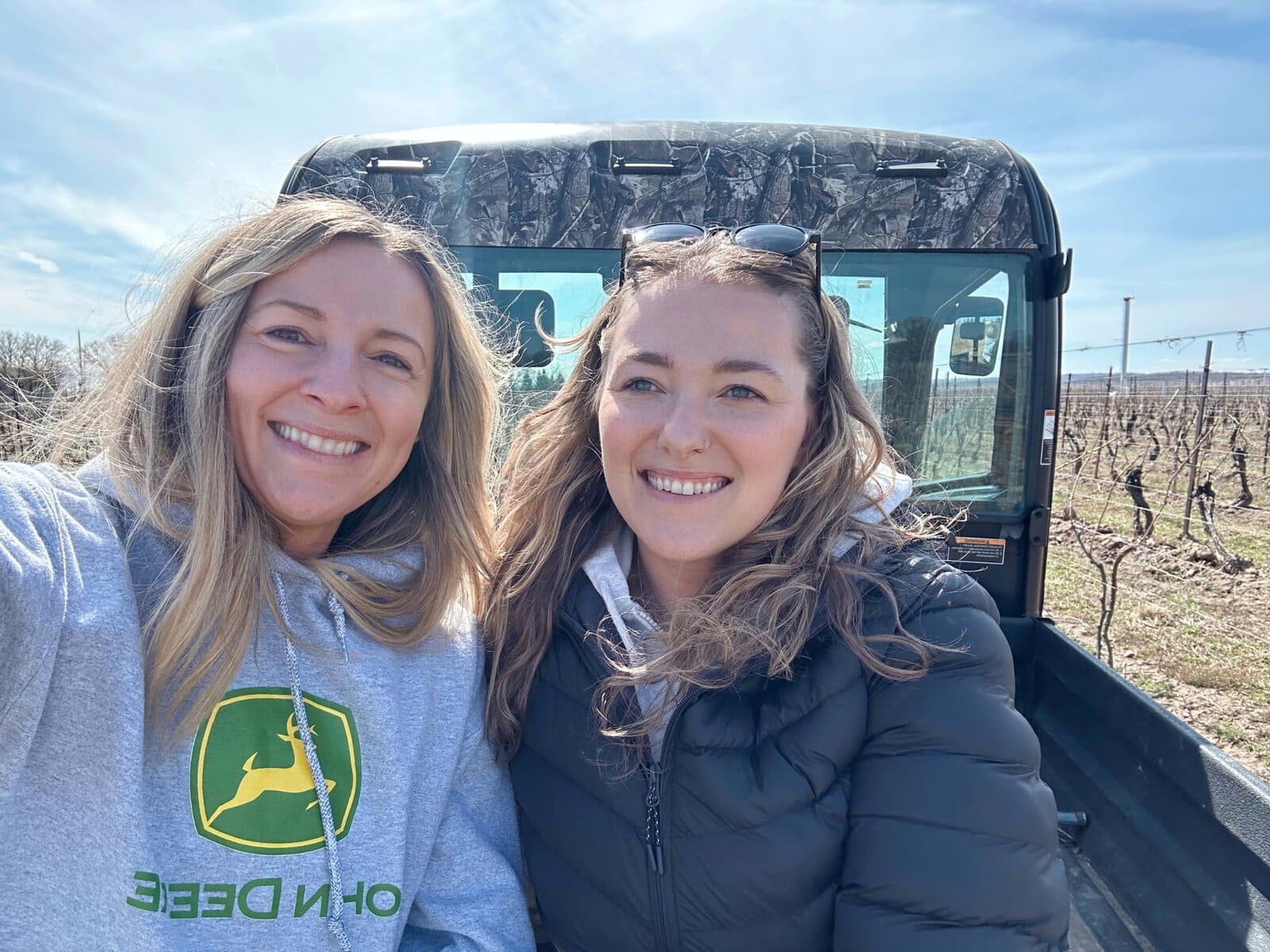


It’s easy to take the life you were given for granted. For Alison and Jessica Oppenlaender, who spent their childhoods on a small vineyard in Queenston, they figured the lives they had were ordinary.
“We’ve always known grape-growing,” Alison says. “In your backyard, you see these cool harvesters, you’re just like, ‘This is normal, every kid experiences this.'”
However, going away for university made them realize the world, and the knowledge, they had access to was far from typical.
“You realize, ‘Oh no, people don’t actually know where wine comes from or where the local food that’s on their table comes from,'” she says.
“It was just a privilege for us,” Jessica says.
Now, as the sisters continue a way of life for their family that started four decades ago, they hope to encourage a new generation of winemakers and grape-growers, especially fellow women, to forge their own paths.
They’re the owners of Liebling Wines in Niagara-on-the-Lake, which opened almost three years ago — a longtime dream for the Oppenlaender family, which has been growing grapes in NOTL for decades.
The second-generation growers are the daughters of Matthias Oppenlaender, who co-founded Huebel Grapes Estates in 1984.
For years, the family planted and sold grapes to winery operators in the region. However, it was their dream to cement their own status in the winemaking world by producing and releasing their own vintages.
It was through Jessica that their dream became a reality.
The younger sister says she’s always loved science and technology. Going to university and taking a course on the biology of plants, however, branched a connection between that passion and her love of the outdoors.
“I realized they were a lot of cooler than human biology,” she says. “I was hooked.”
That led her to discover more about the science, study and technical art of grape-growing and winemaking and realizing she could have the best of both worlds.
“I can do all the tech, nerdy stuff, all this fun that I like, but I can also be outside,” she says. “I really haven’t looked back.”
In 2021, Jessica earned a bachelor of science in oenology and viticulture. A year later, she told her father it was time to make their winemaking wish come true.
Then, in May 2023, Liebling Wines was born.
In their day-to-day work, Jessica and Alison say they split their time between being in the office and outdoors.
Right now, they’re preparing for the start of the growing season: taking part in planning meetings, purchasing equipment and preparing to welcome the temporary foreign workers who will arrive next week to begin their work on the vineyards.
Come summertime, and then harvest, they’ll be outdoors a lot more, they say.
“There’s no typical day,” Alison says.
When it comes to the representation of their gender in the industry, Jessica says on the one hand, women are well-represented on the winery and winemaking side — on the grape-growing side, not so much, though it’s getting there.
“I see a lot of young female grape-growers that have a brother or their dad’s doing it and they recently decided to come back to the farm — very much my story — and they’re trying to find their place in that,” she says
“I’ve talked to a few of them and I’m like, ‘You’re going to do something on this farm that you don’t even know. You have so much value,'” she says.
Alison says it’s important to highlight the presence of women in the world of agriculture, as the misconception that it’s always a man who’s in charge hasn’t gone away.
She mentioned, for example, being at a farming event with her husband where people assume that he, not she, is the farmer.
“The older generation all just went to my husband and said, ‘What do you grow? What crop do you grow?’ and he was like, ‘Uh, I fix things. I’m an engineer. I’m not the farmer,'” she says. “But everyone just graviatated towards him and not me.”
The sisters hope to see more women enter the agricultural space and noted that it’s a large industry with a variety of roles one can find a home in.
“It can be as hands-on as growing in the field and in front of the computer doing accounting,” she says. “What is needed in agriculture is so vast.”
In the same way these women have supported and encouraged them in their careers, Alison says they have to nurture the next generation in winemaking and grape growing.
“If we want this industry to be sustained, not just producing good crop, we have to produce good people.”