


Fort George National Historic Site brought Camp Niagara back from the dead last weekend, staging a full First World War re-enactment on the grounds where more than 75,000 Canadian, American and Polish soldiers trained before shipping overseas.
The two-day event, “Fort George in the Great War,” ran May 30 and 31 from 10 a.m. to 5 p.m. Re-enactors travelled from as far as British Columbia and Virginia on their own time and without pay.
The schedule covered battlefield tactics, field medicine, nursing history, the Polish Army’s presence at Camp Niagara, the suffragette movement during the war, medal history and a funeral service honouring a real Canadian soldier buried at Vimy Ridge.
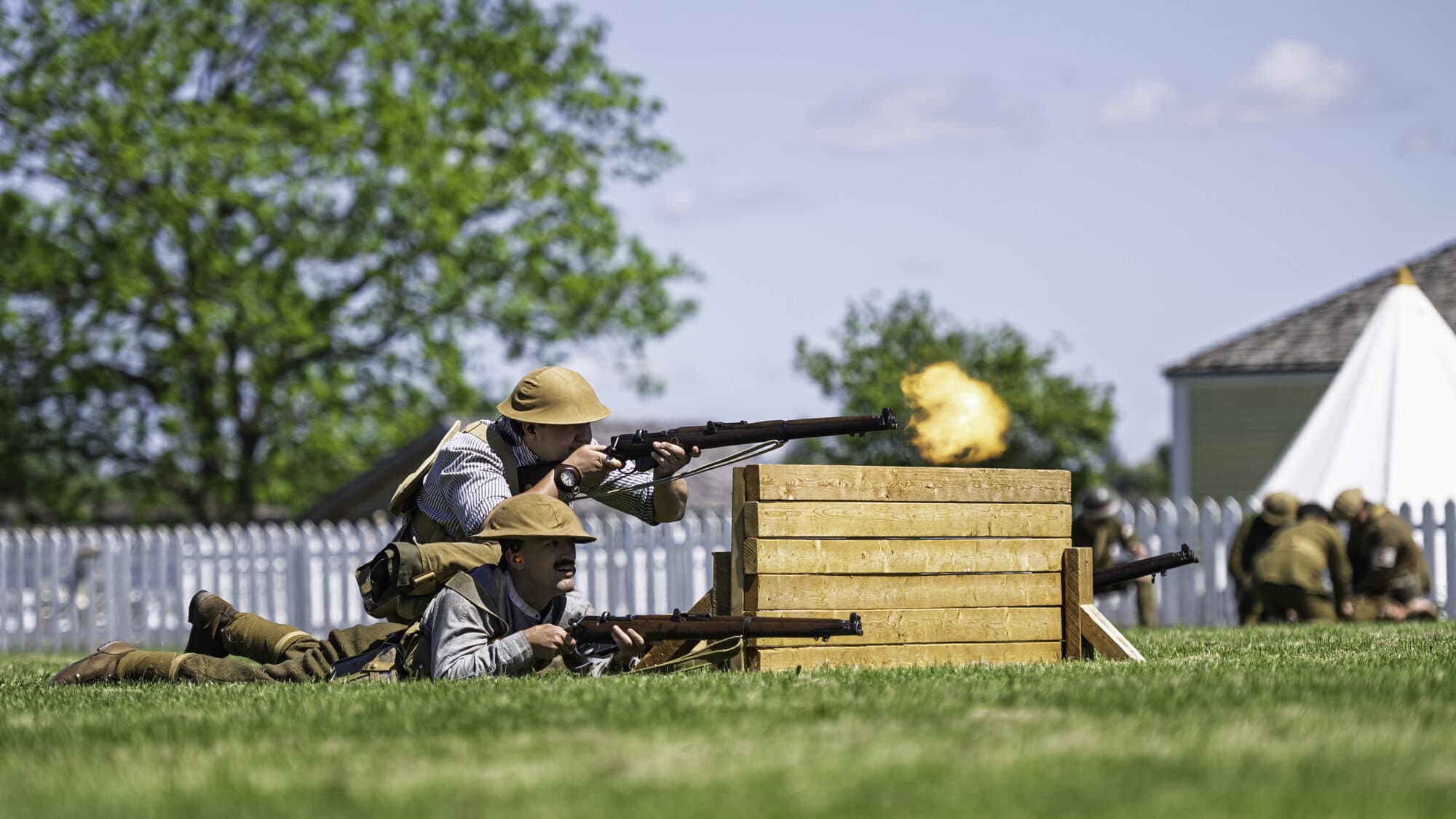
The tactical demonstration on the parade square sent re-enactors playing Canadian soldiers advancing from behind the barracks building toward a fortified position, then across the open field to a machine gun nest staged in the guardhouse doorway. Blank fire echoed across the fort. A simulated casualty dropped on the field, and stretcher bearers carried him to the medical tent for the second phase.
The medical demonstration walked visitors through treating a femur wound on the battlefield. Peter Monahan, playing the role of the medical officer, told the crowd the stakes plainly.
“A wound in the upper thigh if it broke the femur was a death sentence because you’d bleed out,” said Monahan.
The Thomas splint, developed by British physician Hugh Owen Thomas, kept a fractured femur parallel to stop the bleed. Without one, Monahan improvised a tourniquet from a stick. He then demonstrated ether anaesthetic, counting ten drops aloud, and extracted simulated shrapnel from the wound.
“It’s shrapnel, which is the good news, but it’s in there really deep, which is the bad news,” Monahan said.
Susan Spencer presented separate demonstrations on nursing sisters in the depot, covering the role Canadian nurses played in field hospitals overseas. A session on the history of military medical fashion ran in the officers’ quarters Saturday morning.
The funeral segment centred on Sgt. Ellis Wellwood Sifton, a farm boy from Wallacetown, Ont., population roughly 250, who enlisted at Chatham, trained at Valcartier in Quebec and shipped to Europe as an ambulance driver before transferring to the 18th Battalion. Within six months of joining the infantry he rose from private to sergeant.
At Vimy Ridge on April 9, 1917, he circled behind a German machine gun nest, threw a grenade and attacked alone, clearing the position. A German soldier he believed dead shot him in the back moments later. Sifton received the Victoria Cross posthumously. He is buried in a shell crater with 74 other soldiers near where he fell, his marker reading only E.W. Sifton V.C.
A re-enactor playing the chaplain told visitors the scale of death at Vimy made individual burial offices impossible. One reading covered entire mass graves, some stretching eight feet wide and six feet deep, filled shoulder to shoulder.
“In Canada, we had over 60,000 die,” the chaplain told the crowd. “Do you think I, as the chaplain, am going to read the burial office 60,000 times?”
Demonstrators placed a replica Victoria Cross on a draped coffin and walked visitors through the pall-bearing sequence. Ropes replaced handles, as they would have on the front lines.
Camp Niagara served as summer training grounds between the wars for the Royal Canadian Regiment and the Royal Canadian Dragoons, then revived in 1939 as an active training site for the Second World War. Camp Borden, which opened July 11, 1916, drew the bulk of Canadian Expeditionary Force training away from Niagara, and by 1917 Camp Niagara had emptied of Canadian recruits.
The U.S. Army filled the vacancy that September, using the site to train 22,395 Polish Americans from October 1917 to March 1919 to fight for Polish independence. The camp closed permanently in 1966.
Fort George returned to presenting its War of 1812 story, and this annual event remains the one weekend each year the site addresses what happened on these grounds between 1914 and 1919.