


Senior doctors from five Ontario medical schools spent the weekend at the Shaw Festival, learning better bedside manner through the same exercises stage actors practise every day.
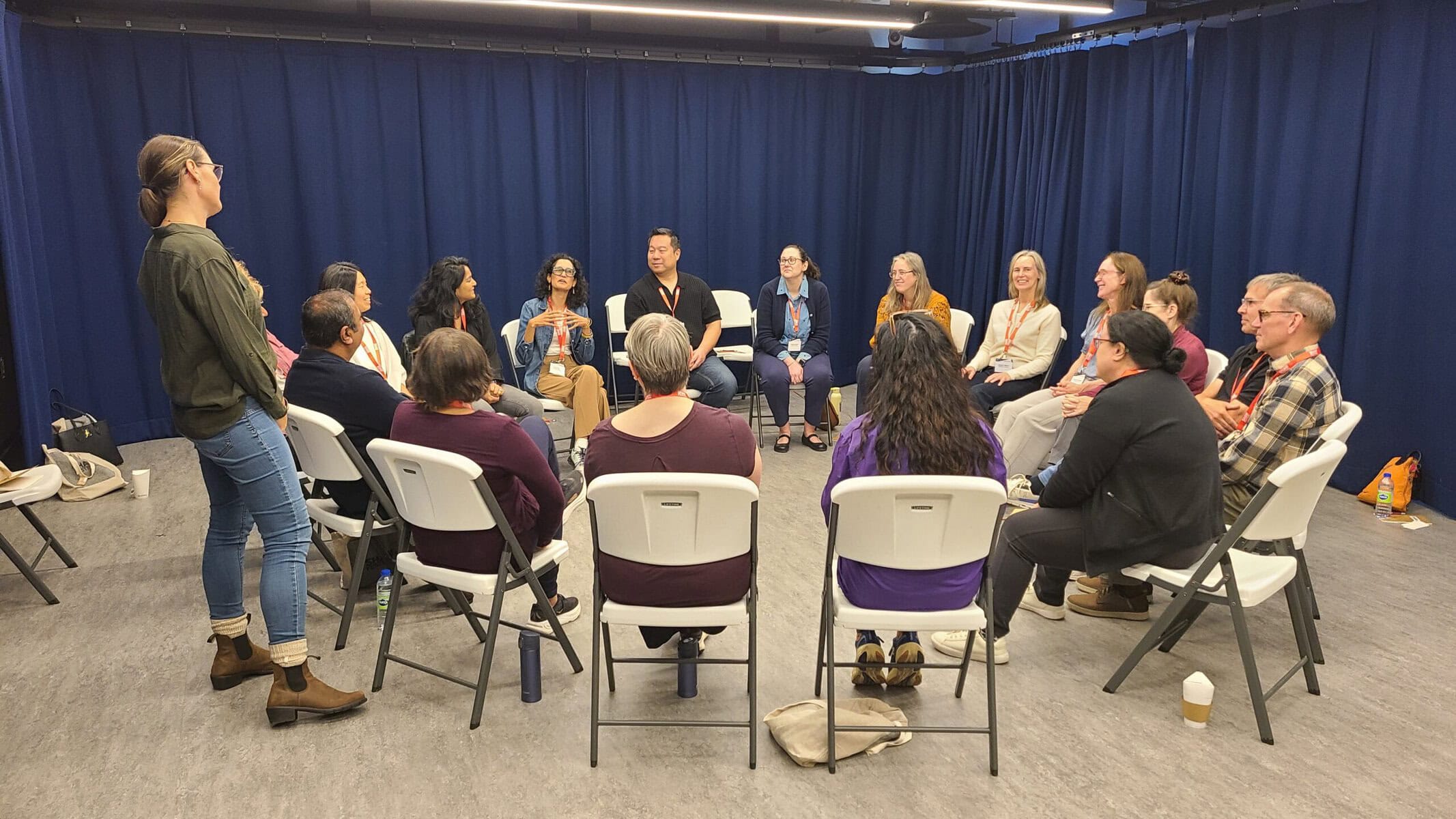
The Shaw’s Theatre of Medicine program brought physicians and medical educators to the festival’s Spiegeltent Annex Village for workshops on eye contact, posture, vocal tone and first impressions. The program began Sept. 25 evening and wrapped up with lunch on Sept. 27.
The festival started its Theatre of Medicine program in partnership with the Royal College of Physicians and Surgeons of Canada. The University of Toronto’s Temerty Faculty of Medicine accredits it as continuing education for doctors.
Alexis Milligan, the program’s director and the Shaw’s resident movement director, hopes the physicians who attended from five Ontario medical schools could add theatre-based communication training to their students’ first year.
“They are the ones who could change education,” she said. “If we could get it folded into the first year, it has the real potential to be part of their whole system of practice.”
In one Saturday morning exercise, Milligan asked the physicians to walk across a circle while making eye contact with each other. On the second try, she had them cross the circle while looking down at iPads.
“There is hesitancy, there’s disconnection,” she told the group. “What happened to those smiles? Gone.”
She compared the exercise to a doctor who walks into a patient’s room while reading a chart. The doctor needs the information on the screen, but the patient sees someone who won’t look at them.
Milligan said the gap between what a doctor intends and what a patient experiences causes much of the miscommunication and mistrust in medicine.
“A body standing in space is already saying something,” she said. “So the question is, then what are you saying?”
Several physicians at the workshop said medical training often teaches doctors to push that emotional awareness aside.
Milligan said the program originated around 2014 when Dalhousie University nursing researcher Brenda Sabo watched her rehearse a theatre project about death and stage-four cancer. Sabo wanted to know whether Milligan’s techniques for actors could help nursing students talk with patients.
When Milligan taught the students simple exercises in eye contact and movement, their discomfort with direct connection convinced her the skills belonged in health care.
“It’s been encouraged in their learning to disassociate, but now we have the research that that connection improves your patient outcome,” she said.
Dr. Teresa Chan, an emergency physician and founding dean of Toronto Metropolitan University’s new School of Medicine, attended the workshop and said it reminded her of improv classes she took in high school in Niagara Falls.
Chan said in her practice, the situations she encounters might vary significantly on an emotional level — a single emergency shift might potentially require her to tell a family someone has died, then face a patient furious about a six-hour wait for an X-ray.
“I have to compartmentalize like a champ and really be able to read the room and play the role in real time,” she said. “If that’s not theatre, I don’t know what is.”
As an educator, she sometimes asks senior residents to watch her next three patients and critique how she spoke to each one. The exercise reverses the usual order of medical training, where senior doctors critique the residents below them.
“It doesn’t always have to be, ‘I’m the boss.’ In fact, I could learn from them,” Chan said.
Dr. Ahtsham Niazi, vice-chair of education for anesthesiology at the University of Toronto, said operating-room teams can often skip introductions before a patient goes under.
“The patient doesn’t know who the anesthetist is, who the surgeon is, who anybody is,” he said.
Niazi said he would like introductions of everyone in the room added to the surgical checklist teams complete before an operation.
Milligan said the presence of leaders from Queen’s University, Toronto Metropolitan University, McMaster University, the University of Toronto and Western University shows medical schools are paying attention to the benefits the Shaw’s Theatre of Medicine program can bring.
“They’re here, which tells me there’s a shift happening,” she said.