



On Aug. 21, 2025, I wrote a column (“Arch-i-text: Something is wrong with this picture”) that spoke to the disturbing trend in this province toward marginalizing, diminishing and — in some cases — allowing the destruction of our shared history, built heritage and cultural landscapes.
Included in that article was the example of the circa 1830 dwelling and a centuries-old tree that had been on the property at 1475 Lakeshore Rd. E, Oakville until both were razed to the ground without municipal permission or permits.
I questioned at that time whether the property owner (1475 Lakeshore Road East Inc.) may have believed that, given our current political environment vis-à-vis heritage, whether any financial penalty that may be levied would be high enough that it could not be recovered by revenues accruing from the future development of the lands.
Indeed, in Doug Ford’s Ontario, it is even imaginable that said owner may have thought he would get a slap on the wrist and just get away with it.
Now, allow me to outline the maximum fines that could be applied. Under the Ontario Heritage Act, the ceiling for total illegal demolition of a designated heritage building has been set at $1 million, plus up to a year in jail. Under the Building Code Act, the maximum fine for a corporation is $500,000 for demolishing a building without a permit.
So, if the maximum fines were applied, the perpetrator of this destructive and illegal act would face a total financial penalty of $1.5 million (plus any fine for violating the town’s tree protection by-law) and one year behind bars.
Well, not willing to simply do a slap on the wrist, the Town of Oakville filed charges in September 2025 with the Provincial Offenses Court in Burlington. In July, the court rendered its decision.
The owner (a corporation) must pay fines that include $50,000 under the Building Code Act and another $700,000 under the Ontario Heritage Act. In other words, these fines amounted to $750,000 or 50 per cent of the $1.5 million penalties allowable under the law. No mention of jail time.
Here, I must note that the $700,000 fine is considered a “landmark” case, since it is significantly higher than the norm in decisions relative to these types of cases.
When we add the fine for violation of Oakville’s tree protection, which arrived at $72,000, the total fines that the corporation is required to pay amount to $822,000.
It is notable that, according to Robin MacLennan’s article published by Ontario Construction News on July 15, 2026 (“Oakville court imposes $822,000 in penalties for unauthorized demolition of designated heritage home“):
“The owner had previously received heritage approvals from Oakville council as part of a redevelopment proposal that would have relocated and restored the heritage structure while allowing new construction on the property. Those approvals did not authorize demolition of the designated building.”
And, perhaps the blatant disregard of legislation by an owner who clearly understood the law and due process when giving the demolition direction may have been a factor in the court’s decision.
That said, how hard a hit on the corporation’s pocket book is a fine totalling $822,000 on a property that is currently listed for sale at $11.99 million?
A paltry 6.9 per cent. Something well within any educated investor’s damage control margins considered in their ROI projections.
All said, while I applaud the Town of Oakville for standing up and committing the funds to underwrite this overture — and congratulate them for their landmark win — there is still an elephant in the room.
How do we, as a society, value the protection and preservation of our shared history?
And, what do we want our legislative bodies — municipal and provincial — to do to underwrite our shared wish relative to protecting Ontario’s heritage?
That decision remains in the hands of you, the voters.
Now, bringing this thing closer to home.
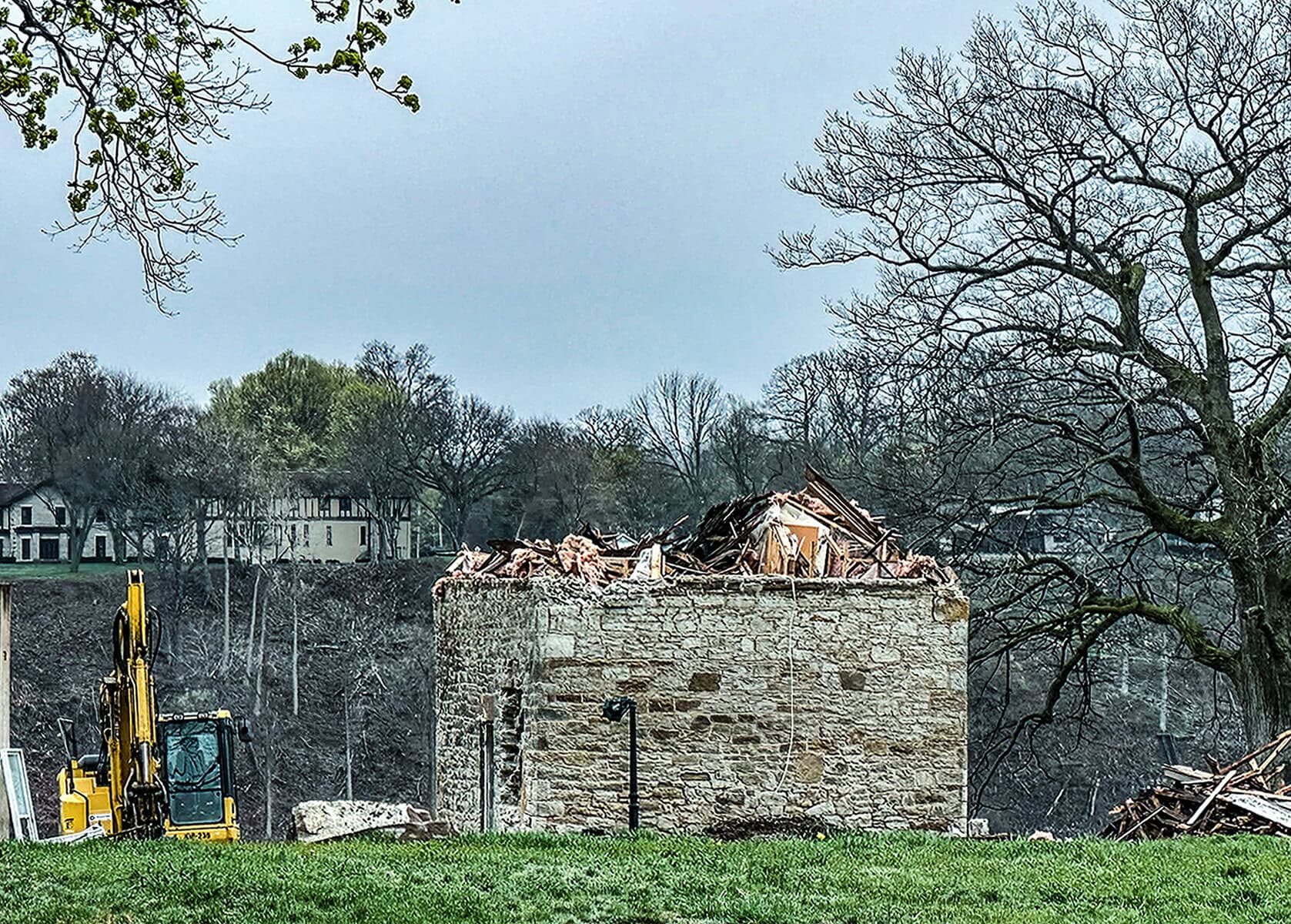
The Oakville case had many applicable references to the attempted demolition of the heritage-designated building at 14785 Niagara River Pkwy. as this columnist shared on April 23 (“Arch-i-text: Clear violation of heritage law at old schoolhouse“).
Apparently the property owner had, in hand, a heritage permit to move the old stone school elsewhere on the property as one piece (that is, the building must be lifted and moved as a complete structure) but, for a structural stone building this undertaking, while possible, is fraught with risk and very expensive.
The owner, who began his career as a mason before becoming a developer, can reasonably be considered an educated individual vis-à-vis both the issues involved in moving a masonry building and the requirement for permit(s) that specifically detail the work allowed to be performed.
No demolition or associated heritage permits had been issued by the town prior to him commencing that work. And, in fact, the town was forced to issue a stop-work order halting the unauthorized demolition.
The question remains: will the Town of Niagara-on-the-Lake follow Oakville’s example or come to some other accommodation with the property owner?
We will have to wait and see.
Brian Marshall is a NOTL realtor, author and expert consultant on architectural design, restoration and heritage.