
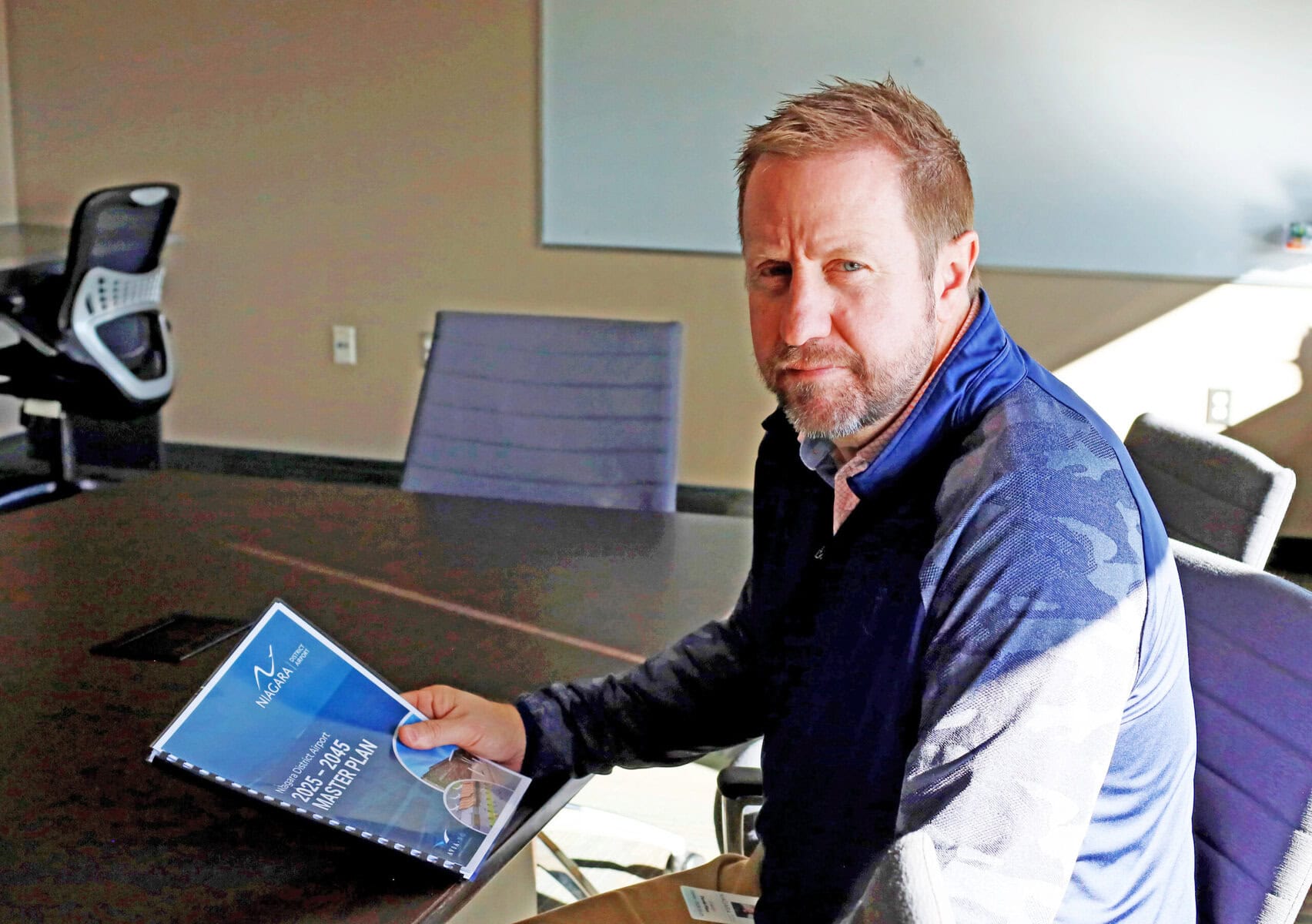


Commercial flights to and from Niagara-on-the-Lake are one step closer to reality, after the Niagara District Airport secured $9.7 million from the province for the project.
With this funding acquired, the airport will now start laying out what its major expansion will look like. The design work will take about a year and a half (18 to 20 months) and will help nail down how much the airport’s full upgrade, currently estimated at $200 million, will actually cost before the airport seeks further investment for construction.
“None of it will fund any construction,” airport chief executive officer Dan Pilon told The Lake Report. “All of it will fund design work that’s necessary for us.”
The work will begin by bringing on the necessary partners to design projects outlined in the airport’s 2025-2045 master plan, including a proposed runway extension of 2,500 feet, terminal upgrades, taxiways, roads and a new building for airport operations and emergency services.
It will also include environmental work, land surveys and planning for water, wastewater and noise.
The airport, located in NOTL and jointly owned by the town and the cities of St. Catharines and Niagara Falls, is pursuing a 20-year plan to transform the small facility into a regional airport offering scheduled passenger flights.
Pilon said the new design work is meant to replace the full redevelopment’s broad $200-million estimate with a more dependable price tag by narrowing its margin of error.
“We have to have what I would call an investment number,” he said. “We need to have a number that we have the ability to have that and go, ‘We’ve done a significant amount of work, and here’s what we think it’s going to cost.’”
Only then can the airport approach organizations such as the Canada Infrastructure Bank and Building Ontario Fund, along with other public or private partners, for the money needed to build it.
That means construction will not necessarily start as soon as the design work ends. The airport may still need to secure more investment and must hire contractors before work can begin.
“We did a vision, and now we’re going to design what that vision looks like,” Pilon said. “Then, go look at building.”
The plan looks at extending the airport’s main runway by 2,500 feet, taking it to 7,500 feet from 5,000. Pilon said that remains part of the airport’s vision and is not being reconsidered through the new design process.
The airport will also need to acquire some extra land, although Pilon said it would not require a “massive amount.”
Despite the size of the project, the goal is not to build another Pearson International Airport in rural NOTL.
“We’re not talking about a 12-gate or 15-gate airport. We’re talking about a four- to six-gate airport,” Pilon said.
No scheduled passenger flights currently depart from the airport, and offering them will take time. Pilon said the master plan lays out a five- to seven-year process to design and build the gates, security screening areas and other facilities necessary to make that happen.
That also means the airport is not yet in a position to negotiate flights and routes with airlines.
“If we had someone come to us and said, ‘I want to do this starting tomorrow,’ we couldn’t,” Pilon said. “We don’t have the facilities to do it.”
The airport has previously identified possible Canadian, American and warm-weather destinations, but no routes have been confirmed either.
For now, the airport’s only direct connection to a commercial airline is the Air Canada Landline service, which allows Air Canada passengers to check in there before travelling by motorcoach to Toronto Pearson.
The province announced the airport investment as part of its Destination Niagara Strategy, which aims to attract 25 million visitors annually and add $3 billion to Ontario’s economy.
Pilon attributed the investment to years of planning, public presentations and meetings with municipal, provincial and federal officials about the airport’s future.
The provincial support, he said, shows the expansion is gaining credibility.
“This is a very real and very tangible investment that says, ‘Yeah, we agree with you, and we think it’s a necessary step forward for Niagara as well,’” Pilon said.
“For me, it means, ‘Hey, let’s get back to work because we have a lot to do.’ But it certainly is an interim validation of the hard work that a lot of people have done.”
Pilon said the airport plans to hold more public information sessions as the designs take shape and residents will have further opportunities to learn about the project and ask questions.