

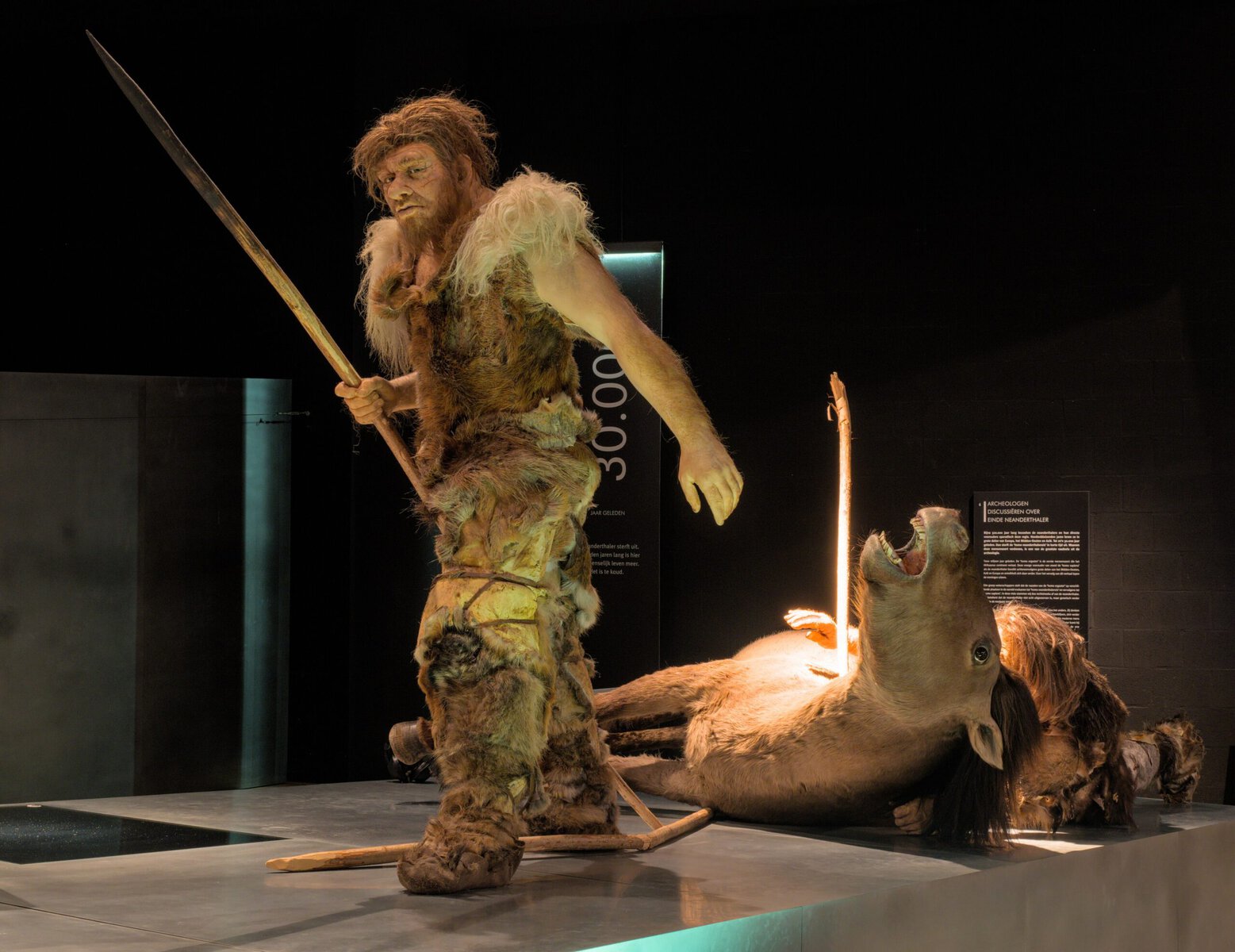


Ever since the first fossilized skeleton of a neanderthal was discovered in 1856 in the Neander Valley of Germany, controversy followed them.
Were they as dumb as their heavy-boned skeletons and facial features suggested to some, or were they as clever as modern humans, or even close?
Why did they disappear from the record 30,000 years ago, leaving some of their DNA in ours to this day?
Was the rise of our species the reason their lineage died out much as many other large species seemed to have done on almost every continent in the wake of the coming of modern humans?
All questions, some of which can be answered and some which cannot.
A March 2026 article in Science by Andrew Curry (“Neanderthals survived on a knife’s edge for 350,000 years”) suggests that “neanderthals survived on a knife’s edge for 350,000 years.”
Despite having much of Eurasia to themselves before the arrival of modern humans 45,000 years ago, genetic evidence suggests there weren’t many of them — no more than several thousand, scattered over much of Eurasia in small, vulnerable groups.
Scattering may have fostered genetic diversity between groups, but inbreeding within groups led to an accumulation of harmful mutations — a risk which was the fate of other now-extinct species such as the woolly mammoth, or perhaps some of our predecessor species in the hominin ancestral tree.
Their low numbers put them at risk for extinction in the face of the changes in climate such as the ice age, which gripped Europe between 75,000 and 65,000 years ago that was associated with a decline in their numbers, from which genetic evidence suggests only one genetic line survived to expand again when the ice age receded, only to crash once more after modern humans moved into Europe 45,000 years ago.
Crashes and extinctions were probably common among our vulnerable predecessor species, the most striking of which was the crash of early humans from an estimated total population of close to a million total in Africa and beyond nearly 900,000 years ago to less than 4,000, where it remained for well over 100,000 years before beginning to recover.
That crash, had it been total, would have meant no you and me. Like the near-extinction of neanderthals in Eurasia 75,000 to 65,000 years ago, it was caused by severe climate change.
Despite all the foregoing talk about extinction, neanderthals were highly successful hunters of small- to medium-sized animals, as well as very large animals such as mammoths and straight-tusked elephants, the latter two of which they made good use of for food, building materials for shelters, and to create clothing, flutes and other useful finely crafted instruments and tools.
Success hunting large animals with well-designed thrusting spears must have required considerable planning, co-ordination and co-operation of the group to distract an animal as large and dangerous as a straight-tusked elephant, as well as knowing precisely where the thrust should be made to do the job effectively with the least risk to the hunters.
Remains at the same site in Germany point to hunting other animals such bears, beaver and aurochs.
The movie movie “Dances With Wolves” is one of my favourites for many reasons: one was its illustration of how Plains Indians orchestrated hunts for buffalo and the division of labour and skills required to herd and kill the animals and process them at scale.
Hunting one elephant, such as the one documented 125,000 years ago in Germany, would have required similar co-operation and suggests that some neanderthal groups were larger than genetic evidence suggests or that several smaller overnight groups may have come together to hunt.
Why neanderthals went extinct isn’t clear. Was it because of an accumulation of disastrous mutations, which might have affected fertility or potency? Or were their numbers simply too small to survive bad seasons for plants and animals to hunt?
What’s obvious in the fossil and genetic records is that humans are the last hominin standing. Several times in our evolution, there were two or more hominin relatives living at the same time.
For example, as recently as 100,000 years ago, there were six homo species (denisovans, neanderthals, floresiensis, Luzonensis, a late version of H erectus, and us) of which, as anthropologist Chris Stringer reminds us, we are the lone survivor.
The more I learn about our cousin species, the neanderthals, the more I admire them. As a defined species, they lasted for approximately 400,000 years (as did their close cousin species, the denisovans).
In that time, they created cave art, flutes, tools and weapons with great skill and did so long before humans reached Western Europe, and as early as 400,000 years ago, were able to create at will and control fire.
But it is the picture of their footprints left on what was a beach in southern Spain 110,000 years ago that I find most endearing. The footprints tell a story of 20 or so adults walking close to one another. Ahead of them are prints left by children jumping back and forth.
Most of us have done something similar at some point in our life and, because the adults were close together and apparently walking at leisurely pace, they must have been talking to one another much as we might have done in our summers. So I hope and so, imagine.
They were clever and survived many challenges but, in the end, there was an end. As there will be for us, whether through continued evolution or, as current wars remind us, we might become the authors of our own extinction. That’s the choice as John Gurche reminded us in his 2013 book, “Shaping Humanity.”
Dr. William Brown is a professor of neurology at McMaster University and co-founder of the InfoHealth series at the Niagara-on-the-Lake Public Library.