


BEYOND THE STAGE
Artists’ Village, Burton Centre for Lifelong Creative Learning and the Festival Theatre.
Something very positive is happening at the Shaw. No snooze possible. It is the positive programming of the “Beyond the Stage” events that is changing the underpinning of theatre in our town.
It is a subtle shift from patronizing theatre to a more intentional involvement of understanding what exactly makes theatre tick beyond backstage tours.
The belief that great plays belong in great playhouses and seeing one or two predictable productions, combined with a meal and perhaps a weekend stay, would be enough to keep a theatre company going is no longer feasible. Changing tastes, demographics and economic pressures on theatres cannot be ignored.
There is only one Bernard Shaw production this season and it is not in the Festival Theatre but the Jackie Maxwell Studio Theatre. Survival dictates new directions. “Beyond the Stage” is expanding our experiences of theatre by allowing us to witness and explore exciting new paths.
Should “Funny Girl” have been staged may remain debatable. What is not debatable is the value of an inaugural event at the Artists’ Village Burton Centre for Lifelong Creative Learning.
It was a “Funny Girl” singalong with the Shaw’s music director, Paul Sportelli, at the keyboard. We not only sang along to the music score from our individual songbooks, but we learned many astonishing backstage tidbits from the original theatre and film productions.
For example, they were going to cut the song “People.” Barbra Streisand had recorded it as a single, which shot to number one on the charts — “People” was retained.
In the song “Sadie, Sadie,” Sportelli’s discussion with Sarah Farb as Fanny Brice was about how she would give voice to her thoughts in the seduction scene as to speak or sing unguarded thoughts makes us vulnerable. Also, lyrics that didn’t quite rhyme needed the Lower East Side accent to make those words rhyme. Fascinating insights.
It was pouring buckets outside as the participants enthusiastically sang and sustained notes right to the end of “Don’t Rain on My Parade.” Paul was impressed. There will be a “Cinderella” singalong during the holiday season.
For those less inclined to go south of the border these days for state fairs or Buffalo wings, there is the welcome return of “The Gospel Choir,” a joyous and uplifting event under the sparkling creative direction of Jeremiah Sparks.
The singers are a diverse group made up of Shaw administrative staff, actor-singers, composers and community folks who love to sing four-part harmonies a cappella.
Out of the African roots of the slavery of the South, gospel singing evolved to provide spiritual resilience, faith and hope in times of sorrow. As drums and instruments were forbidden, rhythmic traditions of call and response, harmonies, hand-clapping and foot-stomping became a passionate and participatory style.
From the 16th century to the Civil War to the 1920s blues and radio broadcasts, to the Civil Rights movement, to a long list of performers from Mahalia Jackson to Ray Charles, Elvis Presley and the Beatles, gospel has been in our lives.
This recent performance began with a thoughtful “Thank You Lord” and segued to rousing renditions of “So Good,” “Lead Me, Guide Me,” “Glory, Glory, Hallelujah” and the gentle “Let It Be,” written by Paul McCartney.
In 1968, the Beatles were fracturing and Paul was trying to keep them together. His late mother came to him in a dream saying, “It’s going to be all right. Let it be.” He got up and wrote the melody and lyrics.
There will be further opportunities to hear and enjoy “The Gospel Choir.”
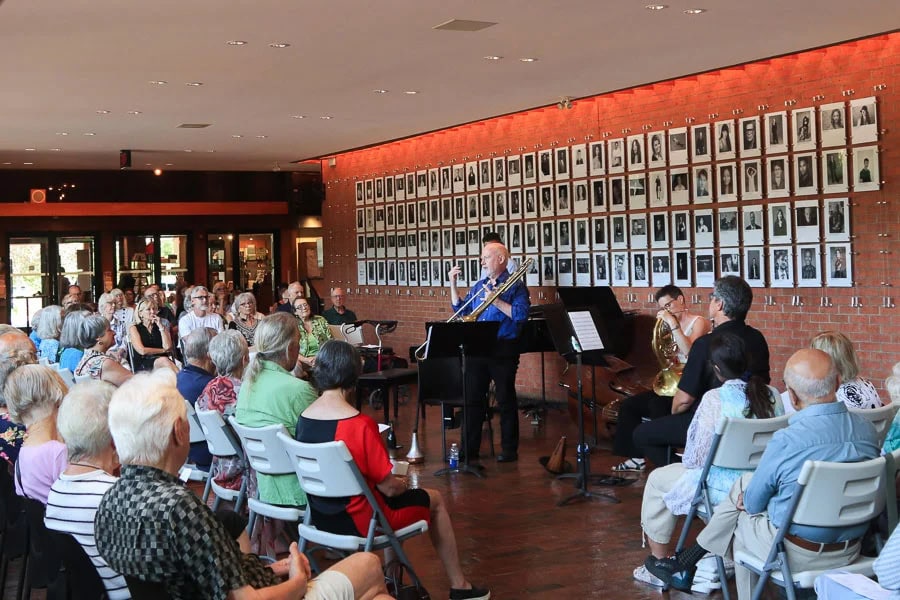
Paul Sportelli was at the keyboard of the newly donated Bechstein grand in the lobby of the Festival Theatre for a soothing and entertaining Sunday “Coffee Concert” of classical and contemporary music. The program included the elegiac Johannes Brahms Trio Opus 40 for piano, violin and French horn, which Sportelli explained was written by Brahms after the death of his mother.
In contrast, the Mozart Quartet in G minor gave us a foretaste of the “Amadeus” production to come. Sportelli gave us a master class of how the 18th-century “Sturm und Drang” movement and the Enlightenment influenced Mozart’s variations of buoyant joy to more serious drama.
The last composition was “It’s Not All, But It’s All Right” from “The Adventures of Roderick Random,” music and lyrics created by Paul Sportelli and Jay Turvey. This was sung by Jade Repeta with accompanying musicians including the Shaw’s artistic director, Tim Carroll, on guitar.
Sportelli and Turvey are now off to Wales to research and prepare for a new production for the Shaw.
There is much to come with the “Art of Ideas” events and opportunities to discover more about writers, musicians, dance, puppets and theatre, all the “true stories” and tall tales that will continue to intrigue and entertain us.
Penny-Lynn Cookson is an arts and culture historian, writer and lecturer living in Niagara-on-the-Lake.