


They might be tiny, but their negative effects on the environment are anything but.
Microplastics have become a hot topic in the realm of ecology and health, with more studies published every year detailling the prevalance of the synthetic solid particles in our food, water and air.
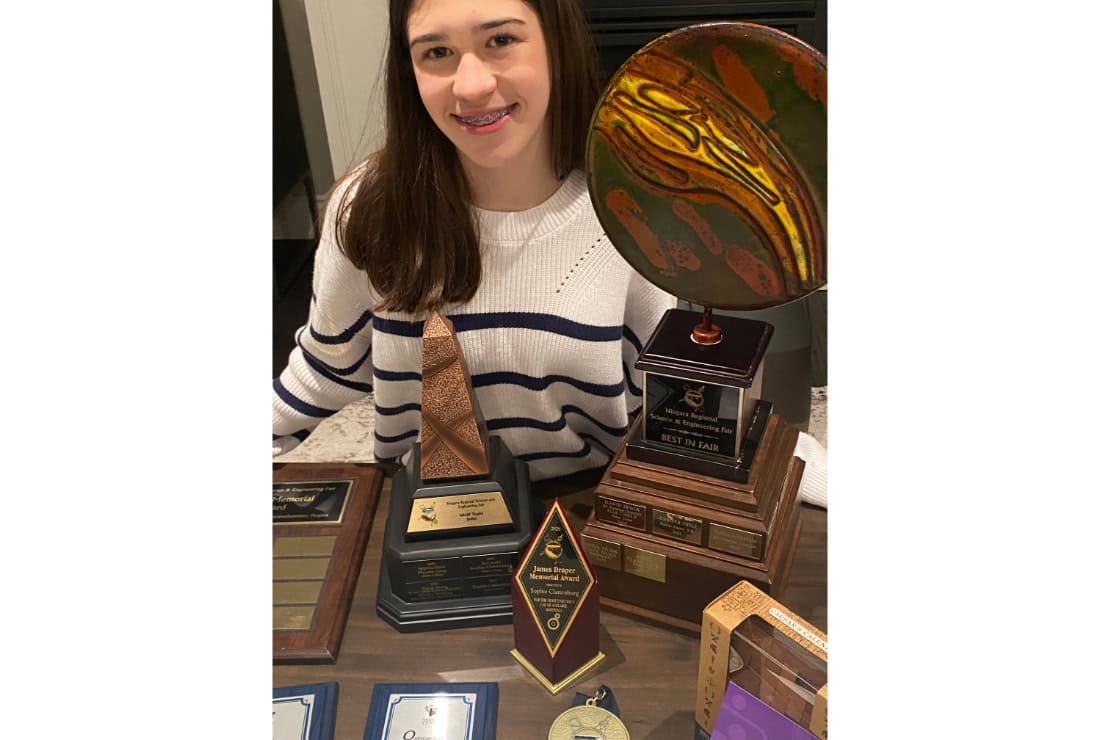
For Sophie Clattenburg, a Grade 8 student from Virgil with a passion for chemistry, it’s a topic of great interest to her.
“It’s so invisible to you, you don’t realize what problems they’re causing, despite their small size. They’re ubiquitous,” she said. “People are just learning about them now, but before it wasn’t very known.”
She put her passion into a project on the topic — and won big.
Clattenburg won Best in Fair at the Niagara Regional Science and Engineering Fair, held last week, for her research project on natural alternatives to the chemicals used to remove microplastics from the drinking water in the Niagara region.
In her project, she covers how the Niagara Region uses aluminum sulfate, a synthetic coagulant, to remove microplastics when treating drinking water.
The problem, she said, is that synthetic coagulants can generate non-degradable sludge, which can contain toxic chemicals, requiring cleanup.
Instead, she said, there is growing research showing that natural materials, called bio-coagulants, can be used to remove microplastics from the water.
The project involved extensive research into the topic, including conversations with a representative from the Niagara Region’s drinking water treatment team, and work in a laboratory.
In the lab, she created her own microplastics using microspheres made of polyethylene terephthalate and polystyrene. She “weathered” the microplastics through grinding, oxidation, abrasion and UV exposure.
Then, she tested the removal of these microplastics from water using three types of bio-coagulants: chlorella bulgaris (a micro algae), ulva lactuca (a type of macro algae) and psyllium (a soluble fiber supplement).
“It was really eye-opening,” she said of the process. “I thought it was amazing to be able to work in a lab and it made me feel like a real scientist.”
Clattenburg wrote up the findings of her research and lab work and presented it at the science fair on April 1 in St. Catharines. She received extensive feedback from the judges of the competition, who called the project’s topic “cutting-edge.”
As for what’s next for the 13-year-old, she’s heading to the Canada-Wide Science Fair in Edmonton in late May. She’ll be presenting the same project there.
“I’m really passionate about the topic of microplastics, so I’d definitely like to keep researching that,” she said of her future. “The more I keep learning about science, the more passionate I’ll get, and I’ll see where that takes me.”