


Keith McNenly
Special to Niagara Now/The Lake Report
Once again, Premier Doug Ford bemoans the number of politicians in Niagara and has a simplistic solution to the perceived problem: get rid of the towns and cities.
Small-town politics, though, is different from his personal political experience and I don’t think the premier gets the extent of the difference.
Local government exists as the smallest expression of democracy available to citizens in a free society. Local citizens can be a hindrance to the aspirations of developers and the brand of politics that feeds their coffers, and so there is conflict.
Southern Ontario is one of the most acute examples of the successes and failures of unfettered growth. In a microcosm, Niagara-on-the-Lake is a study in the never ending conflict between citizens and developers.
The ultimate form of the ensuing compromise between homeowners interests; heritage and environmental preservation, resource protection, versus the interests of developers, depends upon the political colours of the flag currently unfurled over Queen’s Park. Conservative governments are generally pro-development and facilitators of developers projects.
Most developers would prefer a comfy sofa instead of the hot seat in a local council chamber, facing the actual people who have been volunteered to live beside their latest enterprise. That’s actually a good thing. Sending out bulldozers should never be easy.
The problem is the mindset. Citizens are not the enemy. If citizens are the enemy, then democracy is the enemy, because citizens are the true and only representation of democracy.
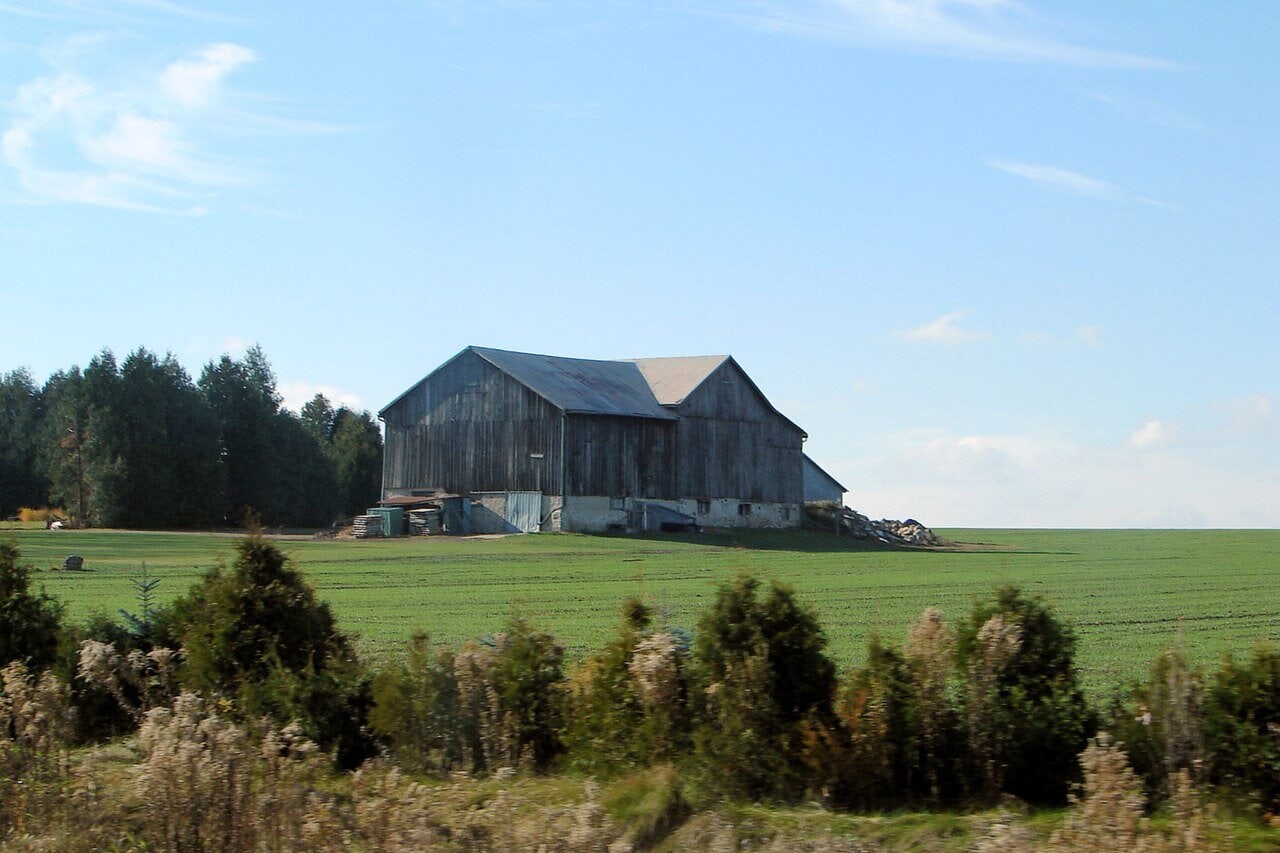
More than 50 years ago, I became chief administrative officer in a small municipality on the opposite side of Lake Ontario, similar in many ways to NOTL; rural in nature with a citizenry that had a perspective on the importance of their local community within the larger picture.
You can’t truly appreciate and advocate for a place so much as the folks who actually live there. Diluting their voice is effective for development at the detriment stewardship.
Niagara-on-the-Lake and its unique future potential was not on our communities radar. The equally important nature of my former community, called the Town of Mono, was just as far from the mind of NOTLers. At the time, we knew NOTL as a place that grew Concord grapes for juice, peaches and cherries.
If the NOTL countryside had given way to subdivisions like Mississauga did, also a prime agricultural region, the evolution to viniferous grapes and the now nationally important wine region might never have happened.
The unique soils of a prehistoric massive lake and a climate regulated by the surrounding Great Lakes make this community unique. Additionally, our historic nation-building heritage is unparalleled in Canada.
My former community had none of these characteristics, but has its own unique importance to the fabric of southern Ontario.
Mono is the headwaters of four major river systems feeding lakes Ontario and Erie to the south and Georgian Bay/Lake Huron to the north and west. That community deflected the proliferation of rural subdivision development, instead championing environmental preservation. It held national-level conferences about fresh water and started a new tourism region called Headwaters Country to help spread awareness and consolidate the sustainability ethic.
Just like in NOTL, it fell upon the locals to recognize the special importance of their community, to advocate for preservation of its natural and built heritage, and to vigorously take on its stewardship; in short, to resist shortsighted development proposals, which it successfully did.
My reason for telling you about this is to illustrate that the two communities, separated by a couple hundred kilometres, are more alike than different in that it was the local inhabitants who recognized the underlying value of their environment and the need to preserve it for the future.
Unspoiled clean clear water from the protected streams and aquifers of Mono feed into the Niagara River that flows alongside our entire community.
Premier Ford extols a repetitive mantra about the need to reduce the number of local politicians. I agree, in part.
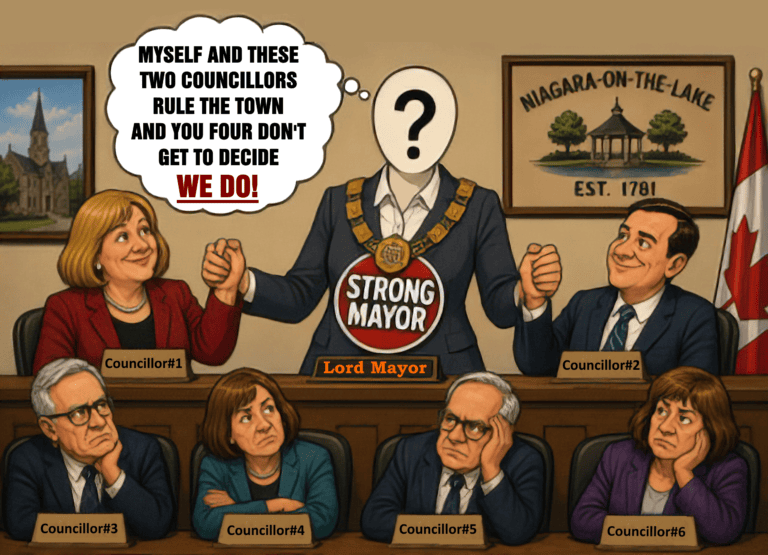
There is no need to have nine members of local council and I would suggest that as few as five could adequately represent our community, so let’s talk about a change. Having one or two representatives on a “Niagara City” council is a less desirable solution.
Our five-person council north of Toronto consisted of an assortment of farmers and other community members. They are what Premier Ford calls “politicians.” In the thankless job on local council, with meagre compensation, they were really citizen volunteers.
Here is an anecdote to illustrate.
A troop of officials in Queen’s Park arranged to meet the head of council and CAO to advise us of a drastically new zoning bureaucracy called the Niagara Escarpment Commission.
On the morning of the meeting, the reeve (now called mayor) called the town office saying he had to skip the meeting because he had a cow that was having trouble birthing and she needed his help. This was before cell phones, so his absence couldn’t be conveyed to the visitors until they arrived.
I asked him if he has any specific message for the dozen provincial directors and staff about to arrive, and he said to just “tell them that I have a cow having trouble giving birth, and she needs my help, so I’ll have to miss the meeting.”
The meeting took place and it was then left to us to figure out where to put the half-dozen new file cabinets we would need for the latest provincial incursion into local government.
Democracy, and especially democracy at the closest and most local level, is community members representing community members. These men and women aren’t “politicians” of the ilk perceived by Premier Ford, with offices in glass palaces and numerous staff.
They are, for the most part, just neighbours working from kitchen tables, wanting to give back to their community — when we make the wrong choices, we get to have a do-over in four years.
A lot of snow has been scraped off the roads since that meeting. More importantly, I can report that mother-cow and calf had a successful delivery — that’s local politics, too.
Niagara-on-the-Lake resident Keith McNenly was the chief administrator of the Town of Mono for 41 years.