

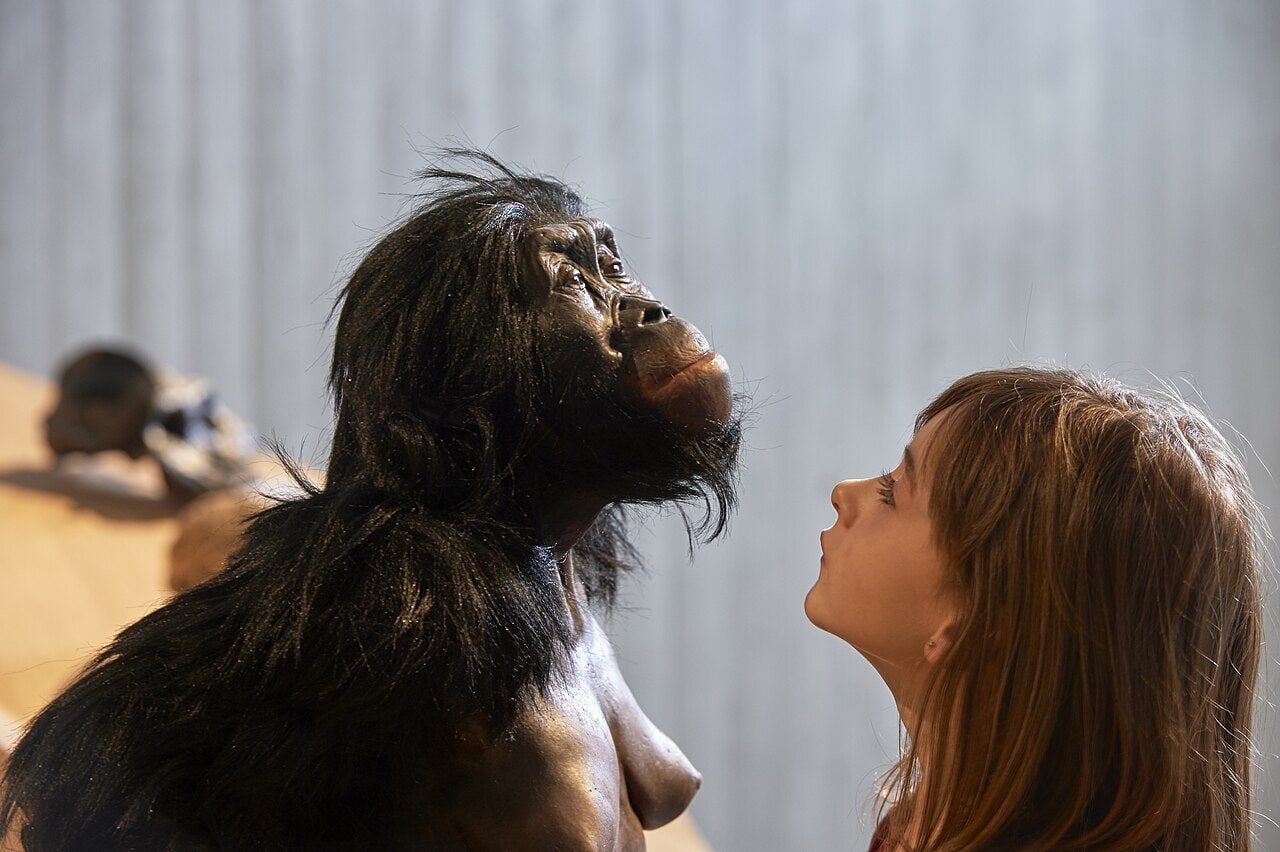


The broad evolutionary trail that eventually led to chimpanzees and bonobos on one hand, and the other hand to modern humans, began with a common ancestor some six to seven million years ago in Africa.
On the human side of the split, evolution was dominated for several million years by a variety of small ape-like creatures, with brains only a few hundred cubic centimetres in volume.
They became increasingly bipedal and accompanied by a series of related adaptive changes in their spine, pelvis, hips, knees, ankles and toes that favoured fluid walking and even short distance running, but less suited for climbing.
These were the australopiths, of which one, A. afarensis, was famously called Lucy after the Beatles 1967 song, “Lucy in the Sky with Diamonds.”
As a group, australopiths, were highly successful, probably because subgroups evolved to take advantage of changes in their environment, especially food sources.
For example, differences in the shapes and sizes of their jaws and teeth, such as smaller teeth and jaws, probably reflected an abundance of easily found and chewable foods or the opposite, the need to dig up and chew tougher foods such as buried hard-skinned legumes, which favoured stronger, more robust jaw muscles and bigger molars for grinding and chewing — hence the name robustus, applied to one australopith variant.
There’s little evidence that australopiths regularly created and used tools in their lives. However, toward the end of their reign, other transitional species emerged with slightly larger brains, who made regular use of stone tools, one of which, homo habilis, was initially claimed to be the first tool-maker by Louis and Mary Leakey, and hence the first of homo lineage.
Then, about two million years ago, a bigger brained homo species appeared called erectus, now fully erect and bipedal, which managed over the following two million years to continue to evolve and spread throughout Africa and Eurasia as far as Indonesia.
Through that long period, the brain almost doubled in size in later variants such as homo ergastor, later still, homo heidelbergensis and later still, even variants such as our cousin species, the neanderthals in Europe, and the denisovans in Asia, whose brains exceeded the size of the last of the line, fully modern humans 150,000 years ago.
Finally, about 30,000 years ago, what had often been several overlapping species finally died out, save us, the lone survivor (as Chris Stringer is fond of expressing it) of so many evolutionally distinct species before us.
The picture of human evolution that emerged was a chancy affair that could have ended several times and almost did, 950,000 years ago when the population of prehumans (H ergastor), plummeted from nearly one million to less than 3,000, where it remained for more than 100,000 years before gradually increasing.
At any one time, there were often two or as many as four or more prehuman species, sometimes living in the same region and competing with one another for resources much as the neanderthals may have done with modern humans in Europe for a few hundred thousand years in Europe and perhaps the denisovans in Asia, both of which species left genetic legacies in modern humans to this day.
Beyond the foregoing highly simplified summary of human origins, there are other issues about the human origins story.
For example, the fossil record is spotty and incomplete. Finding fossils isn’t easy and although new discoveries will be found, many will not.
Genetic studies suggest there are many ghost species, for which there are genetic traces but no matching fossils. And what fossils are found, are often very incomplete, such as the earliest period between the last common ancestor and the emergence of the australopiths.
These days, there are many more well-trained scientists around the world interested in human evolution now helped by novel technologies for identifying variations of species, and even new species, and telling us something about how they might have lived.
This is especially so in China, where there have been several discoveries of species variants which help to fill in evolutionary record of our species’ history.
These changes suggest to me that the picture of human evolution, and indeed the evolution of most species, may look very different by the mid-century mark and beyond. That’s what makes the story so intriguing for me. For most of my life, I knew little more than recorded history because that’s what was taught, and because I was busy with neuroscience and medicine.
If there’s a lesson to be learned from reconstructing the past history of our species, it’s that our evolution was a dicey affair, dictated by chance and, for almost all of our history, by natural selection as Charles Darwin and Alfred Russel Wallace suggested in the mid-1800s. That may change with the introduction of technologies designed to change our genome.
How long will our species last? That’s next week’s subject.
Dr. William Brown is a professor of neurology at McMaster University and co-founder of the InfoHealth series at the Niagara-on-the-Lake Public Library.