



The 20th century was the age of modern cosmology. From a universe thought to be unchanging, without a beginning or ending, everything changed.
Einstein’s masterpiece general theory of relativity strongly suggested that large enough masses could collapse space-time into what was initially called a singularity and later forms, black holes.
For physicists, the math strongly suggested that the universe was expanding and began with something incredibly tiny and energetic, which suddenly inflated exponentially for less than a second, created the first subatomic particles within a few seconds and thereafter continued to expand stretching the wavelength of the ever diminishing heat energy into the microwave range as the universe continued to expand and cool.
That radiation, called the cosmic background radiation was the first solid evidence for the Big Bang hypothesis to explain the beginning of the universe.
Since then, enormous progress has been made in understanding the life cycle of stars, how elements beyond the original three created in the Big Bang — hydrogen, helium and a bit of lithium — to heavier elements forged by nuclear fusion in the lifetime and especially death of stars.
Progress in cosmology was rapid especially in the latter half of the 20th century, leading to several Nobel Prizes and the emergence of a working “standard cosmological model” for how the universe evolved.
However, many questions remain.
Observational studies and theoretical models of the universe left a surfeit of mass and thus gravitational force to explain how rapidly orbiting stars in the outermost regions of galaxies managed to stay together.
Hence, there had to be more matter than what we can see which doesn’t interact with electromagnetic energy and is therefore, invisible.
Or what about dark energy, the expansile force in the universe? What is it? Why does the rate of expansion seem to vary with time and position in the universe?
How and when did the first stars and later galaxies appear and what role did theoretical early giant black holes and dark matter play in the genesis of those early stars?
Estimates suggest the universe is 13.8 billion years old. Theoretical models and tantalizing evidence using the James Webb telescope suggest that the earliest stars might have formed as early as 100 million years after the Big Bang, a time when the universe was much smaller, denser and also simpler — only hydrogen, helium and some lithium — as yet no other elements.
To create those first stars would have required enough gravitational force to clump matter together — possibly generated by massive black holes, dark matter or both.
The earliest stars were probably giants — hundreds, even thousands of times larger the size of our Sun and probably burned through their hydrogen fast enough to make them burn brightly before collapsing in supernovae a few hundred thousand years following their birth.
So far, no giant stars meeting the criteria for “first” stars have been spotted or even whole galaxies of bright first stars. Why?
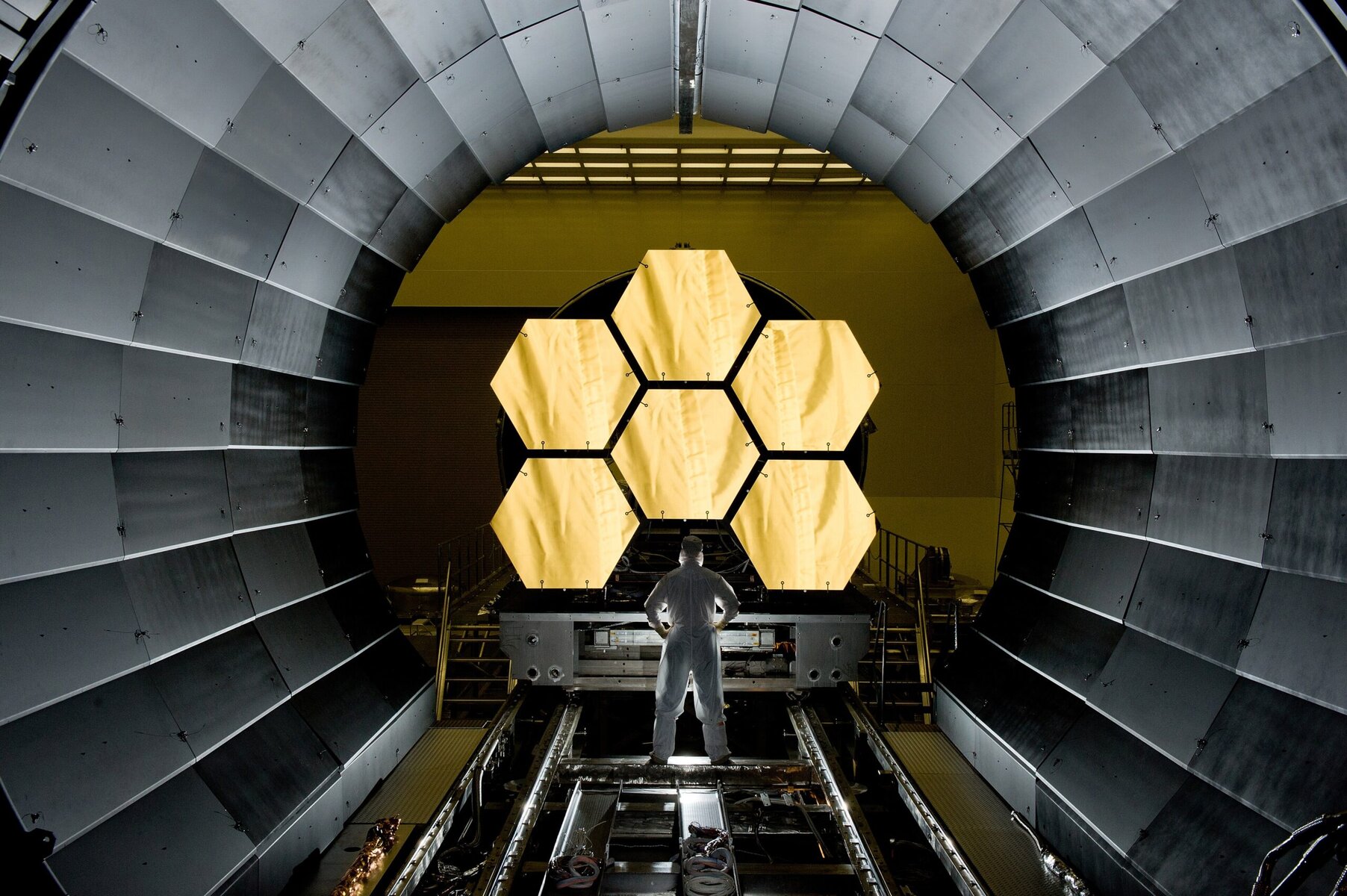
The problem is that the James Webb telescope isn’t large enough to spot those first generation stars and galaxies without help.
For help, physicists can thank Albert Einstein who many years ago suggested, based on his general relativity studies, that large masses such as single galaxy or even multiple galaxies could act as a stellar lens between a very distant galaxy or giant star of interest and the lens of an observers telescope — in this case, the James Webb telescope.
Under the right conditions, stellar lensing can magnify galaxies and stars of interest by as much as a thousand times or more.
The real answer may require more powerful telescopes capable of seeing back in time to within a few million years of the Big Bang, if we’re ever going to see what generated the first stars.
Possibly, we’ve reached the limits of what we can see now, even with the aid of stellar lensing.
There are limits to what we can know, given that estimates suggest that 95 per cent of the universe is beyond what we can see, because of the limit imposed by the speed of light and the continuing expansion of the universe.
Whatever the limits to studying the universe now and in the future, the creation story told by science is stunning at so many levels including the origins and evolution of the universe on the largest and quantum scales and the origins and evolution of earth and life, including town species beginning 200,000 years.
With the possible exception of our cousin species the neanderthals and denisovans, modern humans are the only species to create and imagine stories but unlike our extinct cousins, our creation stories continue to evolve as we understand more.
That doesn’t mean we should ditch older creation stories because they might not be factually true. Many creation stories speak to relationships between nature and humans and between humans, which remain as true in our time as when they were first experienced or imagined.
Science’s creation stories are “works in progress” subject to evidence.
Dr. William Brown is a professor of neurology at McMaster University and co-founder of the InfoHealth series at the Niagara-on-the-Lake Public Library.