


Round and round and round we go on what to do with the old hospital on Wellington Street.
It appears that the majority of town residents do not support razing the building and replacing it with a new wellness-tourism facility cum condominium as what was proposed by Nick Vaccaro (RegenaLife and Wellness Estates) of Niagara Falls.
Although the results of the public survey report commissioned by the town, through the firm NPG Planning Solutions, was largely inconclusive.
The consultants did suggest that respondents — many cases by very slim margins — felt the community needs housing for an aging population, parking, medical services, community programming, arts and culture, a welcome area, community spaces and a school.
This lack of definitive community preference renders the question of future best-use of this property a political “hot potato” and hence there will be no “safe” position for our elected councillors.
But, before contemplating a possible future use, let’s talk about the building itself.
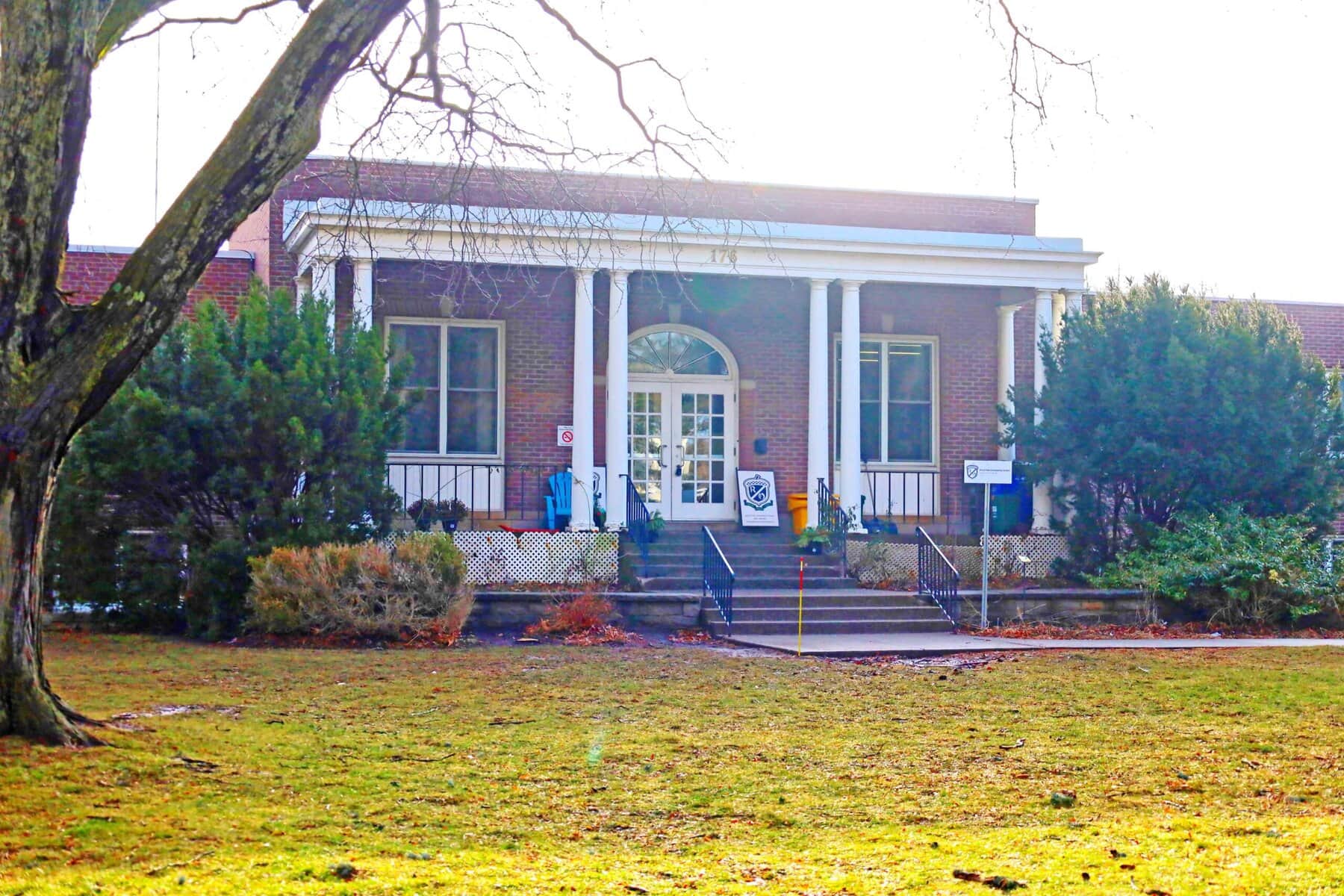
The original 1951 centre block boasts an impressive glass paneled double door entry surmounted by a fanlight in an opening that sports limestone imposts and keystone. This entry is approached by a wide double-rise (from grade to porch level) staircase establishing a grand street-view presentation.
This presentation is, in turn, raised to a grander level by the classically styled colonnade with four sets of paired columns supporting a deep, elegantly simple entablature and flat roof sheltering the entry.
Between 1954 and 1968, further additions were made to complete the long, low building that graces this property in the current day.
Allow me to observe, the architecture of the old hospital is a superior example of mid-20th-century institutional design, which is compatibly couched within the context of the associated streetscapes.
Despite occupying nearly a full town block, it does not dominate, but rather, serves as an end-bracket to the surrounding buildings. Its brick cladding and form contextually speaks to the broader character of Old Town while serving as a gentle contrasting backdrop to St. Vincent de Paul and Simcoe Park.
Unfortunately, nearly without exception, all the proposals to date have either endorsed the total demolishment of the building or loosely suggested that the existent building had passed its best-before date and should be consigned to the dust bin of history.
Let’s set aside the benefits of preserving historical architecture …
Here’s why adaptive reuse of an old existing building makes financial sense.
It has been reliably reported that adaptive reuse of existing buildings results in a 15 to 19 per cent lower cost than new construction. In fact, a Deloitte study and analysis revealed that compared to new construction, adaptive reuse projects cost around 16 per cent less and are completed in 18 per cent less time.
And these savings are considered very conservative. In an article published by the US architectural firm Weber Murphy Fox (“Why Developers Are Turning to Adaptive Reuse”), those savings are “up to 20-30 per cent compared to new construction.”
From an environmental perspective, a milestone National Trust study entitled “The Greenest Building: Quantifying the Environmental Value of Building Reuse” unequivocally found that a new building, even if 30 per cent more energy-efficient than an existing one, requires between 10 to 80 years to offset the carbon emissions generated as a result of its construction — a finding that has been substantiated in a wide variety of international studies on the topic.
Realistically, it will be our kids or their children who will live to see that “new” building finally break even on its environmental carbon debt.
I could go on but, quite frankly, there are no viable general arguments (financial, environmental or otherwise) that can be made to justify demolition and re-build over adaptive reuse.
So, let’s return to the question of future use for the old hospital.
Since there is no general consensus, why can we not blend the community’s opinions into a true socially responsible multi-use facility?
Let’s take the central core, introduce a glass skylight system into the roof to allow natural light to illuminate the interior and devote this space to an arts and Niagara-specific cultural show piece.
Bracket the rear of each wing with a glass corridor that serves as a walkway with views onto the parklands behind and access to a series of doors which, to the right, provide entry to approximately 20 affordable rental housing units (evenly split between age-in-place seniors and younger employees of the town’s businesses).
In the left wing, the existing school could be incorporated with the unused remainder of the space devoted to affordable rental units.
And, since we are blue-skying here, let’s demo the loading dock extension and introduce a greenhouse (reflecting Niagara’s farming tradition) that, tended by residents, could be both a healthy food source and a public educational feature.
Landscaping?
A series of Carolinian edible food forest gardens augmented by typical tender fruit plantings which demonstrate to the world what Niagara has to offer.
Moreover, since we have not altered the basic building footprint, there would be plenty of space available for a parking address.
Of course, we would introduce cutting-edge technologies to make the building largely self-sustainable and carbon-neutral.
In short, the old hospital could become an adaptive reuse example to the world — provided the political will is brave enough to move forward.
Brian Marshall is a NOTL realtor, author and expert consultant on architectural design, restoration and heritage.