
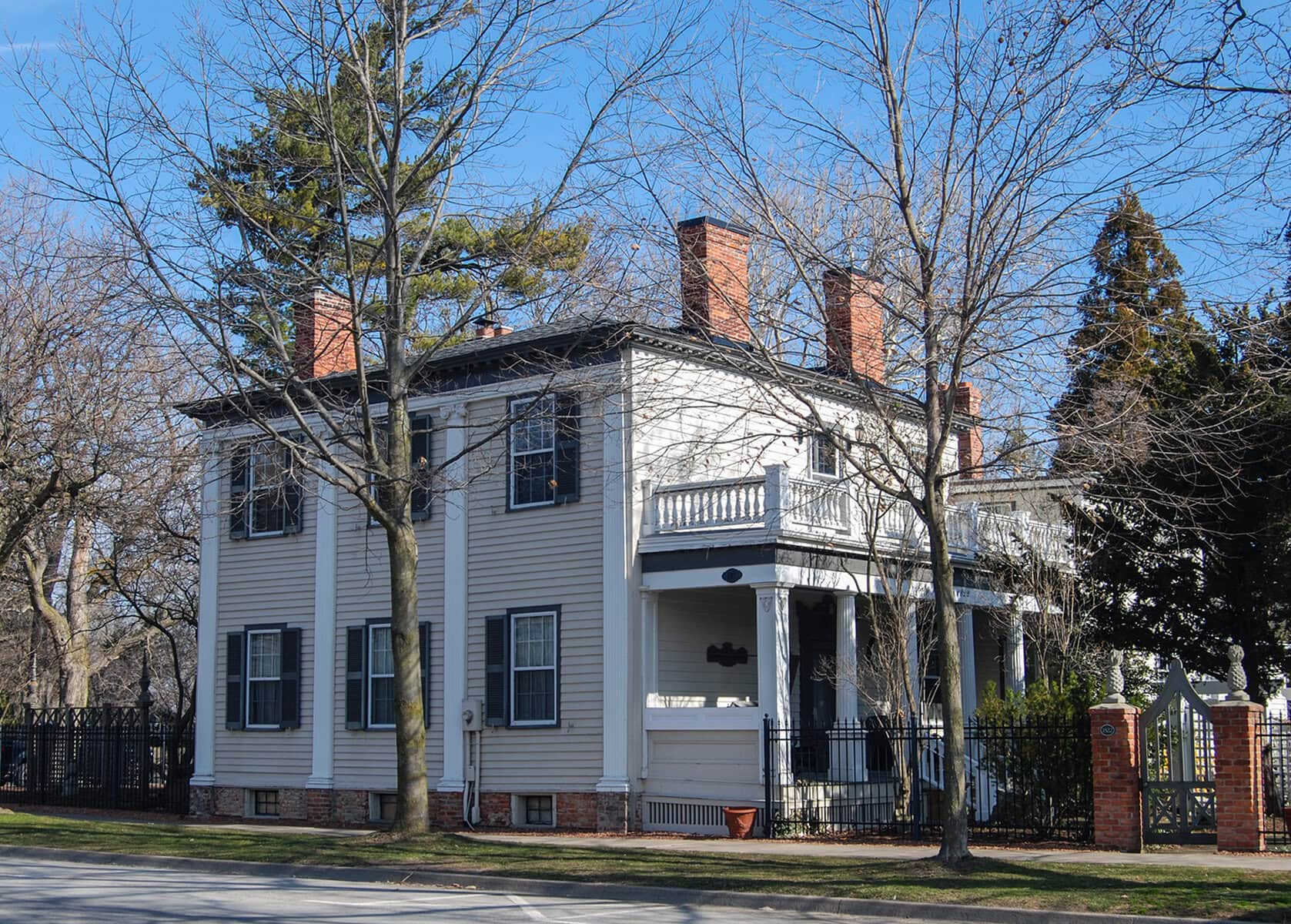


I had hoped that, at least for the month of January, this column could focus on the positive side of the ledger and offer glimpses of options that might re-enforce our town’s character. Sadly, due to recent developments, that is not to be the case.
During the Jan. 14 meeting of the municipal heritage committee, an application was made for a heritage permit to allow the construction of a garage (with living space above) attached to the historic facade of the designated Crysler-Burroughs House at 187 Queen St., together with a driveway off Queen.
Now, let’s take a moment to review past events vis-à-vis this property.
In the first half of 2024, the then-owner of the historic property, Rainer Hummel, submitted application to facilitate the severance of one new vacant lot for future residential use, fronting Simcoe Street. On July 30 and Aug. 15 respectively, council and the committee of adjustment refused the applications.
Predictably, the owner filed appeals of these decisions with the Ontario Land Tribunal.
In September 2024, rather than defend the aforementioned decisions before the tribunal, council elected to direct the town’s legal counsel to engage in mediation to reach a negotiated settlement with the appellant (applicant) with regard to these applications and present such settlement to the Ontario Land Tribunal.
In January last year, the settlement was presented to the Ontario Land Tribunal and the official decision of that body was published on April 9, 2025 (see: notl.com/media/6051). Said decision allowed for the severance of the historic property into two lots with site specific zoning and multiple negotiated provisions.
I would note that after careful review of this decision, it is my opinion that at no point in the document is there direction — specific or implied — that approval of a site plan (such a plan was not included in the attachments to the decision) including any proposed garage is required by the town.
Further, the only mention of a driveway entrance off Queen Street is found in 1.1.12 of the decision, wherein it states that “the owner/applicant must obtain approval in the form of a municipal entrance permit from the town’s operations department for a new driveway.”
In other words, the approvals pursuant to a site plan on part two (the new lot containing the heritage building), which included an attached garage, and the introduction of a driveway off Queen Street remained solely in the hands of Niagara-on-the-Lake’s town staff.
However, the decision does include, in part 1.1.5 (a), that the owner must acquire a heritage permit through the municipal heritage committee for “any alterations” (which would certainly include an attached garage) to the Part IV designated dwelling.
Oddly, in the Jan. 14 municipal heritage committee meeting, town staff’s recommendation vis-à-vis the heritage permit application focused entirely on the design elements of the garage — not on the question of whether the garage attachment to the heritage asset’s facade or the driveway off Queen Street should be permitted at all.
In fact, when this issue was queried by a member of the committee at one hour 27 minutes into the meeting, specifically asking about the site plan and the entrance off of Queen Street, the town’s heritage planner stated: “It was part of the (tribunal) settlement, the application that was approved at the (tribunal). They got approval for entrance off of Queen Street and the (zoning bylaw) approvals as part of that settlement.”
The member responded, “In other words, it is a done deal.”
To which the heritage planner replied, “Yes.”
This exchange clearly left the members of the municipal heritage committee under the mistaken impression that approval of both site plan and the driveway were a part of the Ontario Land Tribunal decision and therefore unchallengeable.
Whereas, in reality, these approvals had been generated by town staff and still required (per said tribunal decision) heritage permit recommendations through a municipal heritage committee vote to be taken after due deliberation and appropriate consideration of the impact on the designated property by the members of that committee.
It is also important to observe that there is an immense gulf between the site-specific zoning as approved in the tribunal decision and actual site plan approval.
Several municipal processes related to proposed and undertaken alterations of this important heritage property have been fundamentally flawed since the Ontario Land Tribunal decision was rendered.
As such, it would behoove the elected members of town council to delay any decisions pursuant to applications on this property until it can be determined by independent third party review that the proceedings, to date, have either fulfilled all legal and statutory requirements or require correction to ensure compliance.
At a minimum, the application should be referred back to the municipal heritage committee with a complete and accurate staff recommendation encompassing whether, or not, a heritage permit should be approved for the proposed attached garage in its current form/location, and et al.
In my opinion, anything less would be an insult to the members of this committee and a slap in the face to Old Town voters.
Brian Marshall is a NOTL realtor, author and expert consultant on architectural design, restoration and heritage.