


Realistically, this town needs more apartment buildings.
We require both affordable long-term rental accommodation and condominium units to satisfy the needs of the people who work in NOTL businesses plus first-time buyers and older folks who would like to age in place in our wee town.
Now, I am not talking about high-rise apartment towers such as what is proposed for Glendale’s White Oaks development — as I have written previously (“Arch-i-text: What’s wrong with this picture,” March 9, 2024) this type of building is inherently unsustainable, dehumanizing and, practically, never truly “affordable.”
No, what I am speaking to here is the need for low-rise (three or four storeys) buildings located on green-field (or carefully selected brown-field) sites that the town’s planning department has pre-identified and correctly zoned for such development(s).
I realize this approach to planning — proactive versus reactive — is rare in this province; however, that is not to say it shouldn’t or couldn’t be done.
Simply, as long as planning remains in the reactive mode, the future of our urban landscapes (including heritage streetscapes), together with NOTL’s rural and natural spaces, remain largely subject to the demands of developers — demands driven by profit versus what is best for the community.
Let us postulate for a moment that proper proactive planning has been instituted and provisions have been made for low-rise apartment developments on lands within our urban boundaries that respect the existing settlements and streetscapes. Would there be any reason to oppose such development?
I can only think of one.
Frankly, the architecture of most apartment buildings is crude: a single block massing sometimes articulated by harsh straight lines to resemble a jumble of smaller blocks.
Exterior finishes are largely sterile — either uniformly drab or a combination of white and black broken by the occasional application of manufactured wood grain material.
And, in those instances where colour is utilized, it is invariably applied in patterns that resemble the painting of a child in kindergarten.
This simplistic design approach to apartment buildings has dominated the sector for decades and has resulted in a quasi-institutionalized environment within the resultant neighbourhoods.
It really doesn’t have to be this way.
For contrast, let’s visit midtown Toronto to take a quick look at five ionic apartment buildings that reflect the times during which each was built.
First we’ll head to Avenue Road just south of St. Clair where there a three buildings that were constructed during the late 1920’s and reflect the social exuberance of that time as expressed in the architecture.
At the corner of Avenue Road and Balmoral (#150) stands the Balmoral Apartments, a superb example of the period revival (Eclectics) style drawing heavily on Tudor revival.
Clad in brown brick, it is decorated with limestone appointments. The main entrance is within the recessed courtyard on the north elevation: a space accessed by passing under a monumental round-arched opening whose keystone is surmounted by a stepped gable with carved detailing and flanked by rounded buttresses with finials.
Clarendon Avenue is one block south on Avenue Road and at #2 stands the Clarendon Apartments.
Much more modest than the Balmoral, it’s similarly anchored in the Tudor revival expression of the Eclectic styles. Its main field is brown and red brick laid in a Flemish bond pattern with extensive limestone appointments. Of particular note is the extensively carved cornice banding around the roof.
Finally, directly opposite on Clarendon, is the eye-popping Claridge Apartments.
Principally rooted in the Romanseque Revival style with a sprinkling of Moorish arches and classical detailing, its buff brick is also laid in a Flemish bond pattern with limestone, concrete and some marble appointments. The brick pattern decorations, standing proud of the main field are real show-stoppers.
And its lobby, with its art deco fixtures and ceiling mural painted by the Group of Seven artist, J.E.H. MacDonald, is perhaps the most beautiful in Toronto.
Next, we’ll head north to St. Clair and turn east. At 110 St. Clair West and at 64 St. Clair are the Parklane and Fleetwood apartments, respectively.
Built in the final years of the 1930s, these buildings are two outstanding examples of Toronto’s art deco architecture.
In my opinion, this architecture is just plain sexy. The curves accentuated by the horizontal brick bands create a nearly organic feel to the art deco architectural homage to streamlined modern design as expressed throughout all facets of society during this period.
Having visited the past, I wondered if there were any present-day Ontario architects producing more refined low-rise apartment designs which flew in the face of modern “factory” generated residential buildings.
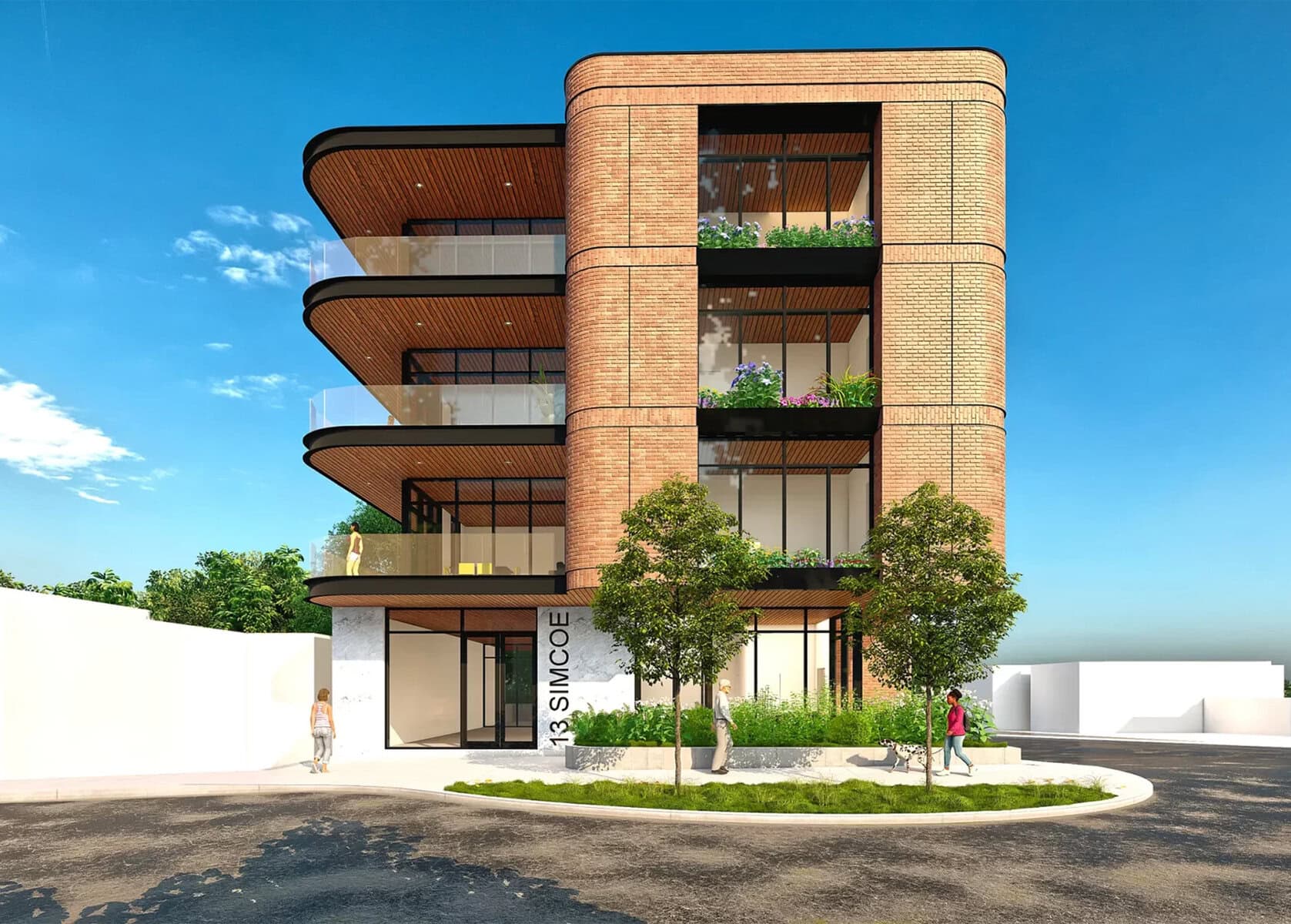
In short order, I found the Simcoe Lofts.
Developed by the Toronto firm Boldera Architects for a site in Penetaguishene, Ont., the subtly curvaceous design recalls the art deco style. The building incorporates biophilic design principles, with every residential unit granted gardens, views of the lake, while daylight and natural ventilation floods the interior spaces.
Clearly, it can be done. The question remains, “Why is this the exception rather than the rule?”
Brian Marshall is a NOTL realtor, author and expert consultant on architectural design, restoration and heritage.