


ANECDOTES & STORIES FROM THE THEATRE
**** (out of five)
Shaw Artists’ Village.
Confess. Don’t we all lean forward in expectation of a good bit of gossip or a delectable story about theatre in our town?
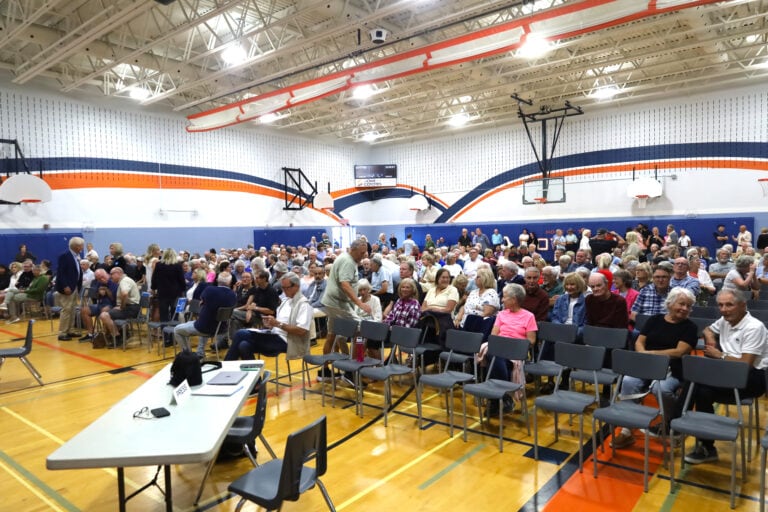
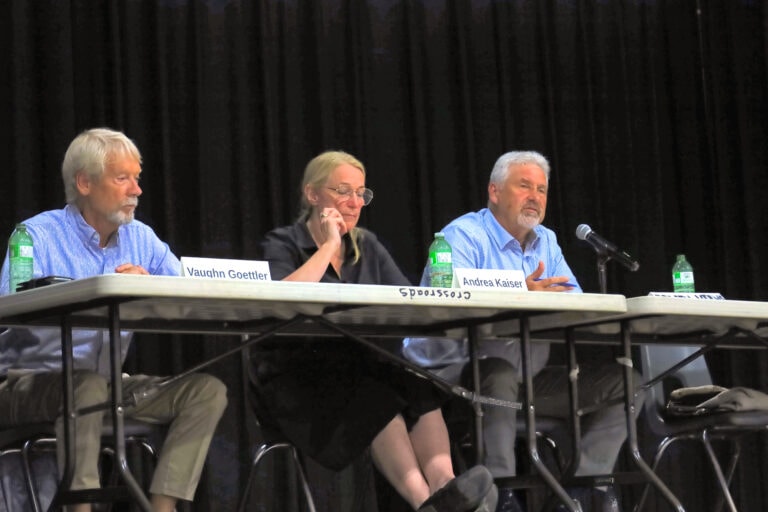
It was very clever to bring Anthony Chase, the theatre critic, historian and NPR host of “Theatre Talk” up from Buffalo, N.Y. to interview three veteran Shaw actors, Sharry Flett, Patrick Galligan and Sanjay Talwar.
The relaxed and effervescent Mr. Chase had the audience and actors immediately at ease with expected questions: How and why did they become actors? What was the road to the Shaw? How long have they been at the Shaw? What have been their experiences?
Result? Fun banter, stories of stage disasters, directors and actors fondly remembered or not so fondly remembered, the value of mentoring, curiosity and constant learning. In short, they shared a love and total commitment to what they are doing.
This is Sharry Flett’s 34th season. After obtaining a music degree from McGill University, she aspired to opera, attended a theatre school in London, had a stint in New York, roles at Stratford and elsewhere, and found home at the Shaw. She discovered that music could lead to theatre and in Canada, theatre could lead her back to music.
She has gone from Tolstoy’s “War and Peace” in 1988, to Ibsen and Chekhov among others and happily on to recent musical productions of “Funny Girl,” “Anything Goes,” “My Fair Lady” and as the charming songster Rat in “The Wind in the Willows.”
Patrick Galligan received an offer to join the Shaw when he was 40. He self-describes as a “newbie” after 23 seasons. He began with Theatre Plus in Toronto appearing with Seana McKenna in “Saint Joan,” then apprenticing at Stratford.
At the Shaw in 1993, Neil Munro’s direction of “Saint Joan” brought a contemporary, rapid-fire pace and a radical idea of Bernard Shaw. Munro’s belief in getting a dialogue going “so we have a sense of who we are” led to Galligan questioning his own faith and relationship with God.
His first performances in 2003 were in “Widowers’ Houses” and “The Plough and the Stars.” He is currently starring in “Sleuth” and “One for the Pot.”
Sanjay Talwar’s focus was on mathematics until he joined the high school drama club and worked backstage. It was the moment of being an understudy and feeling the power of being on stage that have led to performances elsewhere and 12 seasons at the Shaw.
This season he appears as an actor in “One for the Pot” and “Heartbreak House” and in previous seasons directed “Wait Until Dark” and “Prince Caspian.”
The question of “What can go wrong?” brought much laughter. Sharry Flett related the 2006 “High Society” near-fiasco.
Patty Jamieson, playing the maid, had recently delivered a baby, who was present. Jenny Wright was very pregnant at nine months. The lead, Camilla Scott as Tracy Lord, lost her voice. She lip-synced on stage while Jenny Wright read Scott’s lines and sang from the wings. The director, Jackie Maxwell, was left holding the baby backstage.
When the curtain fell, the entire group, including baby, appeared on stage to thunderous applause.
Patrick Galligan reminisced about being unable to remember his opening line as Sir Wilfred in “Witness for the Prosecution.” He stood in awkward silence with Kristopher Bowman waiting for him to speak. He quickly said he had to go to the loo, dashed off stage to the wing where the stage manager holding the script would be. No one was there.
He saw the script and quickly rifled through it to get his line. Meanwhile, the sound of thundering hooves was audible from backstage as help raced from the opposite wing to Galligan. He got the line. The play resumed. “Nobody died.”
Lesson? “Never assume you know the play.”
Sanjay Talwar’s first play at the Shaw was as an understudy in “Come Back Little Sheba.” He had to go on. At intermission, he went to the dressing room. On the return for Act 2, Sharry Flett whispered, “You’re in the wrong costume.”
He flew back to the dressing room, started throwing off his clothes, checked the script and discovered he had been wearing the right costume. He raced back to the stage. Did Sharry make mischief or make a mistake? No disclosure.
All agreed on the importance of mentors. Sanjay Talwar said that after six years at Stratford, he appreciated the ensemble generosity of the veterans at the Shaw. He learned nothing is taken for granted. He applauded the giving of space, the direct mentorship he received, the importance of learning and the realization of how he could help others.
Sharry Flett, arriving in 1988, learned from older actresses and Christopher Newton, how to find humanity in the characters. She continues to value the mutual mentoring of actors and the opportunity to “observe young actors to see where the world is now.”
“How they approach roles is different and we learn from them. Endless curiosity is important.”
For Patrick Galligan, he has learned valuable lessons. For example, have no expectation that you will be back. Anticipating roles in the next season is a recipe for disappointment. Learn from the company. Tony van Bridge suggested, “Just try it this way.” Douglas Campbell quietly told him, “Self-pity isn’t a very good choice, dear boy.”
He watched Jim Mezon take a villainous role and peel back layers to reveal the rich complexity of a conflicted character. To receive non-threatening welcomes from the company members, particularly Sharry Flett, was encouraging. Learning to fight with hacky sack games as well as learning the lines of others remains bonding.
All spoke of the importance of the audience referring to the intimacy and trust that is there during the performance. It’s live theatre. It will never be the same again. There is no archive. There is joy at the beginning of the season and at the end, you go home. They did not speak of hobbies. Their days remain focused on their work, on roles, on teaching, on sharing their knowledge.
We were not in a theatre witnessing actors. We were in a space witnessing life. The audience, the host, the actors, the writer were all part of a unique event, never to be repeated, with a shared elation and insights that will be remembered.
Penny-Lynn Cookson is an arts and culture historian, writer and lecturer living in Niagara-on-the-Lake.