



A CHRISTMAS CAROL
*** (out of five)
Royal George Theatre, 1 hour, 40 minutes, one intermission. Ends Dec. 21. By Charles Dickens. Adapted for the stage and directed by Tim Carroll.
Oscar Wilde once said, “In life, there are two tragedies. One is not getting what one wants. The other is getting it.”
This gives one pause for thought. Some will mourn the final performances of “A Christmas Carol” at the Royal George for the foreseeable future. Others will mourn the passing of the theatre itself, given its pending destruction and debated reconstruction. Both are stories of the past, present and future.
“A Christmas Carol” has within it experiences of Charles Dickens’ own life (1812-1870). He was that lonely boy, forced out of school and home at 12, to work in a boot blacking factory due to his father’s incarceration in a debtors’ prison.
Despite a lack of a formal education, Dickens edited a weekly journal for 20 years, wrote 15 novels, five novellas, including “A Christmas Carol,” and hundreds of short stories and articles.
Passionate about the theatre, he loved mimicry and performing his characters on tour in Britain and America. Dickens was a major influencer of the mid-Victorian times, a dynamic intellectual, a prolific force in literature, journalism, theatre, performance art and social activism. No Scrooge, he was a generous man.
His two favourite books were the “Arabian Nights” and “Robinson Crusoe,” which influenced “A Christmas Carol.” The fantasy tales, narrated by Sheherazade, were stories within stories told over many nights. This framing device was used by Dickens for the ghosts of Christmas Past, Christmas Present and Christmas Future.
And in the descriptive character of the loner Ebenezer Scrooge lies the influence of the hardened Robinson Crusoe, a shipwreck survivor alone on a remote tropical island set in the era of imperialist expansion for trade and profit. Ideas transferred to the cold ruthlessness of business in London.
In contrast to the warm anticipation of Christmas Eve, those within the office of Scrooge and Marley remain chilled to the bone. Scrooge denies extra coal to his shivering employee Bob Cratchit (Travis Seeto).
Nephew Fred (Jay Turvey) arrives to extend a cheerful Merry Christmas to Scrooge. He is dismissed with “Bah! Humbug.” Two gentlemen canvassing for donations for the poor are briskly rebuffed.
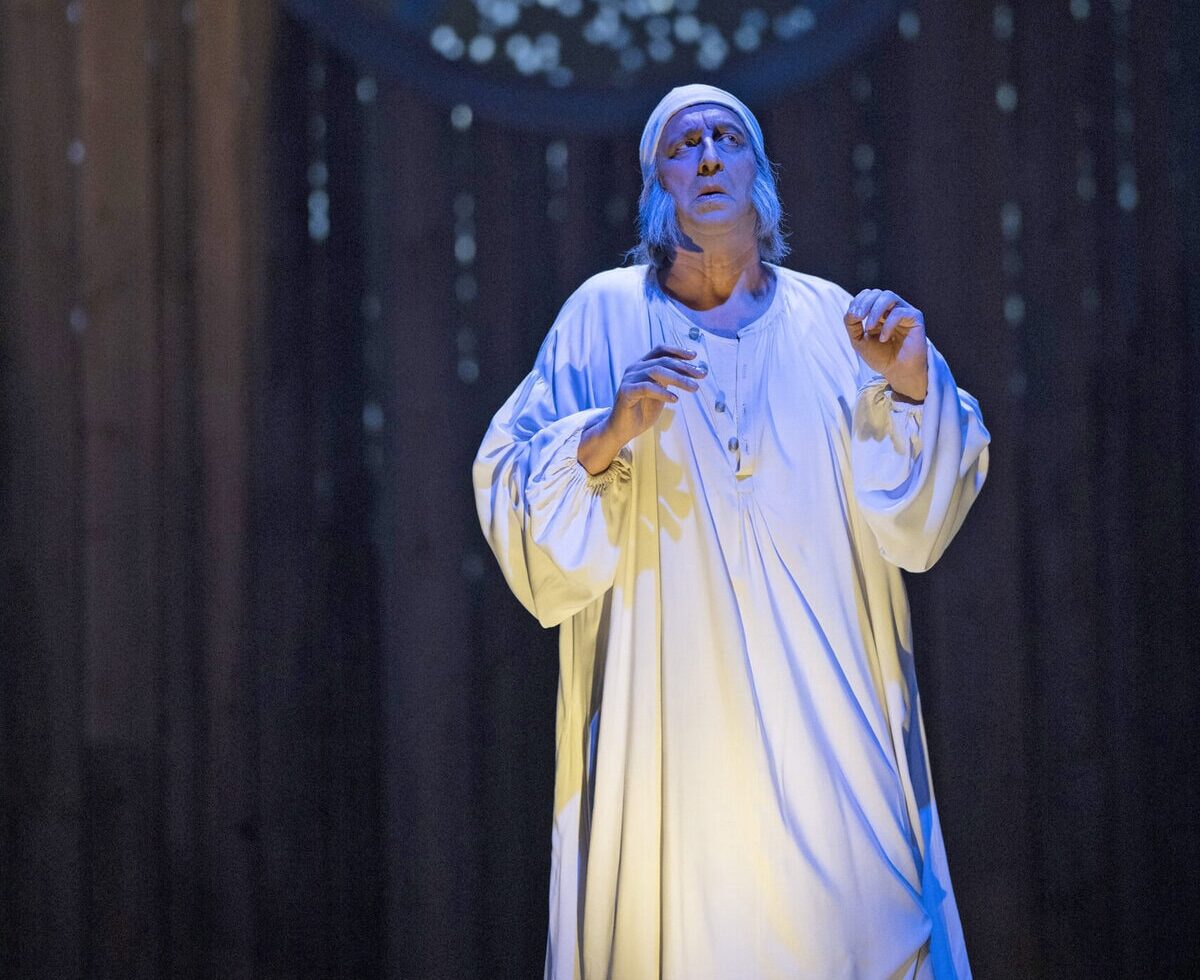
Scrooge (Sanjay Tanwar) resents giving Christmas Day off with pay to the long-suffering Cratchit, who, with a family of a wife and six children, is terrified of losing his job and his small income. Scrooge’s only concern is how many gold coins are nestled in his money box.
Home alone, Scrooge is spooked by the ghost of his former partner, Jacob Marley, who, condemned to wander the afterlife in iron chains, has come to warn Scrooge of his bleak fate if he doesn’t change his ways. Scrooge’s one chance to escape a bitter destiny is to agree to the visits of three spirits: Christmas Past, Present and Future. He agrees.
Christmas Past uses clever Victorian black silhouettes to reveal Scrooge’s lonely boyhood. He witnesses his fiancée, Belle, leave when she recognizes money means more to Scrooge than love.
Scrooge sees his beloved sister, Fan, die in childbirth. The infant, his nephew Fred, survives (Dickens lost his own beloved sister Fanny).
Christmas Present (Kristopher Bowman) is a jolly giant of plenty, clothed in a green robe and scabbard festooned with fruit, fish, fowl and drink. Together, they observe the Cratchit family, which includes the crippled Tiny Tim, sharing a modest Christmas dinner.
Christmas Future swoops in as a large white shroud, a phantom of what is to come. Scrooge is shocked to hear his business acquaintances express “a very cheap funeral” and that they might attend if lunch is provided.
At a resale shop in the grimy back alleys of East London, Mrs. Dilber (Patty Jamieson), Scrooge’s former charwoman, flogs his linens and bed curtains, rings and all. Once Scrooge sees his name on a tombstone, he understands the error of his ways and becomes a changed man.
Suddenly, free of gloom and full of the spirit of love and giving, Scrooge vows to be a good uncle, a good boss, a good friend, and become “as good a man as the good old city knew…”
We wanted to feel that spirit of love, but the production seemed tired. It was the assured, solid performances of veterans Jay Turvey, Graeme Somerville and Patty Jamieson that carried the show.
Curious casting had Turvey as Scrooge’s nephew Fred, appearing as old as Scrooge. Conceivable but questionable. Travis Seeto is too young, too fresh, to be the weary Bob Cratchit carrying the weight of his job and family with a dying child. Tiny Tim is an essential character and this rigid wooden puppet has never worked, nor do the other puppets.
For Scrooge, redemption has arrived. A changed and overjoyed Scrooge, back from the brink of tragedy, shares his wealth, embraces his family and will be a better person.
And so, in the spirit of the present and future joyous experiences, “A Merry Christmas, everybody.”
Penny-Lynn Cookson is an arts and culture historian, writer and lecturer living in Niagara-on-the-Lake.