



Plans to let a developer keep a piece of land that was going to be turned over to the Town of Niagara-on-the-Lake triggered a wave of frustration, confusion and concern from St. Davids residents during a virtual open house last Monday night.
The plot of land at 46 Paxton Ln., next to the historic David Secord House, was originally required to be given to the municipality for archeological protection after clearing the land.
Many said the proposal creates new uncertainty about how the subdivision will evolve and what it could mean for traffic and the layout of what’s called the Settlement at St. Davids (Extension).
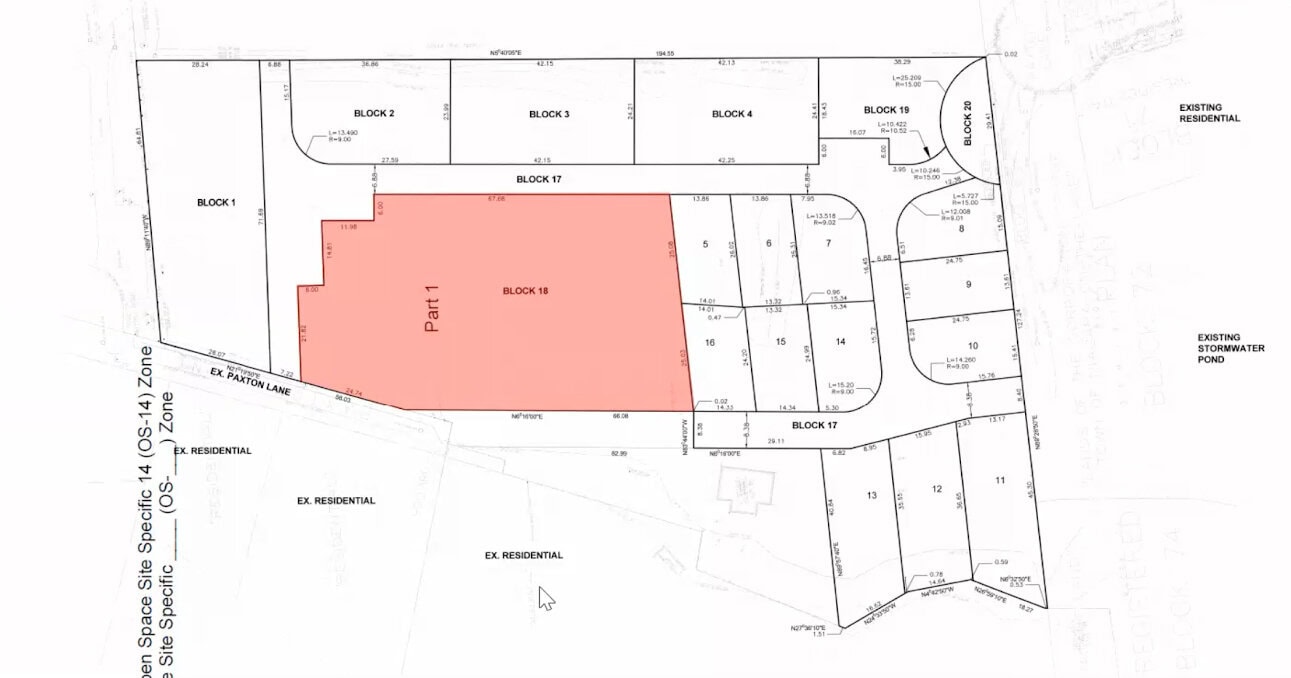
The lot, block 18, is a leftover piece of land inside the subdivision that was supposed to be conveyed to the town because the site still needs archaeological review, a requirement set when the draft plan was approved by the Ontario Municipal Board (now the Ontario Land Tribunal) in 2013.
That approval permitted a 36-unit condominium elsewhere on the site, along with a park, while block 18 was set aside as protected land requiring a future archeological assessment.
No archeological clearance has been issued and the block has remained untouched, still owned by 2233497 Ontario Limited, a numbered company based in Toronto.
The developer is now seeking approval for a revised 29-unit plan — fewer units than previously approved — and the removal of the original requirement that block 18 be conveyed to the town.
It is also asking to add a holding symbol that would freeze the site until the Ministry of Citizenship and Multiculturalism issues an archeological clearance letter and a future development application is approved.
The Ontario board has since delegated authority to the town to amend draft plan conditions.
Jennifer Vida, the planning consultant representing the developer, said the developer and the town agreed it was better for block 18 to remain in private ownership.
She said studies have already confirmed artifacts on the site that must be excavated but there is no indication that anything “insurmountable” would prevent future development, calling the process largely “a matter of cost.”
Although the developer could ultimately leave the land protected if excavation costs are too high, the “what ifs” set off strong reactions from residents.
Traffic concerns take centre stage
The entire subdivision relies on a single access point off Four Mile Creek Road, with no secondary exit.
“I live on Goring Way, and my biggest concern about this development is the traffic,” said resident Lorraine Jensen. “When you have young children in a subdivision and there’s already a lot of traffic. That’s obviously a huge concern.”
Vida said the Ontario board “did refuse to allow another entrance to the north extent of Paxton Lane, because that is an unimproved road,” adding the single entrance “was always part of the intent.”
She said the current plan’s 29 units — down from the 36 approved in 2013 — should translate to “a little bit of relief” on traffic.
Greg Walker said the subdivision “already” needs another way in and out and noted he previously raised the issue with town planner Connor MacIsaac, asking whether improving North Paxton Lane could relieve existing traffic issues and support any future development.
MacIsaac said the town cannot require improvements tied to a development application it does not yet have, but said comments would be forwarded to operations staff. He added that a reduced unit count does not usually trigger road improvements.
Laura Walker said residents had already requested a traffic study — one that was not presented at the open house — and warned that left turns onto Four Mile Creek Road will be a “nightmare” without better access.
Vida said traffic concerns will be addressed in a future town recommendation report and advised residents to raise concerns about existing conditions directly with operations staff.
Louanne Rudisuela said changes to block and lot labels are where “the confusion really lies,” asking, “Why is there a change?”
Vida said the map and numbering system now being used “are slightly different” from what the Ontario board approved.
Municipal ownership isn’t practical, consultant says
Vida said keeping block 18 in municipal ownership “is just too much of a financial burden” due to the cost of excavation and because the parcel sits inside a private condominium.
“The land can’t really be used by the town,” she said.
MacIsaac said the Ontario board’s decision “specifically laid out” that block 18 would not be considered open space and “was just a methodology of protecting the archeological resources.”
Vida added the block was “simply zoned as open space as a no-touch zone because of the archeological.”
Laura Walker suggested the town could benefit from the land in the future, but Vida said it “can’t be touched” without costly archeological work the municipality would not undertake.
There is no firm timeline for the archeological work on block 18, but Vida said the developer wants to begin construction on the rest of the subdivision as soon as possible.
Any future application for the block of land, she said, would depend on archeological clearance and market conditions and would require a separate application and full public process.