

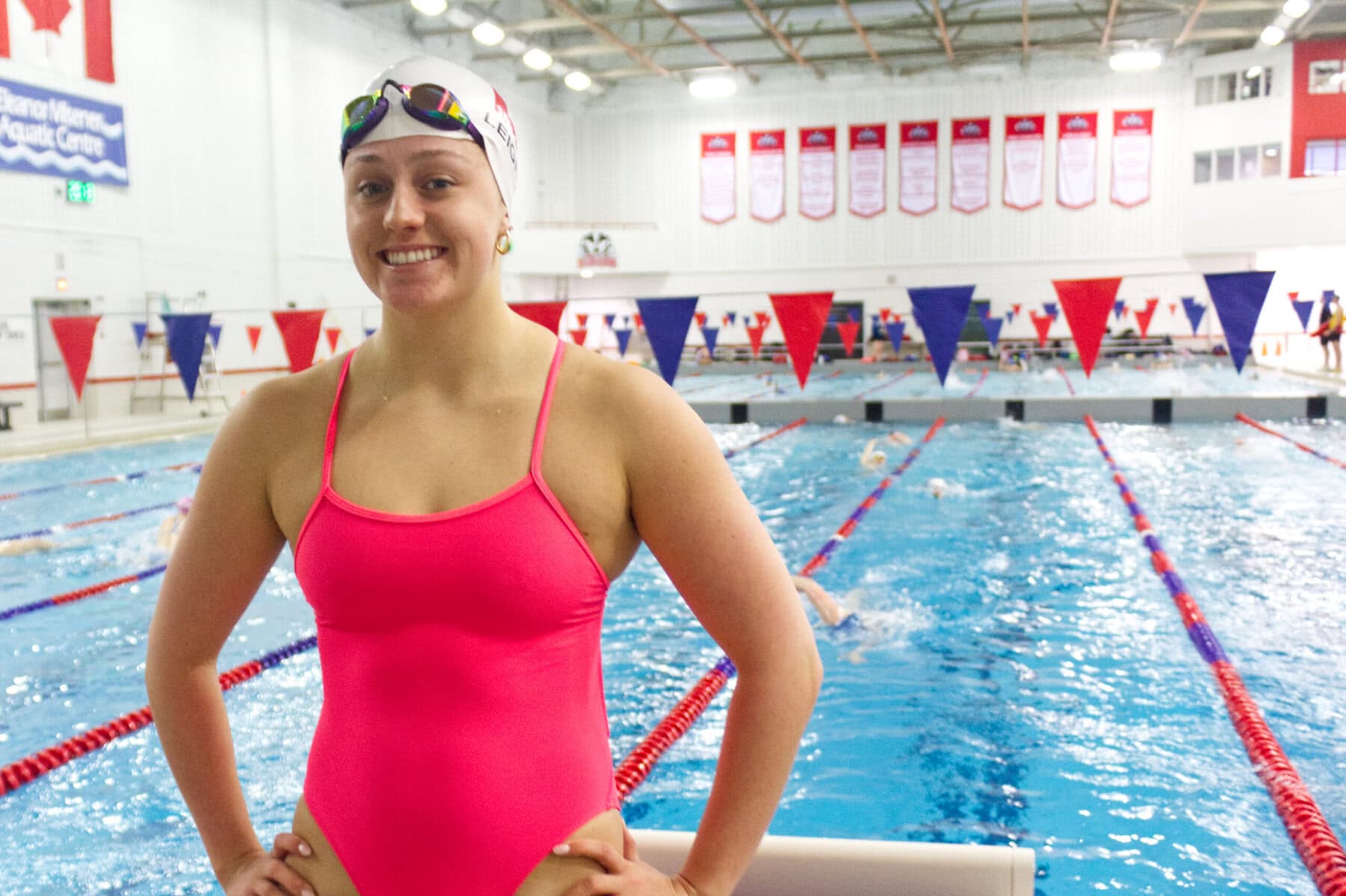


Garrison Village-based swimmer Peyton Leigh has been swimming for nearly all her life — she was first in the pool at five months old.
While her focus is on feats of speed and endurance in the water in competitive settings, she also knows that basic swimming skills can save your life.
Leigh said she could do survival-level swimming at age two. She said that all kids should get a taste of some of the training she has received.
“I know a lot of kids don’t have access to being … put into swimming lessons and a lot of children don’t know how to swim. I think it’s a great life skill.”
Her assessment comes in response to the Town of Niagara-on-the-Lake voting to urge Ontario’s Ministry of Education to make survival swimming lessons mandatory in elementary schools across the province.
“I think it should have been done a while ago,” Leigh said.
Town council passed the motion last Tuesday after it was introduced by Coun. Adriana Vizzari, a St. Davids-based councillor with four children attending St. Davids Public School.
The Swim to Survive program, offered by the Lifesaving Society of Canada, teaches basic water survival skills for situations such as falling into a pool or lake. The requirements are rolling into deep water, swimming 50 metres and treading water for one minute.
The Lifesaving Society of Canada reported 189 drowning deaths in Ontario in 2021, the most recent year for which data is available, according to its 2025 Ontario Drowning Report. Drowning is the third-leading cause of injury-related death for children under 14, which is why Vizzari believes this program would be a good idea.
Vizzari said she remembers taking Swim to Survive lessons as a child and wants the program offered to her children and students across Ontario.
“When I went to school, there was Swim to Survive,” she said. “We went to Brock and all kids learned how to survive.”
That tradition continues. Leigh’s coach, David Ling, teaches Leigh and other swimmers at Brock University and was lifeguard certified for 20 years. He agrees with Leigh’s and Vizarri’s assessments.
“We want them to be safe around bodies of water and not get to the point that they’re in their early teenage years, their friends are jumping into a quarry and they’re having a good time, they jump into a quarry thinking it might be OK and it’s not,” he said.
“There are high, high, high consequences to not being water safe.”
Vizzari said making the program mandatory would ensure equal access for all children.
“I think water safety should be treated as a basic life skill and provincial support creates consistency across communities,” she said. “(It’s about) making sure safety doesn’t depend on income or opportunity.”
Vizzari said the proposal remains in the early stages and she has not yet discussed it with town staff or the province. However, she said she has received positive feedback and noted that other Niagara region municipalities, including Niagara Falls and St. Catharines, have expressed support.
Parents in NOTL have also voiced support.
Janice Dodd, who has three children, said swimming skills are essential.
“100 per cent we think swimming is very important,” she said.
She added that her family is fortunate to have access to a pool.
“We are lucky that we have a pool,” she said. “Mike (her husband) and I grew up with parents recognizing the importance of swimming as a survival skill.”
Ella Loewen, whose 12-year-old son and 10-year-old daughter have both taken swimming lessons, said she supports a school-based program.
“Having grown up in Germany, I experienced a system where swimming education was integrated into the public school curriculum,” she said. “Instruction was mandatory, fully funded and delivered during school hours.”
“Coming from a family of 10 children, private swimming lessons would not have been financially feasible. School-based programs ensured that every child, regardless of economic background, learned this essential life skill.”
Accessibility was also raised by Christy Vanderloos, who has a seven-year-old daughter.
She said the government must ensure adequate access to facilities.
“We have a pool, and getting my daughter lessons she needed wasn’t easy,” she said. “If we are losing facilities like the Y, that cuts back on availability of places to teach those skills.”
“Ontario would benefit from adopting a similar approach.”
Amarjog Johal, who has four children, said learning to swim is especially important in communities with easy access to water.
He referenced a news story in which a 13-year-old in Australia swam four miles to shore to get help for his mother and two younger siblings after their kayak tipped over in bad weather.
“I think it’s a good idea overall, especially given the local water access,” he said. “Also it becomes very important when you learn of some stories like this one.”
Asked about logistical challenges such as liability, Vizzari said the program could be handled in a manner similar to school field trips, though she was unsure how that would work at the Ministry of Education level.
She said she does not yet know what success would look like but said zero drowning deaths would be ideal.