



Niagara-on-the-Lake council has approved the teardown of two 20th-century barns in the town’s rural area, rejecting a recommendation from its municipal heritage committee to keep one of the barns up.
The town is siding with municipal staff, which said the buildings aren’t significant enough historically and culturally and don’t meet the province’s criteria to prevent demolishing them.
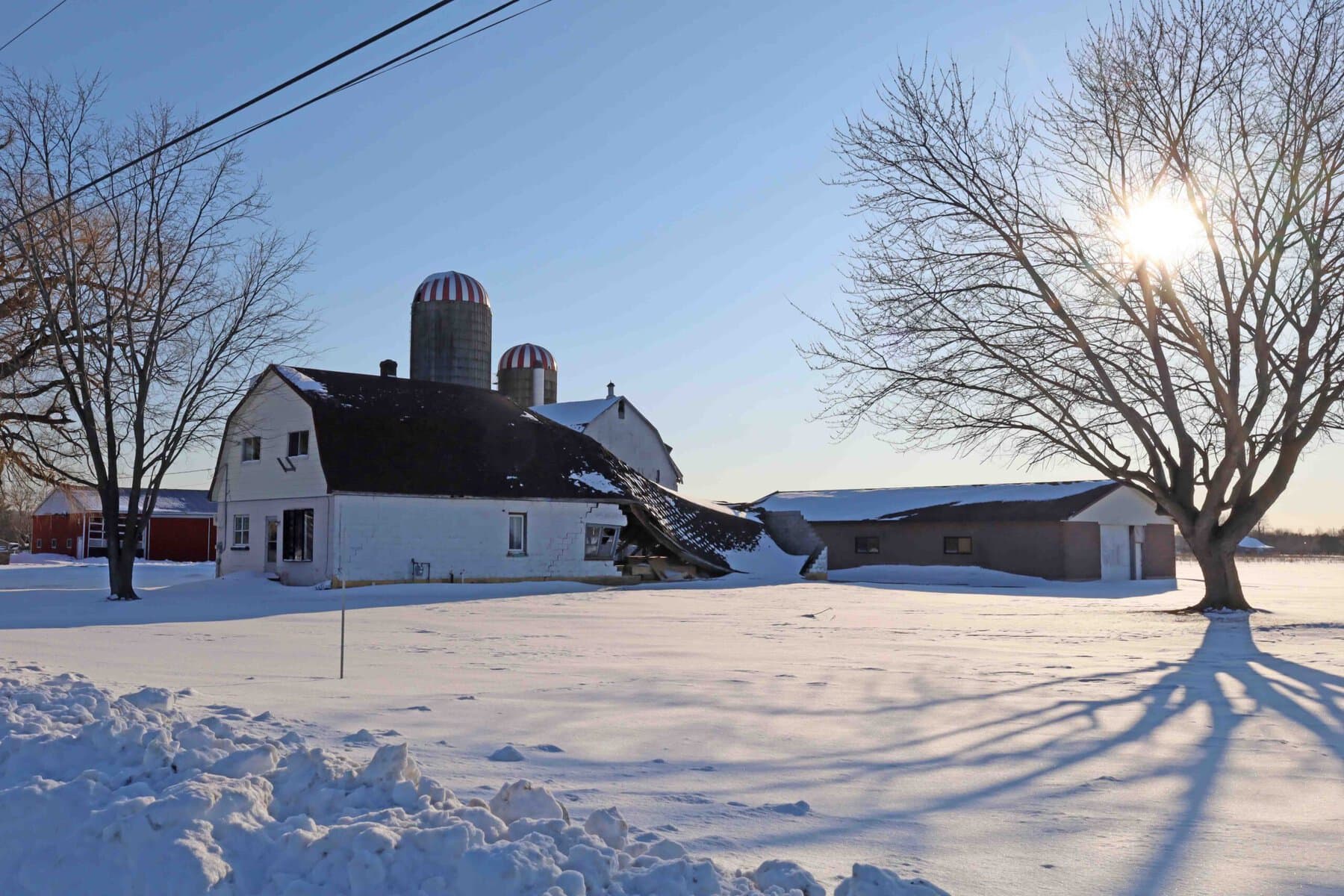
During its Jan. 27 meeting, council voted to allow the demolition of a large barn with an attached silo and a smaller, partially collapsed barn.
Coun. Gary Burroughs, a member of the heritage committee, cast the lone vote in support of not demolishing one of the barns.
The two barns sit on a single property at 766, 774 and 796 Four Mile Creek Rd.
A report by heritage planner Garrett France-Wyllie, presented to the municipal heritage committee during its meeting on Jan. 14, states that part of the larger, wooden framed barn was constructed before 1934, with additions made between 1965 to 2000.
The smaller, concrete barn was constructed between 1934 to 1955.
A Zillow listing for the Four Mile Creek Road property says the site was built in 1904.
During the Jan. 14 meeting, members discussed the demolition request, made by the property owner. They talked about the barns’ visual and cultural significance as part of the rural landscape and noted that similar barns are disappearing in NOTL.
The committee ruled that the larger barn and one of its silos should stay, while the partially collapsed barn could be demolished.
It recommended that staff evaluate the property as a potential cultural heritage landscape.
During the council meeting, Coun. Tim Balasiuk, a member of the heritage committee, said the committee was concerned about the steady loss of large, traditional-looking barns in NOTL’s rural areas.
“A lot of these large barns in Niagara-on-the-Lake’s rural areas are disappearing,” he said, calling them “a bit of a landmark.”
However, in a report presented to council during the Jan. 27 meeting, France-Wyllie wrote that heritage staff determined the barns do not meet the Ontario Heritage Act’s criteria needed to prevent demolition — they satisfied only one of two required criteria, the report said.
“Staff would not support the inclusion of the barns as heritage attributes within a designation for the dwellings, as the heritage value is not strong enough to merit protection for the barns,” the report said.
Balasiuk said the committee accepted that the partially collapsed barn would have to be torn down and focused on whether the larger barn could be preserved. But images later submitted by the property owner suggested the structure was in poor condition.
“The barn does not look sound,” he said. “That was what I think the municipal heritage committee was looking for: some sort of evidence.”
“I hate to see it go,” he added.
Burroughs said the heritage committee had hoped to slow the process down to allow more time for assessment and documentation.
“We all, there, value driving by that property and it’s a cultural, agricultural image that — all we were trying to do at the committee level — was to see effectively preserved.”
Burroughs said his goal was to allow time to “save what could be saved or not” and record “what was a very important farm scene in our community.”
Staff said the buildings will be photographed before removal, with images provided to the town and the NOTL Museum. Salvageable materials must also be offered to salvage companies to reduce waste.
Coun. Maria Mavridis acknowledged the emotional connection some have to the site but said staff resources need to be focused elsewhere.
“These are memories,” Mavridis said, “but we’ve got a long list of heritage properties that are designated that we’ve been meeting with ministers trying to save.”
Coun. Erwin Wiens agreed: “We don’t need money. We need boots-on-the-ground help to get through 200 homes.”
“We’re coming up to a serious deadline,” he added, referring to the Jan. 1, 2027 deadline Ontario municipalities are facing to decide whether to protect properties on its heritage register or risk losing interim protections.
He also raised concerns about imposing preservation costs on the owner.
“I don’t know if it’s up to me to impose those views,” said Wiens.
Coun. Wendy Cheropita said the silo and remaining barn are emblematic of the town’s rural heritage and that she hoped anything salvageable could be preserved.
“I’m so torn by this one,” she said.
Cheropita said the silo is “the drive-by that is the cultural heritage of the rural area,” calling it, and the barns, “really reflective of the great heritage that we have in our rural area.”
“So much of it is disappearing,” she said.
Coun. Sandra O’Connor questioned how a cultural heritage landscape would be evaluated and what protections, if any, it would provide. Staff said evaluating a cultural heritage landscape would require a process similar to a heritage conservation district, including assessing staff capacity, costs and the historical merit of a broader rural or agricultural area.