


The gloves came off on stage Thursday night when one Niagara-on-the-Lake council candidate accused two fellow candidates, both incumbents, of betraying residents over the Parliament Oak development, questioning whether voters could trust them with another four years in office.
“There are two incumbents here tonight who voted for Parliament Oak,” Steve McGuinness told the audience. “Will they betray your trust again?”
He was referring to Couns. Maria Mavridis and Adriana Cater-Vizzari, who voted in favour of the 129-room hotel on King Street when council approved the project in a narrow 5-4 vote in June 2024.
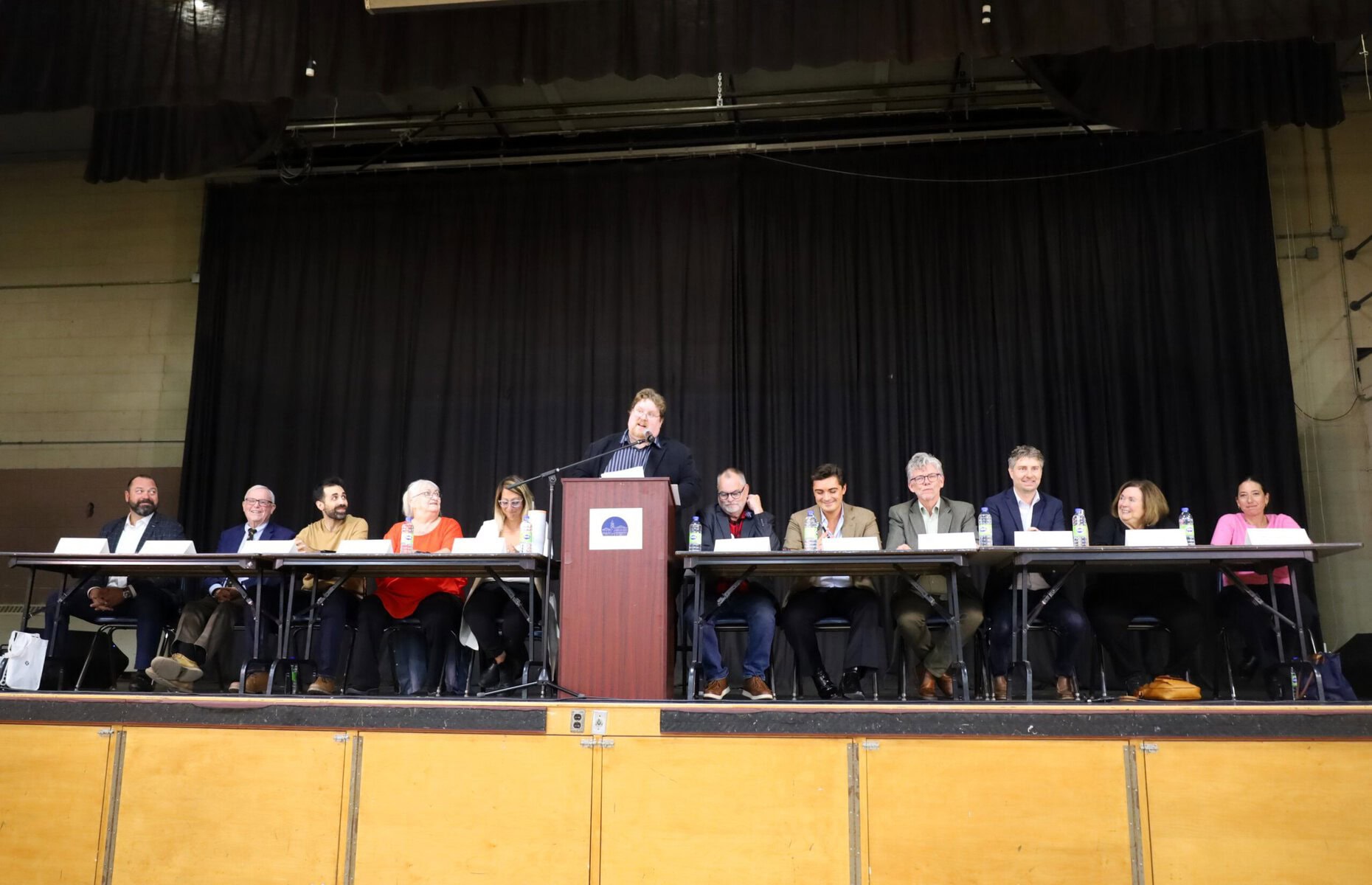
The accusation came during the closing remarks at a NOTL Chamber of Commerce council candidate forum, held at Vineridge Academy on Niagara Stone Road on Oct. 15.
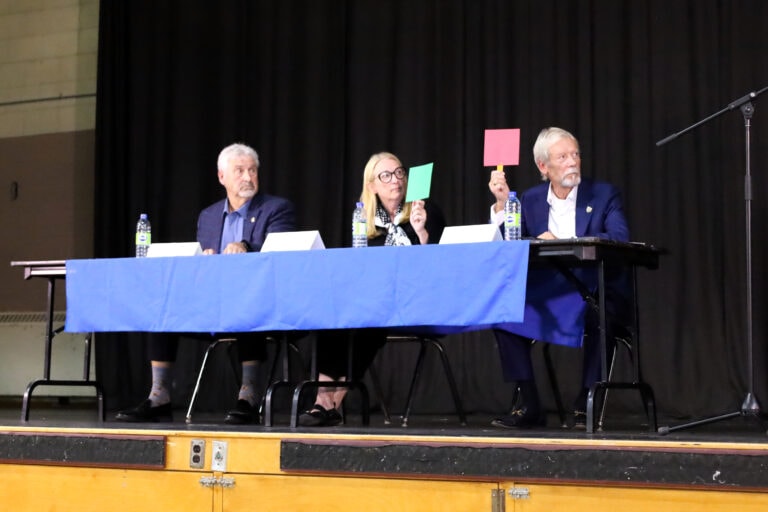
It was a pointed end to an evening that saw all 11 candidates answer eight questions, with just 45 seconds each to respond, before a lightning round where they held up green or red cards to signal whether they agreed or disagreed with a series of statements.
How many exceptions are too many?
The divide between candidates became clear when they were asked whether developers should be allowed to seek exceptions to the town’s official plan, which guides where and how development happens.
For Nicholas Colaneri, the answer was easy.
“Coming with an amendment is laughing at that official plan,” he said, arguing that none should ever be allowed.
Mavridis presented a contrasting argument. She called the official plan “a guiding document” and argued some projects need changes to the rules in order to move forward.
“It’s not legislation,” she said.
“So, to say zero amendments is literally impossible to do,” she added, offering a hypothetical example of a grocery store in Glendale that might need an amendment for loading docks.
Coun. Sandra O’Connor would make exceptions only in extraordinary circumstances — for example, if a hospital wanted to build in town.
“I would consider amending the official plan for something like that,” she said. “But apart from that, I think we should stick to what we have.”
Weston Miller said he would generally vote against developments that don’t follow the plan unless there is a clear public benefit.
According to Miller, council approved 72 zoning bylaw amendments and 21 official plan amendments over the past four years.
“That’s not the exception anymore, that’s the standard operating model,” he said. “That needs to change.”
Coun. Gary Burroughs said the next council must “be very strict” with what he called a “living document,” noting that it’s also up to developers to “follow the rules.” Meanwhile, Coun. Tim Balasiuk said he could support amendments that benefit residents.
Tourism: too much of a good thing?
Has NOTL reached its limit when it comes to visitors? Possibly, said McGuinness.
“We may have reached the tipping point,” he said.
McGuinness criticized the province’s Destination Niagara strategy for calling for a doubling of visitor numbers across the region.
“I want to put residents first. That means before developers. That means before tourists. We need to protect the jobs in the industry, but we can’t have a doubling of tourism,” he said. “It’s not responsible.”
Coun. Andrew Niven disagreed with that diagnosis.
“I don’t think we have a tourism problem. I think we have a tourism management problem,” he said. “I feel we should really focus on not necessarily growing the tourism economy, also just managing the tourism economy.”
For Rick Mills, the question was also about who foots the bill.
“The tourists visit us. It does cost to attract them, but it must cost the tourists more — more than us,” he said.
Karen Taylor-Jones, listed on the ballot as Karen Jones-Taylor, warned against losing the distinctive character that draws visitors to town.
“We shouldn’t sacrifice those things in the process of attracting more visitors,” she said.
Cater-Vizzari pointed to the other side of the equation: tourism brings in money that can help fund local amenities. She cited municipal accommodation tax revenue used to support the NOTL Museum expansion.
McGuinness, an accountant, argued that developers and tourists should shoulder more of the cost of maintaining the town’s infrastructure and services. He called for higher development charges and greater contributions from visitors to ease the burden on property taxpayers.
Promises, and a warning
Asked what they would do in their first year to make NOTL a better place to run a business, Colaneri promised to restore resident advisory committees, arguing that residents had lost their voice.
“They’ve lost their ability to shape their future themselves,” he said.
Mavridis, again, offered a pointed contrast.
“Committees are great, but committees consist of six to 10 people,” she said, defending the broader business roundtables held during the current council’s term and arguing councillors should get out of town hall and speak directly with the people affected by their decisions.
Balasiuk also pointed to existing business roundtables and said the town should continue supporting entrepreneurs, though it cannot guarantee their success.
O’Connor said her first priority would be rebuilding trust with the business community through regular meetings and meaningful discussions.
Cater-Vizzari suggested bringing municipal officials into Business After Five networking events to hear directly from local business owners.
Miller proposed working with local businesses, Niagara College and employers to address workforce needs and barriers to business growth.
When it came time to make their final pitches, Taylor-Jones rejected the idea of making a long list of campaign promises.
“I’m not a professional politician,” she said. “I’m not going to pretend to know everything.”
“But I will listen to you.”
“I’ll ask the questions that need asking and I’ll do my homework — and stand up for what I believe is right, even when it’s not popular,” she added.
Niven defended his approach to his previous council decisions.
“I’ve asked the questions. I do the homework,” he said, noting proposals should not automatically receive a “yes” or “no” vote without considering their effects on residents, infrastructure and the town’s future.
“I was given the opportunity to serve on council, and now, I’m asking residents for the opportunity to continue that work,” Niven said.
McGuinness, meanwhile, called for a shakeup at the council table, warning that re-electing the same councillors could mean repeating the mistakes of the past.
For Mills, it’s not about having every solution. In fact, he said he has “more questions than answers.”
“I’m here to work together,” he said. “I’m here to be hopeful.”
And Burroughs, a former lord mayor and regional chair, delivered a warning to residents.
“In all the years I’ve served this community, I’ve never been more concerned about its future.”
“The decisions ahead are critical — and so is your vote,” Burroughs said.
The candidates have had the microphone.
Voters will have the last word — on Oct. 26.