

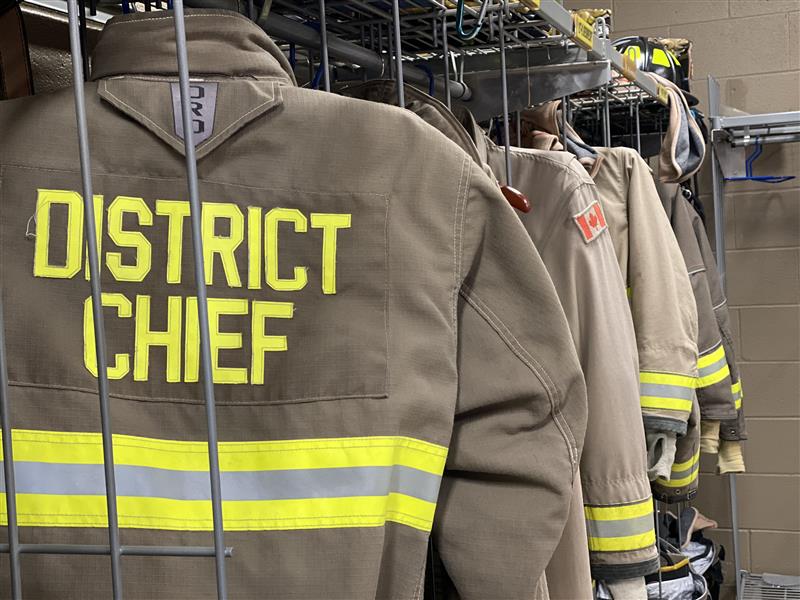


Firefighters’ bunker gear is designed to protect them in emergencies — but after a fire, that same equipment can carry cancer-causing contaminants, making access to clean backup gear critical.
Niagara-on-the-Lake Fire and Emergency Services will receive an $82,000 provincial grant to purchase second sets of bunker gear for firefighters so it can remain available while contaminated equipment goes through its lengthy wash-and-dry process.
The fire department received the funding after applying for the Fire Protection Grant, a $30-million program the Ontario government introduced in 2024 to help fire departments reduce cancer risks for firefighters.
Fire Chief Jay Plato said 100 per cent of the money will be used to purchase 24 additional sets of bunker gear.
Plato said the department learned about the grant through the application process administered by the Office of the Fire Marshal under the Ministry of the Solicitor General.
He said the fire marshal’s office provided suggested funding thresholds and after assessing the town’s bunker gear needs at about $82,000, the department applied for that amount and was approved.
Andre Thurairatnam, a spokesperson for the office, said the Ontario government is committed to firefighter health and safety and introduced the grant to support firefighter cancer prevention. Grant amounts were based on the number of active fire stations, he said.
“Funding amounts were based on the total number of active fire stations in each municipality who were approved for grant funding,” said Thurairatnam. “This approach ensures a fair and consistent distribution of funding across the province.”
All 380 eligible Ontario municipalities applied and were approved for funding in the 2025–26 grant year, he said, and municipalities with one active fire station received approximately $16,000, with the amount increasing per active fire station.
Marah Minor, the town’s communications co-ordinator, says the town received notice that the grant application was approved, but hasn’t received the funds yet.
Plato said the additional gear is key to reducing repeated exposure to cancer-causing contaminants after fires.
“After a fire, bunker gear — like the coats and pants that firefighters wear, even everything, gloves, hats, helmet, everything — are contaminated,” Plato said. “They’re contaminated with carcinogen.”
Properly cleaning that gear takes time, Plato said. Moving bunker gear through a full wash-and-dry cycle can take up to eight hours.
“So, what the extra gear does is it ensures that all of our firefighters are able to still be responsive,” he said. “But at the same time, it provides the backup.”
Each full set of bunker gear now costs roughly $3,500, Plato said, and the grant helps round out a council-approved initiative launched a few years ago to provide firefighters with second sets of gear.
Thurairatnam said the program supports cancer prevention by funding measures — such as equipment replacement or backups — to reduce exposure to hazardous contaminants.
He noted contaminated protective equipment can expose firefighters to hazardous biological and chemical substances and reduce its effectiveness.
“Firefighters die of cancer at a rate up to four times higher than the general population,” he said. “On average, 50 to 60 firefighters die of cancer yearly in Canada — and half of those are from Ontario.”
Beyond second sets of bunker gear, Plato said the department has made other investments to reduce exposure risks, including installing large extractor washers at each station, direct-capture exhaust systems for fire trucks and providing shower facilities so firefighters can clean up after incidents.
“We’ve made some good investments,” he said.
“Cancer prevention within the fire service is huge,” said Plato. “There’s a number of things that we’re doing, ensuring to keep cancer prevention on the top of mind and then trying to do it for our folks.”
Plato said cancer prevention has become a growing focus provincially, too.
“There’s probably been more focus within the last 10 years,” he said, adding “it’s always been something that’s been known within the fire service.”
“Provincially, it’s become more of a focus and a topic that people are chatting about,” said Plato.
“Just even in the last couple years,” he said, pointing to “a couple new cancers” being added to an updated prescribed cancer list.
Plato said protecting volunteers is especially important in a community-based department like NOTL’s, where firefighters serve out of commitment rather than compensation.
“People are signing up to become members of our department — not for the pay or not for the reasons that you might become a firefighter in your professional career,” he said.
So taking safety seriously is “the least we can do” for volunteer firefighters, Plato said, “to protect them for the great service that they’re stepping up and doing.”
In a Jan. 16 news release, Lord Mayor Gary Zalepa said the grant supports the town’s priority of protecting volunteer firefighters.
“On behalf of council, we are grateful for this provincial investment,” he said.
Chief administrative officer Nick Ruller said the funding is an important investment in firefighter safety.
“Modern, high-quality bunker gear is a critical line of defence,” Ruller said. “This grant directly supports cancer prevention and long-term health outcomes for the team.”